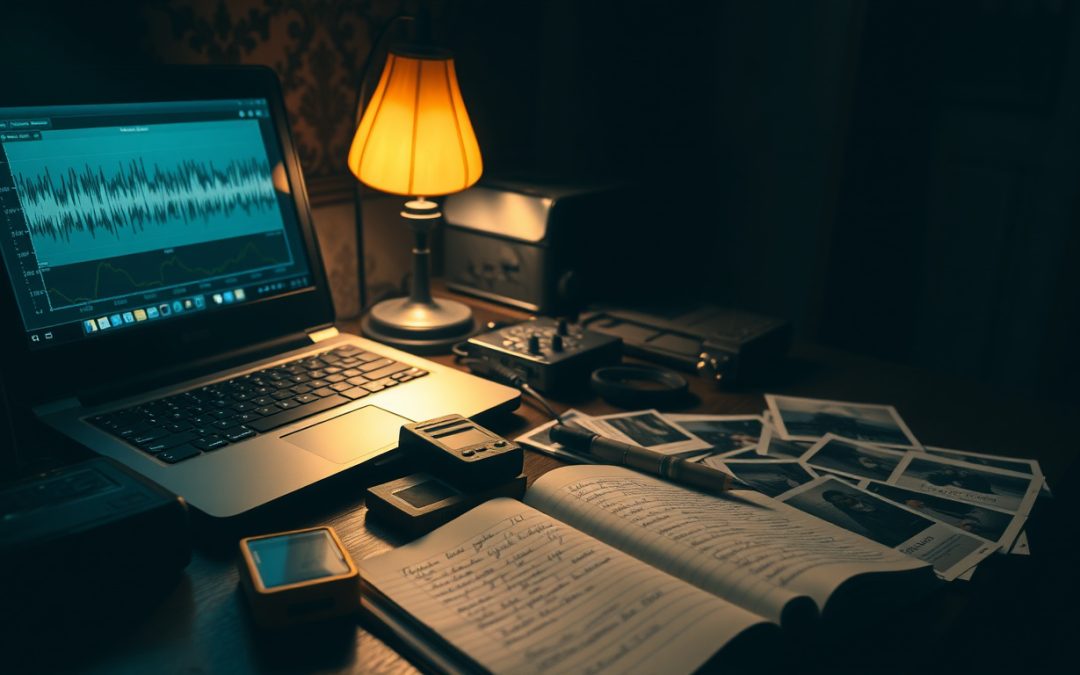
The most important part of a paranormal investigation rarely happens at the location. It happens days later, at a desk, with coffee going cold and a folder full of files that need to be made sense of. Good paranormal research lives or dies in this quiet phase. You can run a flawless night in the field, capture something genuinely odd, and still lose it entirely because your audio files were named after timestamps you no longer understand and your notes contradict your video log.
Evidence that isn’t organized isn’t really evidence. It’s a pile of clips and impressions. The discipline of sorting, labeling, and cross-referencing is what turns a long night into something you can examine honestly, share with a witness, or revisit a year from now without guessing. This is the unglamorous core of responsible paranormal investigation, and it’s where the Lodestra Razor does its sharpest work: ruling out the ordinary before you ever entertain the extraordinary.
Below is a method for organizing what you gathered, with attention to what each type of evidence can and cannot tell you.
Start With a Single Source of Truth
Before you review a single clip, decide where everything lives. Scattered evidence is unreliable evidence. If your photos sit on one phone, your audio on a recorder, your video on an SD card, and your notes in three different notebooks, you will eventually mismatch a timestamp and build a conclusion on sand.
Create one master case file for the investigation. Inside it, keep raw files exactly as captured, untouched. Make copies for working analysis and never edit originals. This isn’t bureaucratic fussiness. In any field that deals with anomalous claims, the integrity of the original recording is the whole game. The moment you enhance, crop, or clean an original file in place, you’ve lost the ability to prove you didn’t introduce the anomaly yourself.
A dedicated paranormal case file manager helps here because it enforces this separation by design. The Lodestra Case File Manager is a local-first desktop tool built around exactly this workflow, with structured documentation sections and SHA-256 hashing that fingerprints each file so you can later prove a piece of evidence is unchanged. Everything stays on your own machine. For sensitive cases involving private homes and worried witnesses, that local-only approach matters as much as the organization itself.
Build a Timeline First
Before you judge any single piece of evidence, reconstruct the night chronologically. A timeline is the backbone of any paranormal research case because most ordinary explanations only become visible when events sit side by side.
Pull every timestamp you have: when you arrived, when equipment started recording, when someone reported feeling cold, when a door creaked, when a car passed outside. Lay them in order. Suddenly the “disembodied footstep” on your audio lines up with the moment your partner walked to the bathroom two rooms over. The “cold spot” at 2:14 a.m. matches the furnace cycling off. Patterns that look paranormal in isolation often dissolve when you see what else was happening in the same minute.
Synchronize Your Clocks
This is the step most people skip, and it quietly ruins more investigations than any other mistake. Cameras, audio recorders, phones, and EMF meters rarely agree on the time. A recorder running three minutes fast will make a perfectly ordinary sound appear to have “no source on camera.” Before your next investigation, set every device to the same clock, or record a single clap or spoken time-check at the start that lets you align everything afterward. When you organize, note the offset for each device so your timeline is honest.
Sort Evidence by Type, Then Review With Discipline
Different evidence demands different tools and different skepticism. Handle each category on its own terms.
Audio and EVP Review
Electronic voice phenomena are among the most reported and most misunderstood categories in paranormal investigation. The core problem is pareidolia: the human brain is relentlessly good at hearing words in noise, especially when primed with an expectation. Play an ambiguous sound and tell someone it says “get out,” and they will hear “get out.” Play the same clip cold, and they hear static.
So review audio honestly. Listen first without telling anyone what you think you hear. Don’t loop a clip forty times until your brain manufactures a word. Check the waveform and spectral view to see whether a sound has the structure of human speech or the flat signature of a knock, a creak, or radio interference cutting through cheap electronics. Log the exact timestamp, your raw description, and the most ordinary explanation you can’t yet rule out.
This is where focused EVP software earns its place. The Lodestra EVP-1 Audio Analyzer brings waveform review, spectral analysis, marker tagging, and evidence notes into one workspace, with PDF export for documentation. It won’t tell you whether a sound is paranormal. No instrument can. What it does is let you examine the audio’s actual structure and keep a defensible record of what you found and where.
Video Review
Video gets treated as strong evidence because it feels objective, but it’s riddled with artifacts that mimic the anomalous. Dust close to the lens becomes a glowing “orb” when light reflects off it. Insects, lens flares, compression glitches, infrared hot spots, and reflections all produce convincing footage. Low light makes it worse, because the camera’s sensor struggles and your enhancement settings can invent detail that was never there.
When you organize footage, tag the exact frames worth a second look and write down what’s happening around them. Was anyone moving? Was a window catching headlights? Enhance dark scenes only on working copies, and always keep the original to compare against. A tool like the Lodestra VID-1 Video Analyzer is built for this kind of careful review, with motion detection, scene enhancement, and anomaly tagging, all processed locally. The point isn’t to find a ghost. It’s to document precisely what the footage shows and to rule out the mundane causes one by one.
Photo Review
Still photos carry their own traps. The classic “ghostly figure” is often a long-exposure smear, a reflection, breath fog on a cold night, or a finger or camera strap near the lens. Before any photo gets flagged, check its metadata. EXIF data tells you the exposure time, whether the flash fired, the ISO, and the timestamp, all of which often explain an apparent anomaly outright. A long shutter speed alone accounts for a startling number of “transparent figures.”
Inspect images at full resolution, compare against control shots of the same scene, and look at light and shadow direction to see whether a bright shape is consistent with a real light source. A purpose-built tool like the Lodestra PHO-1 Photo Analyzer supports metadata inspection, non-destructive enhancement, light and shadow checks, and control-image comparison. It enhances detail without altering the original, which keeps your evidence honest.
Write Down the Ordinary Explanations
For every flagged piece of evidence, record the mundane causes you considered and whether you ruled them out. This single habit elevates amateur ghost hunting into genuine paranormal research. Drafts, settling structures, infrasound, electromagnetic interference, pareidolia, suggestion, equipment artifacts, animals, plumbing, traffic, neighbors. Most reported phenomena have a perfectly ordinary source hiding in plain sight, and your job is to look for it before anything else.
An EMF meter reading near old knob-and-tube wiring tells you about the wiring, not about a spirit. A temperature drop near a window tells you about the window. When you document each ruled-out cause alongside the anomaly, two good things happen. You build a case that holds up to scrutiny, and you stay intellectually honest with yourself. The handful of events that survive that filtering are the ones worth genuine curiosity.
Preserve the Witness Account Carefully
People who invite investigators into their homes are often frightened, and their accounts deserve respect and accuracy. Record what they reported in their own words, separately from your interpretation. Don’t lead them, don’t reshape their memory by feeding them your theories, and don’t promise them answers you can’t deliver. A witness statement is data, and like all data it degrades when contaminated by suggestion. Keep it pristine in your case file, attributed and dated.
Produce a Clean, Honest Report
The final step in any paranormal investigation is a report you’d be comfortable defending. It should walk through the timeline, the equipment used, each flagged item, the ordinary explanations considered, and what remains unexplained, stated plainly without overreach. Use cautious language. “An unexplained sound at 2:14 a.m. for which we could not identify a source” is honest. “Class A EVP of a demonic voice” is not.
A good report serves the witness, your team, and your future self. Months later, when memory has softened the details, the organized case file is what lets you revisit the night without inventing things that didn’t happen. Investigation suites that generate structured, branded PDF reports make this straightforward, but the discipline matters more than any software. The tool only enforces the habit.
The Payoff of Rigor
Organizing evidence well is slow, careful work, and it deflates far more claims than it confirms. That’s the point. Serious paranormal research isn’t about proving ghosts exist. It’s about examining anomalous experiences carefully enough that the rare unexplained event stands out clearly from the long list of ordinary ones. When you rule out the mundane first, document everything, and refuse to claim more than your evidence supports, you end up with something genuinely valuable: a clean account of what actually happened, mystery and all.
If you want to see how this methodical approach translates into field tools and structured workflows, explore the research and field methods at Lodestra. The instruments won’t find a ghost for you, but they’ll help you investigate like someone who takes both the evidence and the truth seriously.