
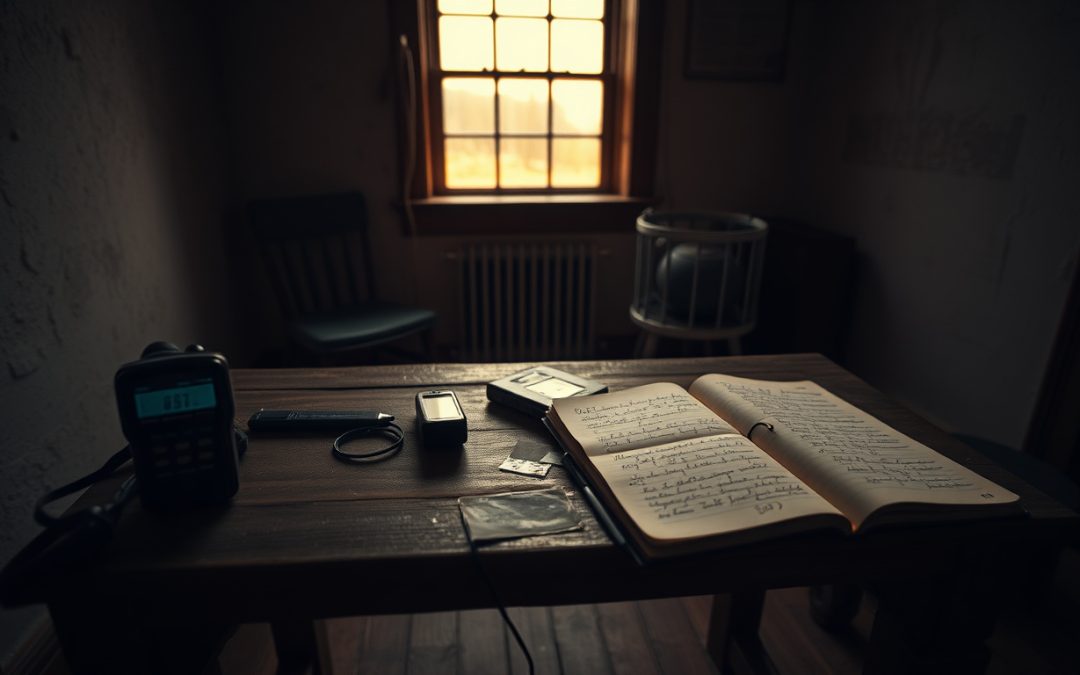
Walk into a reportedly haunted room with an EMF meter and you’ll almost always find something. A needle twitches near the wall. A reading spikes by the old radiator. To an untrained eye, that looks like activity. To anyone serious about paranormal research, it means almost nothing — because you have no idea whether that field was there before you arrived, before anyone reported anything, on an ordinary Tuesday with nobody watching. Without that comparison, a number is just a number.
This is the quiet, unglamorous discipline that separates careful work from guesswork: the baseline. A baseline is a record of the ordinary conditions in a location before, and apart from, any reported phenomena. It’s the control against which everything else is measured. Skip it, and you’re left interpreting readings with no reference point — which is how a humming refrigerator compressor becomes “evidence.”
The Lodestra Razor applies here as plainly as anywhere. Rule out the ordinary first. A baseline is the tool that lets you do exactly that, and doing it well is one of the most valuable habits a field investigator can build.
What a Baseline Actually Is in Paranormal Research
A baseline isn’t a single reading. It’s a deliberate survey of a location’s normal environmental conditions, taken systematically and recorded so it can be compared later. Think of it the way a doctor thinks of your resting heart rate. The number only means something once you know what your body does at rest.
In a typical paranormal investigation, baseline data might include electromagnetic field readings throughout a space, ambient temperature in each room, relative humidity, background sound levels, airflow and drafts, and the layout of anything electrical — wiring, outlets, appliances, fuse boxes. Some investigators also note structural details: where floors creak, which doors swing on their own because the frame has settled, where light leaks in from outside.
The goal is simple. When a witness reports a cold spot in the back bedroom, you want to already know whether that bedroom runs three degrees cooler than the rest of the house every single day because of a poorly insulated exterior wall. When your meter jumps in the hallway, you want to know whether it does that because a junction box sits behind the plaster.
The Difference Between a Reading and an Anomaly
Here’s the distinction that matters most. A reading is data. An anomaly is a reading that deviates meaningfully from the established baseline, with no obvious ordinary cause. You cannot identify the second without the first. An investigator who reports “high EMF” without a baseline is reporting their ignorance, not a finding. An investigator who reports “EMF in this corner measured roughly five times the baseline taken two hours earlier, with no appliance, wiring, or device accounting for it” is reporting something worth examining.
Notice that even the second statement doesn’t claim a ghost. It describes a measured deviation and the absence of a found cause. That’s the honest ceiling of what the instrument supports.
What the Instruments Measure — and What They Don’t
Before you can compare baseline to activity, you have to understand what your tools are actually telling you. This is where a lot of paranormal investigation goes sideways.
EMF Meters
An EMF meter detects electromagnetic fields. That’s all. It does not detect spirits, intentions, or presences. It responds to wiring, electronics, motors, transformers, microwave ovens, cell phones, and the building’s own electrical system. Fluctuating fields can come from faulty wiring or from devices cycling on and off. A meter near a breaker panel or behind a wall carrying live current will read high all on its own. Some research has explored whether strong electromagnetic fields can affect the human brain and produce feelings of unease or the sense of a presence — which, if true, would make EMF a possible cause of reported experiences, not evidence of the paranormal. Your baseline maps where these fields naturally live.
Thermometers and Thermal Imagers
Temperature tools are easy to misread. An infrared thermometer measures the surface temperature of whatever it’s pointed at, not the air temperature of a “cold spot.” Point it at a window, a mirror, or a metal fixture and you’ll get readings that have nothing to do with the air a person would feel. Drafts from chimneys, gaps under doors, and HVAC cycles create real, measurable temperature differences that have entirely ordinary causes. A good thermal baseline records which surfaces and zones run cold normally, and when the heating or cooling system cycles.
Audio and Video Tools
Recorders capture sound, including sound below the threshold most people consciously notice. Infrasound — very low-frequency vibration from traffic, machinery, wind, or plumbing — has been linked in some studies to feelings of dread and even visual distortion, and it’s a serious candidate worth ruling out. Cameras capture light and motion, including dust, insects, lens reflections, and the artifacts of low-light shooting. None of these instruments detects the paranormal. They record an environment, and the environment includes a great many ordinary things.
Building a Baseline Step by Step
Good baseline work is methodical and a little tedious, which is exactly why it’s reliable. Here’s a workable approach for a field investigation.
- Sweep before anyone reports anything. Take your readings early, ideally before witnesses describe where the activity happens, so their expectations don’t steer your attention.
- Be systematic, not random. Move room by room in a fixed order. Record EMF, temperature, humidity, and sound at the same points each pass. Note the location of every electrical source and appliance.
- Take readings at multiple times. Conditions change. The HVAC cycles. Traffic outside rises and falls. The sun moves. A single sweep is a snapshot; several sweeps reveal the room’s normal range.
- Map the mundane. Mark drafts, creaking boards, reflective surfaces, light leaks, and anything that could later be mistaken for activity. This map is gold during review.
- Record exact values, locations, and times. “High EMF in the kitchen” is useless six months later. “EMF reading at the north kitchen wall, 9:14 p.m., elevated near the refrigerator compressor” can actually be compared and trusted.
The discipline of writing it all down is where most casework lives or dies. Memory is unreliable and suggestible. A clean, timestamped record is what lets you make an honest comparison later — and what lets someone else check your reasoning.
Comparing Baseline to Reported Activity
Once you have a baseline and you’ve logged the night’s reported events, the comparison itself is mostly careful bookkeeping. Line up each reported experience with the data from that location and time.
Suppose a witness felt a sudden chill in the upstairs hall at around 10:30. Pull your thermal baseline for that hallway. Did it always run cool there? Was the heating system between cycles? Was an exterior door opened downstairs, sending a draft up the stairwell? Check your draft map. Check the times. Often the chill resolves into an ordinary explanation you already documented hours earlier — and that’s a successful investigation, not a failed one. Ruling something out is a result.
When a reading genuinely deviates from baseline and you’ve walked through the ordinary causes without finding one, you’ve reached the honest edge of the data. The correct conclusion is not “this is paranormal.” It’s “this is an unexplained deviation we could not account for.” That restraint is what gives a case file credibility.
Common Traps in the Comparison
A few errors show up again and again. Confirmation bias leads investigators to scrutinize readings that fit the story and wave past those that don’t. Expectation, primed by a witness’s account, can make a normal creak feel meaningful. And the simple failure to account for time — comparing a 2 a.m. reading to a baseline taken at 8 p.m. when the furnace ran on a different cycle — quietly invalidates a comparison. Honest paranormal research means actively looking for the ways you might be fooling yourself.
Documenting It So the Comparison Holds Up
A baseline is only as good as the record you keep. If your readings live on scattered notes, phone photos, and memory, the comparison gets fuzzy fast — and fuzzy comparisons are where wishful thinking creeps in. This is the practical reason serious investigators lean on dedicated documentation tools.
A purpose-built Lodestra Case File Manager is designed around exactly this workflow: structured documentation from the first contact through the final report, with sections for environmental data, natural-explanation testing, and witness accounts kept in one place on your own machine. Built-in evidence integrity through SHA-256 hashing means a file you logged on investigation night can be verified as unchanged later — which matters when your whole method depends on comparing recorded conditions over time.
For the evidence itself, focused review tools keep your analysis disciplined. The Lodestra EVP-1 Audio Analyzer gives you waveform and spectral review for examining possible audio anomalies against the ambient sound you noted in your baseline, while the Lodestra PHO-1 Photo Analyzer lets you inspect metadata, run light-and-shadow checks, and compare control images — the kind of work that turns a “ghost orb” back into a dust particle most of the time. None of these tools detects the paranormal. They help you examine evidence carefully and rule out the ordinary, which is the entire point.
Why the Baseline Is the Heart of Honest Paranormal Research
It’s tempting to chase the dramatic moment — the spike, the cold rush, the whisper on the recorder. But the unglamorous baseline is what gives those moments any meaning at all. Without a control, every reading is unanchored, and an unanchored reading can be made to say anything. With a solid baseline, you can speak plainly and defensibly about what was normal, what deviated, and what you genuinely couldn’t explain.
That’s the real work of paranormal research: not proving the extraordinary, but measuring the ordinary so carefully that the genuinely unexplained has nowhere to hide. Most of what you investigate will resolve into drafts, wiring, settling timber, and the quirks of human perception. The small remainder that doesn’t — examined honestly, documented rigorously, and never overstated — is where the real mystery lives.
If you want to sharpen your own methods, see how careful documentation and disciplined evidence review come together when you explore the field tools and research at Lodestra. Start with a baseline. Everything credible you’ll ever conclude depends on it.