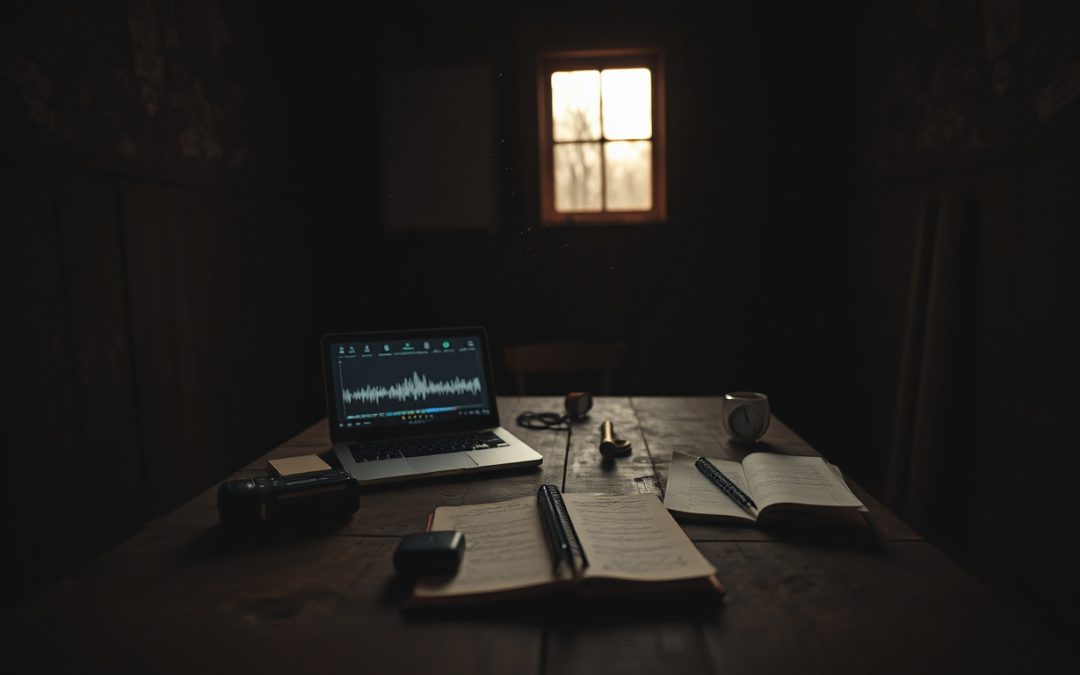
Picture a recorder left running in an empty room overnight. The next morning, somewhere in six hours of audio, there’s a faint two-syllable sound that, to one tired listener at 3 a.m., resembles a word. Does software turn that fragment into proof of a haunting? This is one of the most honest questions in paranormal research, and the answer matters more than most people expect. Software can organize, measure, and clarify. It cannot decide what a sound or a shadow truly is.
The promise of digital tools is seductive. Run the file through a spectral display, push a slider, and suddenly a murky noise looks like structured speech. But the software didn’t find a ghost. It rendered data in a way your brain is very good at interpreting — sometimes too good. Understanding that distinction is the difference between serious paranormal investigation and self-deception with a nicer interface.
This article looks closely at what analysis software actually does, where the science is solid, where human perception betrays us, and how to use these tools the way a careful investigator should: to document and rule out, not to declare.
What “Proof” Actually Means in Paranormal Research
Proof is a heavy word. In any rigorous field, it means a claim survives repeated, independent attempts to knock it down. Most evidence collected on an investigation isn’t proof of anything paranormal — it’s an unexplained observation. That’s an important and honest category, but it is not the same as confirmation.
Parapsychology has wrestled with this for more than a century. Early researchers in the late 1800s and early 1900s, working through organizations dedicated to the scientific study of unexplained experiences, learned a hard lesson: anecdotes pile up easily, but controlled, repeatable results are rare and fragile. The history of the field is largely a history of promising effects that shrank or vanished under tighter controls. That isn’t a reason to dismiss the work. It’s a reason to respect how easily we fool ourselves.
Software inherits that same limitation. A program can show you that a temperature dropped, that a frame contains movement, or that an audio clip has energy at certain frequencies. It cannot tell you the cause. The cause is a question of investigation, and investigation means testing the ordinary explanations first. That’s the Lodestra Razor: rule out the mundane before reaching for the extraordinary.
What Audio Software Really Detects
EVP — electronic voice phenomena — is probably the most popular and most misunderstood category of paranormal evidence. The claim is that recording devices capture voices not heard at the time. The reality is more complicated, and it starts with how sound is recorded and displayed.
The Tools Are Honest; Our Ears Are Not
EVP analysis software gives you a waveform (amplitude over time), a spectrogram (frequency content over time), filtering tools, and the ability to loop and amplify a clip. These are legitimate, well-understood signal-processing functions. A good EVP review tool like the Lodestra EVP-1 Audio Analyzer brings waveform review, spectral analysis, cleanup tools, marker tagging, and evidence notes into one workspace so you can examine a clip carefully and document exactly what you did to it.
Here’s what software cannot do: it cannot decide that a sound is a word. When you loop an ambiguous clip and amplify it, you’re not extracting a hidden voice — you’re often amplifying noise and feeding your brain a pattern. This is pareidolia, the same tendency that makes faces appear in wood grain. Once someone suggests what the clip “says,” it becomes almost impossible to un-hear. That’s why responsible EVP review uses blind listening, where reviewers write down what they hear before anyone shares an interpretation.
Ordinary Sources to Rule Out First
- Radio frequency bleed. Cheap recorders can pick up fragments of broadcast or cellular signals, producing genuine speech with a perfectly mundane origin.
- Environmental noise. Pipes, HVAC systems, settling wood, wind, and distant traffic all generate sounds that compression and amplification can distort into something speech-like.
- Investigator contamination. Whispers, stomach growls, clothing rustle, and breathing are constantly mistaken for anomalies. A disciplined team tags every sound it makes in real time.
- Digital artifacts. Audio compression can introduce warbles and gurgles that have nothing to do with the original sound field.
Good EVP logging software helps not by “cleaning up the ghost voice” but by letting you document the raw file, note the conditions, and preserve the original so others can review it. The value is in transparency, not magic.
What Video and Photo Software Can and Can’t Show
Video and still images carry the same trap in visual form. Enhance a dark frame and a vague smudge becomes a “figure.” Boost the contrast and ordinary sensor noise looks like a shape. The software is doing exactly what you asked. The interpretation is still entirely yours.
Common Visual Explanations
Before a photo or clip earns the word “anomaly,” a careful investigator checks the boring causes, which account for the overwhelming majority of compelling images:
- Orbs. Almost always dust, pollen, moisture, or insects close to the lens, lit by the flash and thrown out of focus. They are an optical effect, not evidence of presence.
- Lens flare and reflections. Light sources bouncing inside the lens create streaks, rings, and bright shapes.
- Motion blur and long exposure. A moving hand, strap, or hair near the lens can produce “mist” or streaks.
- Pareidolia in noise. In low light, cameras amplify sensor noise, and the brain organizes that random grain into faces and figures.
- Matrixing in reflective surfaces. Windows, mirrors, and polished wood reflect the room in confusing ways.
This is where disciplined review tools matter. A video analyzer such as the Lodestra VID-1 Video Analyzer lets you enhance dark scenes, detect motion, and tag moments for later review with local processing — useful for examining footage carefully and separating a moving curtain from something you genuinely can’t explain. On the photo side, the Lodestra PHO-1 Photo Analyzer reads metadata, lets you enhance detail without altering the original, runs light and shadow checks, and compares control images. None of these tools confirm a haunting. What they do is help you test the ordinary explanations rigorously and document your reasoning.
EXIF and the Power of Metadata
One genuinely strong contribution software makes to paranormal investigation is metadata analysis. EXIF data embedded in a photo records the shutter speed, aperture, ISO, flash status, and timestamp. That information often dissolves a “mystery” instantly. A long shutter speed explains motion blur. An active flash explains an orb. A timestamp can confirm or contradict a witness account. Metadata doesn’t prove the paranormal — it usually does the opposite, which is exactly why it’s valuable. Good evidence work eliminates far more than it confirms.
Why No Instrument “Detects Ghosts”
It’s worth being blunt about the hardware that feeds these programs. An EMF meter measures electromagnetic fields. It responds to wiring, motors, microwave ovens, fluctuating currents, and your own phone. A thermometer measures temperature, and temperature changes for hundreds of ordinary reasons, including drafts and your own body heat. None of these instruments has a documented mechanism for detecting consciousness or the dead.
There’s also infrasound — sound below roughly 20 Hz, inaudible but physically real. Research has suggested that infrasound, produced by fans, weather, traffic, or even certain pipes, can create feelings of unease, pressure, and the sense of a presence. A room that “feels haunted” may simply have a low-frequency standing wave. Software that visualizes frequency content can actually help you spot this, turning a spooky feeling into a measurable, mundane cause. That’s paranormal research working the way it should.
The Real Value of Paranormal Software: Discipline, Not Proof
If software can’t prove a haunting, why use it at all? Because the hardest part of serious investigation isn’t capturing evidence — it’s handling it honestly over time. Memory drifts. Files get renamed. Witness accounts blur. Without structure, a case becomes a folder of vague impressions that no one can verify.
This is where documentation tools earn their place. A dedicated paranormal case file manager keeps the entire chain organized: the first phone call, witness statements, environmental readings, equipment used, the raw evidence, and the natural-explanation tests you ran. The Lodestra Case File Manager is built around exactly this discipline — local-first, with documentation sections, SHA-256 evidence hashing so a file can be shown to be unaltered, a field mode for investigation night, and branded reports. Hashing doesn’t make evidence paranormal. It makes evidence trustworthy, which is a different and more useful thing.
How to Use These Tools Responsibly
- Preserve the original. Never analyze your only copy. Keep an untouched master file and work from duplicates.
- Document your process. Note every filter, enhancement, and adjustment you apply. If you can’t explain what you did to a clip, it isn’t evidence — it’s an artifact.
- Review blind. Have people interpret audio and images without prompting, then compare. Disagreement is informative.
- Log the environment. Record conditions, equipment, and known noise sources so you can match anomalies to ordinary causes later.
- Default to the mundane. Treat “unexplained” as a temporary status. Keep testing. Most anomalies eventually have a boring origin, and that’s a success, not a failure.
So, Can Software Prove a Haunting?
No. And any honest practitioner of paranormal research will tell you the same. Software doesn’t prove a haunting any more than a microscope proves a disease — it’s an instrument for looking carefully, measuring precisely, and recording faithfully. The conclusion still belongs to a thinking investigator who has done the hard work of ruling out drafts, dust, wiring, infrasound, suggestion, and the remarkable creativity of the human brain.
What good software can do is make you a better, more honest investigator. It keeps your evidence intact, your process transparent, and your claims modest. It turns a pile of impressions into a documented case that someone else could review and challenge. That’s not as thrilling as a definitive answer, but it’s far more valuable — and it’s where the genuine mystery actually lives, in the small set of observations that survive every reasonable explanation you throw at them.
If you want to investigate with that kind of rigor, you can explore the tools and methods at Lodestra and see how disciplined documentation changes the way a case holds up. Bring your curiosity, keep your skepticism, and let the evidence speak only as loudly as it honestly can.