Somewhere in almost every investigator’s storage drive sits a folder that never gets opened twice. A night’s worth of audio. A few dozen photos. A handful of video clips that seemed promising at three in the morning and forgettable by lunch. Most of that material gets a single pass, a quick label, and then it’s archived and ignored. That habit is one of the biggest blind spots in amateur paranormal research, because the evidence you collected years ago was reviewed with the tools, knowledge, and fatigue you had at the time — not the ones you have now.
Re-analyzing old material is not glamorous. It won’t produce a dramatic reveal on the first replay. But careful re-examination is exactly the kind of slow, unshowy work that separates serious paranormal investigation from a hobby built on first impressions. The Lodestra Razor points the same direction here as it does in the field: before you decide something is unexplained, make sure you’ve truly ruled out the ordinary. A tired reviewer at the end of a long night rarely does that well.
Why First-Pass Reviews Are So Unreliable
The moment you capture evidence, you are also at your most biased about it. You remember the cold spot you felt, the noise that made everyone freeze, the hope that this session finally produced something. That emotional context colors how you hear a whisper in static or read a shape in a shadow. Psychologists call the tendency to find meaningful patterns in random input pareidolia, and audio is especially vulnerable to it. Tell a room full of people they’re about to hear a voice say a specific phrase, and most of them will hear it — whether or not it’s there.
First-pass review also happens under bad conditions. You’re often reviewing on-site, on laptop speakers or earbuds, while packing gear and talking with the team. You may be exhausted. You almost certainly haven’t slept. None of that produces the calm, skeptical attention that evidence deserves. Coming back to the same files weeks later, on good headphones, in a quiet room, with no memory of what you were “supposed” to hear, is a genuinely different analysis.
Time Removes the Emotional Fingerprint
Distance is a tool. When you revisit a recording months after the investigation, you’ve lost the vivid emotional memory of the night. That loss is useful. You’re no longer primed to hear the phrase you wanted, and you’re more likely to notice the boring explanation you missed — a car outside, a settling floorboard, a stomach growl, the HVAC cycling on. Ironically, forgetting the context makes you a better analyst of the recording itself.
Your Tools Are Better Than They Used to Be
Even if your judgment hadn’t improved, your equipment has. Software for reviewing audio, video, and photos keeps getting more capable, and evidence you dismissed as inaudible or too dark may now be readable. This is one of the strongest arguments for keeping an organized archive in the first place: the raw file you saved today can be re-examined with tools that don’t exist yet.
Audio: Slow It Down, Don’t Clean It Up
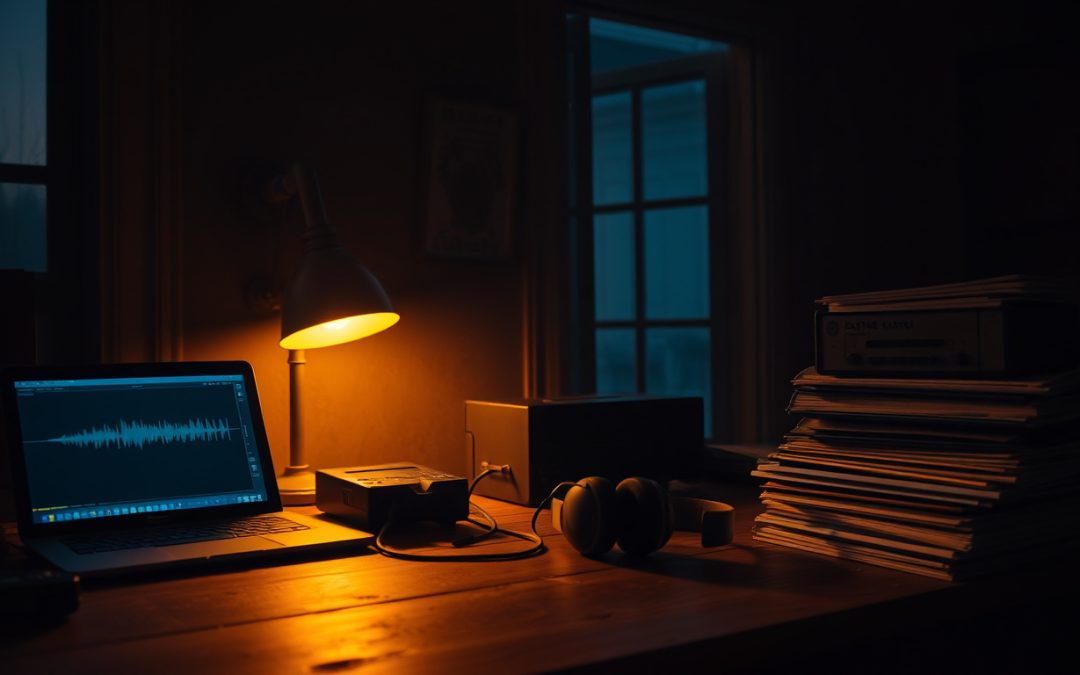
A lot of old EVP review was done with nothing but playback and a volume knob. Modern EVP analysis software lets you slow audio without changing its pitch, isolate a frequency band, view a spectrogram, and mark events precisely — all while keeping the original untouched. That last part matters more than any single feature. Heavy “cleanup,” noise reduction, and normalization can manufacture artifacts that sound like speech. A responsible workflow is non-destructive: you analyze a copy, document every change, and always keep the raw file to compare against.
A spectrogram is especially valuable on a second pass. It lets you see the structure of a sound. Human speech has a recognizable pattern of harmonics and formants; a mechanical rattle or a burst of electrical interference usually doesn’t. If a supposed “voice” shows no vocal structure on the spectrogram, that’s a strong hint it was never a voice at all. Tools built for this kind of careful review, like the DeadAir Audio Analyzer Pro, are designed around isolating, slowing, marking, and classifying possible events without altering the source recording. What they don’t do — and no software does — is confirm that a sound came from anything paranormal. They help you describe what’s in the audio. The interpretation is still on you.
Video: Step Through the Frames
Old video was often judged at full speed, which is the worst way to evaluate it. A “figure” darting across a doorway might be a single frame of compression noise, an insect near the lens, or a reflection. Stepping through footage frame by frame turns a fleeting impression into something you can actually examine. Enhancing dark footage — again, without overwriting the original — can reveal that the “shadow figure” was a coat on a hook the whole time.
Movement detection and motion heatmaps can flag exactly where and when something changed in a long clip, which saves hours and, more importantly, removes the temptation to only look where you expected activity. A tool like the PhantomFrame Pro Video Analyzer supports frame-by-frame stepping, enhancement with a raw comparison, and movement detection, so you can document what changed and export a clean report. It won’t tell you a shape is a ghost. It will let you show, honestly, what the pixels actually did.
Photos: Read the Metadata First
Photographs are the easiest evidence to misread and, often, the easiest to explain. A great deal of “orb” photography is dust, moisture, or insects catching the flash close to the lens. Lens flare, long exposures, camera straps, and reflections account for a huge share of the rest. Before treating any photo as anomalous, read its EXIF metadata: shutter speed, aperture, ISO, whether the flash fired, and the timestamp. A long exposure explains motion blur. A fired flash in a dusty room explains orbs. The timestamp can confirm whether the “figure” appeared in one frame of a burst and vanished in the next — the signature of a passing bug, not a presence.
A dedicated photo tool such as the PhantomCapture Photo Analyzer lets you inspect that metadata, zoom into questionable regions, and compare original against enhanced versions side by side. The goal is not to make a photo look spookier. It’s to find the mundane cause if one exists, and to document your reasoning either way.
What the History of the Field Teaches Us
Re-analysis isn’t a new idea. The organized study of these questions goes back to the founding of the Society for Psychical Research in London in 1882, whose members investigated séances, apparitions, and mediums with a mix of credulity and hard skepticism. Some of the movement’s most important work was debunking: exposing fraudulent mediums, controlled tricks, and cold reading. Later, formal parapsychology labs tried to bring statistical methods to the question, and the recurring lesson across all of it is the same. Claims that looked strong on first inspection frequently dissolved under careful re-examination, better controls, and independent review.
That history is a warning and an encouragement at once. A warning, because the field has a long record of premature conclusions. An encouragement, because re-examination is precisely how the honest work has always been done. When you revisit your own old evidence with a colder eye, you’re following the most credible tradition in the discipline, not abandoning it.
A Practical Method for Re-Analyzing Your Archive
Here’s a workflow you can apply to any old case file. The point is consistency: treat every piece of evidence the same way, so you’re not just hunting for confirmation.
- Work from the raw file. Never analyze a compressed export or a version you’ve already edited. If you don’t have the original anymore, note that limitation in your findings.
- Review blind when you can. If a teammate reviews your audio without knowing what you thought you heard, and hears the same thing independently, that’s meaningfully stronger than you hearing it alone. If they hear something completely different, that tells you something too.
- Chase the mundane explanation first. For every possible anomaly, write down at least one ordinary cause and actively try to confirm it. Cross-reference timestamps against known sources: traffic, plumbing, other team members, weather, wildlife.
- Document your process, not just your conclusion. Record every enhancement, every setting, every comparison. A finding you can’t reproduce isn’t evidence — it’s an anecdote.
- Map the scene. Re-plotting where equipment sat and where activity was reported often reveals a draft path, a vent, or a reflective surface you overlooked. A layout tool like the SpecterGrid Location Mapper lets you rebuild the room and drop evidence pins so the geometry of the night is visible, not just remembered.
Keep Everything in One Place
None of this re-analysis matters if you can’t find the files or reconstruct the context. This is where a proper case manager earns its keep. The Paranormal Case File Manager keeps witnesses, location history, readings, evidence, and debunks in one structured file, so when you return to a case a year later you’re not guessing about what the conditions were. Good documentation is what makes re-analysis possible at all. An archive of loose files with no notes is just clutter; an organized case file is a dataset you can question again and again.
The Real Payoff of Second-Look Paranormal Research
Most of the time, re-analysis will deflate your best clips. A voice becomes a pipe. A figure becomes a reflection. An orb becomes dust. That can feel like a loss, but it’s the opposite. Every ordinary cause you confirm makes the small residue of genuinely unexplained material more meaningful. The whole value of evidence-based paranormal investigation lies in that filtering. If you can honestly rule out ten mundane explanations for a recording and still can’t account for it, that unexplained fragment is worth far more than a hundred clips you never questioned.
Re-examining old evidence is a discipline, not a disappointment. It keeps you honest, it improves your fieldwork going forward, and it treats your witnesses’ experiences with the seriousness they deserve. The best paranormal research doesn’t chase the next dramatic capture. It goes back, patiently, and asks the harder question: am I sure?
If you want to put this into practice, you can explore the research and field tools at Lodestra and start reworking your own archive with a colder, sharper eye. The recording you dismissed years ago is still waiting. This time, review it like you mean it.