
Technology & Investigation · Paranormal Research
Why Motion Cat Ball Toys Do Not Make Good Ghost Hunting Tools
The problem with treating consumer pet toys like investigative instruments — and what to use instead
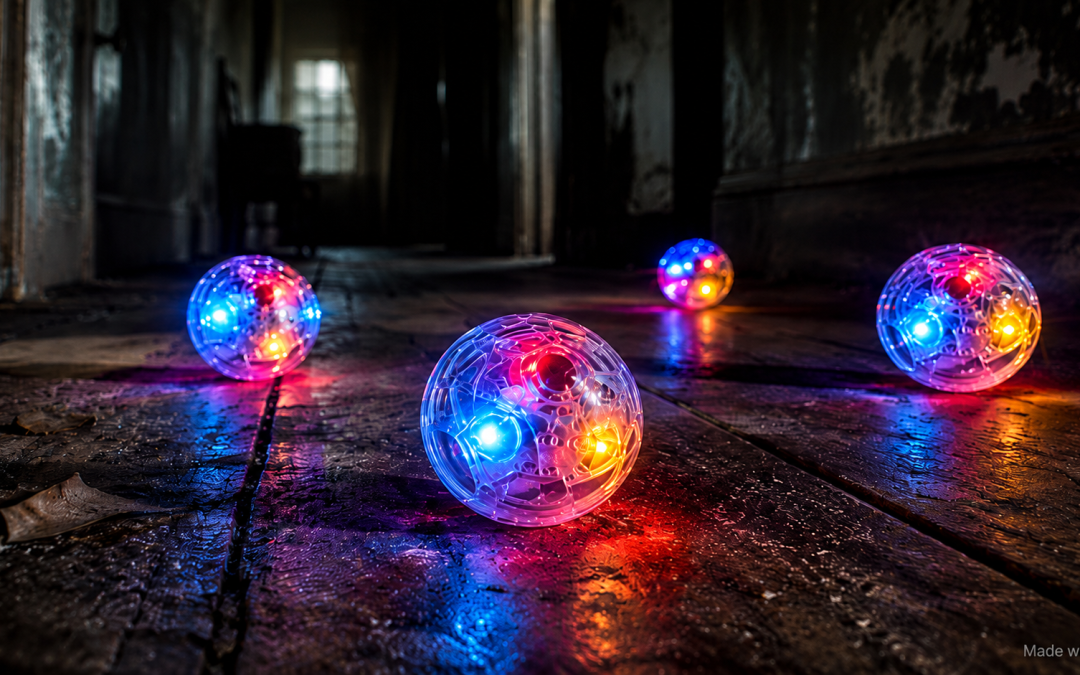
Walk into almost any modern paranormal investigation and there is a good chance you will see one of them on the floor: a small plastic motion-activated cat toy, usually a glowing ball that flashes when touched, bumped, rolled, or vibrated. In paranormal circles, these are often called "cat balls," "motion balls," or "trigger balls." The idea is simple. Place the ball in a room, ask a spirit to touch it, and watch for the light.
It is easy to understand the appeal. Cat balls are cheap. They are visual. They give the room a focal point. Most importantly, they create moments that feel interactive. When the ball lights up in the dark after someone asks, "Can you touch the ball?" it can feel exciting.
But excitement is not the same thing as evidence. For serious paranormal research, motion cat ball toys have a major problem: they are not investigative instruments. They are consumer pet toys being repurposed in an environment they were never designed to measure, document, or control.
What a Cat Ball Actually Measures
A motion cat ball does not detect ghosts. It does not detect consciousness, electromagnetic fields, temperature shifts, voices, footsteps, pressure changes, or intelligent responses. It detects motion, vibration, or impact. That is all. The device is not telling you, "Something paranormal interacted with me." It is only telling you, "Something caused my activation threshold to be met." That something could be interesting. It could also be completely ordinary.
What can activate a motion cat ball
- Direct touch or roll
- Floor vibration
- Table or surface shifting
- Someone walking nearby
- A door closing
- A vehicle passing outside
- Building settling
- HVAC cycling on or off
- Loose internal battery contact
- Sensor instability
- Device malfunction
- Minor air pressure change
The False Simplicity of "It Lit Up When I Asked"
The most common argument in favor of cat balls is timing. An investigator asks a question. The ball lights up. The group reacts. The moment feels intelligent. The problem is that timing alone is not enough.
Humans are very good at noticing patterns, especially in emotionally charged environments. If a ball flashes ten times during an investigation, people often remember the one time it flashed after a meaningful question. The other nine activations may fade into the background. This is not dishonesty. It is normal human perception.
To treat a cat ball activation as meaningful, we need more than proximity to a question. We need controls. We need repeatability. We need to know whether the ball behaves the same way when no one is asking questions. We need to know whether the floor vibrates in that spot. We need to know whether footsteps, wind, nearby roads, HVAC systems, or shifting furniture can trigger it. Most cat ball use skips those steps. That is why the evidence value is weak.
Cat Balls Are Too Sensitive and Too Vague
A good field instrument should tell you something specific. A thermometer gives a temperature reading. An audio recorder captures sound. A camera records visual information. A data logger gives a timestamped record. Even when those tools are imperfect, they produce information that can be reviewed, compared, and challenged. A cat ball gives you a light. That is the entire output.
What a cat ball activation does not tell you
- How strong the movement was
- What direction it came from
- Whether the ball rolled or only vibrated
- Whether the floor moved beneath it
- Whether the activation was caused by impact or internal sensitivity
- Whether the sensor was already unstable
- Whether the event was different from normal background activity
- Whether the same thing happened before or after the session
The response is binary: light or no light. That makes interpretation dangerously broad. A flashing ball can mean almost anything because the device does not provide enough data to narrow the cause. The more vague a tool is, the easier it is to build a story around it.
Environmental Vibration Is a Bigger Problem Than People Think
Many investigators underestimate how much buildings move. Old houses settle. Wood floors flex. Pipes knock. Air systems turn on and off. Doors create pressure changes. Footsteps travel through floorboards. Passing cars can send subtle vibrations through a structure. A motion cat ball placed on a wood floor is especially vulnerable to this — the ball may not need to be directly touched. It may only need the surface beneath it to move slightly. In an old building, that can happen constantly.
This becomes even more difficult during group investigations. Several people standing in a room, whispering, stepping, leaning, or moving equipment can create enough vibration to matter. If the ball lights up, the question should not be "What spirit touched it?" The first question should be, "What physical force could have activated this?" Without that discipline, the toy becomes a shortcut to belief.
The Uneven Surface Problem
Cat balls are round. A round object on an uneven floor is already unstable. Many haunted locations are old buildings with warped boards, soft spots, slanted rooms, loose rugs, or cracked tile. Even if the ball does not roll visibly, a small shift can be enough to activate it. In low light, investigators may not notice tiny movements. The ball flashes, everyone sees the light — but no one sees the subtle cause. The very environments where people most want evidence are often the worst environments for uncontrolled motion toys.
They Are Not Designed for Calibration
A serious tool should be testable. Before relying on a device, an investigator should be able to ask what its activation threshold is, how sensitive it is, whether it behaves consistently, and whether it can be calibrated. Most motion cat balls fail this standard. They are mass-produced toys, not calibrated research devices. Two balls from the same package may behave differently. One may activate easily; another may require more force. One may have a loose internal component; another may have a dying battery.
This inconsistency makes it hard to compare results. If a device cannot be calibrated, cannot provide measurements, and cannot reliably describe the event that triggered it, it should not be treated as evidence-producing equipment. At best, it is a trigger object. That is a very different thing.
The "Intelligent Response" Problem
Many investigators use cat balls as yes-or-no communication tools: "Light it up for yes. Leave it dark for no." This is where the tool becomes especially problematic. A yes-or-no system only works if you have confidence that the responses are intentional. With a cat ball, that confidence is usually not justified. Random activations can easily be interpreted as answers, especially when the questions are broad or emotionally loaded.
Consider: "Are you the woman seen in this hallway?" The ball lights up. That feels like a response. But we do not know if the ball was activated by vibration, floor instability, battery behavior, or chance. Now the investigator continues: "Were you hurt here?" The ball lights up again. At that point, a narrative may begin forming. The team may start constructing a story around the responses, and the location may gain a new layer of legend based on a toy with no ability to verify intent. That is how weak data becomes folklore.
Cat Balls Encourage Confirmation Bias
Cat balls are almost perfectly designed to feed confirmation bias. They sit silently until they flash. When they flash, everyone reacts. If the flash happens after a question, it feels meaningful. If it does not flash, people often keep asking until it does. If it flashes at an awkward time, the moment may be ignored. If it flashes at a dramatic time, it becomes the highlight of the night.
This does not make investigators foolish. It makes them human. The problem is not that people notice meaning. The problem is that the tool provides too little information to test that meaning. A serious investigation should be built to challenge our impressions, not just confirm them. Cat balls often do the opposite.
They Create Good Video, Not Good Evidence
One reason cat balls have become so popular is that they look good on camera. A glowing ball in a dark room is visually clear. It creates suspense. It offers instant payoff. On social media, a flashing light after a question is easy to package as a compelling clip. But video value and evidence value are not the same thing. A viewer cannot feel the floor vibration, inspect the battery contacts, or see every environmental variable outside the frame. Short clips remove context — and without context, cat ball footage can easily exaggerate the importance of a moment.
The Difference Between a Trigger Object and a Measuring Tool
There is one fair use for a cat ball: it can function as a trigger object. A trigger object is something placed in an environment to invite interaction or focus attention. As a trigger object, a cat ball is not completely useless. It can be part of an experiment if the team clearly understands its limitations. The problem begins when investigators treat it like a measuring tool.
How to Test a Cat Ball More Responsibly
If a team insists on using motion cat balls, they should at least build controls around them. Even with all of these steps, the cat ball still remains a weak tool — but these steps at least make the session more honest.
Minimum controls for responsible cat ball use
- Test each ball before the investigation and replace batteries beforehand
- Mark the ball's exact position on the floor and place it on a stable, level surface
- Use a camera angle that shows the floor and surrounding area clearly
- Keep investigators several feet away during sessions
- Log all footsteps, movement, HVAC activity, and door openings
- Run a silent control period with no questions and compare activation rates
- Test whether normal footsteps or nearby traffic can trigger the ball
- Record the session continuously — not just during exciting moments
- Use more than one ball to compare behavior across the same session
- Avoid emotional conclusions based on single activations
Better Alternatives for Serious Investigation
If the goal is to document possible movement, use tools that provide more information.
Fixed Cameras
A stable camera view can show whether an object actually moved, who was near it, and what else was happening in the room.
Vibration Sensors
Help determine whether the floor, table, or object was physically disturbed — and can timestamp the event for comparison.
Accelerometers
Measure motion more precisely than a toy — recording direction, intensity, and timing rather than a binary on/off signal.
Pressure Mats
Document whether weight or force was applied in a specific location without relying on a round object's sensitivity.
Data Loggers
Timestamp environmental changes and allow comparison across multiple devices and the broader investigation timeline.
Multi-Sensor Setups
If a vibration sensor, audio recorder, and camera all record something at the same timestamp, that overlap carries far more weight than any single device.
The Emotional Side of the Problem
Many investigations happen in emotionally sensitive places: private homes, historic sites, former hospitals, old hotels, battlefields, and locations tied to grief or trauma. When a cat ball lights up, people may assign identity to it: "That was the little girl." "That was the former owner." "That was the man who died here." Those statements can have emotional consequences. They can affect property owners, families, guests, and the future folklore of a location.
If an investigator cannot confidently explain what triggered the device, they should be careful about assigning a personality, story, or name to the activation. Respect for the dead, respect for witnesses, and respect for history all require restraint. A more honest way to talk about cat ball activity is simply this: "The motion ball activated during the session."
A flashing light in the dark can be powerful. It can make a room hold its breath. It can create a moment people remember. But serious investigation cannot stop at the moment. The real work begins afterward, when the excitement fades and the question becomes simple: What do we actually know? With cat balls, the answer is usually: not enough.
Motion cat ball toys are not evil. They can be fun, inexpensive trigger objects when used with caution and humility. But they do not make good ghost hunting tools. They are too vague, too sensitive, too inconsistent, and too easy to misinterpret. And if we want paranormal research to become stronger, more credible, and more useful, "not enough" has to matter.