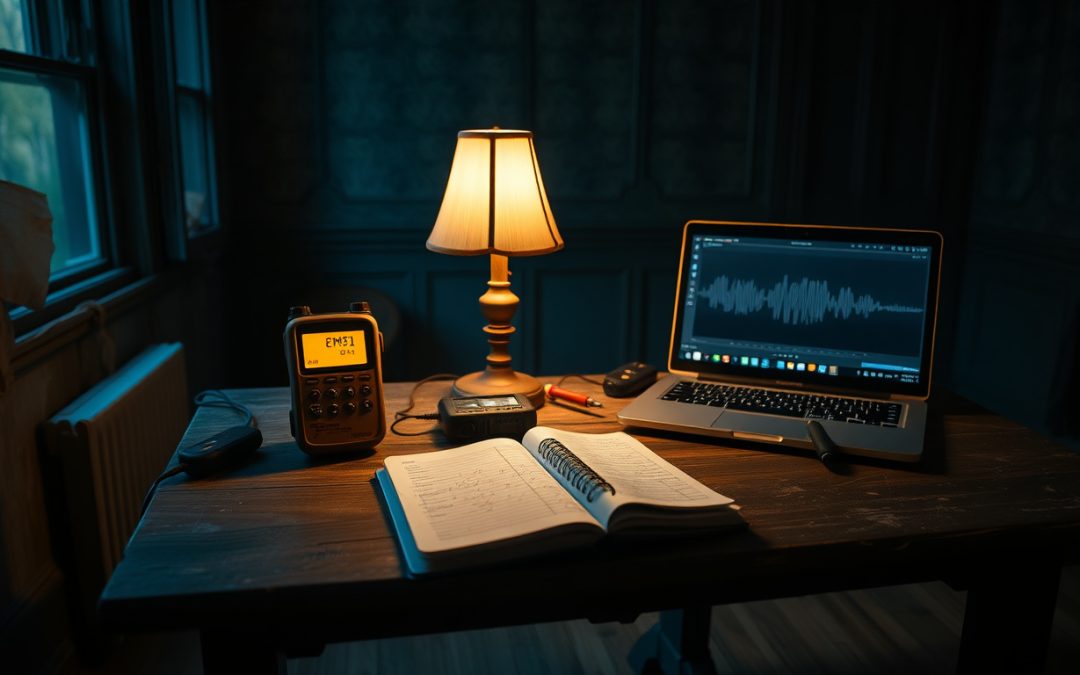
Ask a room full of investigators about the strangest thing they ever recorded, and you’ll get vivid stories. Ask them for the timestamp, the ambient temperature, which device captured it, and who else was in the building at that moment, and the answers get vague fast. That gap — between a strong memory and a documented fact — is where most paranormal research quietly falls apart. Not because the experience wasn’t real to the person who had it, but because nobody wrote down enough to test it later.
Good data logging isn’t glamorous. It doesn’t make for a dramatic photo or a chilling clip. But it’s the difference between an anecdote and a case. If you take the unexplained seriously, the least interesting part of the work — the careful recording of what happened, when, and under what conditions — is also the part that gives your conclusions any weight at all.
This article is about why that matters, what goes wrong without it, and how to build a habit of documentation rigorous enough to survive your own skepticism.
Memory Is the First Thing to Fail
Human memory is reconstructive, not photographic. Every time you recall an event, you rebuild it, and each rebuild is vulnerable to suggestion, expectation, and the natural drift of time. This is well-established in cognitive psychology, and it has direct consequences for anyone doing paranormal investigation. The witness who “clearly heard footsteps” at 11 p.m. may, on the recording, have heard them at 10:40 — or heard the building’s heating system cycle on.
Under the stress and anticipation of a night investigation, memory gets even less reliable. People prime each other. One person says “did you hear that?” and suddenly three people remember hearing it. That’s not dishonesty; it’s ordinary human cognition doing what it always does. The Lodestra Razor — rule out the ordinary before reaching for the extraordinary — starts with recognizing that your own recollection is one of the ordinary things you have to account for.
The only defense is contemporaneous logging. A note written at the moment, with a timestamp, beats a confident memory recalled a week later every single time. When your log and your memory disagree, the log is usually right.
What Poor Documentation Actually Costs You
Weak records don’t just make paranormal research messy. They quietly destroy evidence that might have been meaningful.
You lose the ability to correlate
Say an EVP-like sound appears on your audio at a certain point. Was someone in the next room shifting their weight on an old floor? Did a car pass outside? Did the furnace kick on? Without a synchronized log of who was where and what devices recorded what, you can never rule those things out. An unexplained sound with no context isn’t strong evidence — it’s just an unexplained sound. Context is what lets you eliminate the mundane, and context has to be logged as it happens.
You can’t reproduce your own findings
Serious investigation aims to be repeatable. If you can’t reconstruct exactly what you did — device settings, positions, environmental readings, times — you can’t return and try to reproduce the result. And a result you can’t reproduce is a result you can’t trust. Sloppy logging turns every investigation into a one-off story instead of a step toward understanding.
Your case doesn’t hold up to scrutiny
Whether you’re reporting back to an anxious homeowner or sharing findings with other researchers, your conclusions are only as credible as the trail behind them. A tidy narrative with no data behind it invites doubt, and it should. A well-documented case — even one that concludes “we found a mundane cause” — earns respect because anyone can follow your reasoning.
The Data Worth Logging
Effective paranormal research treats an investigation like a structured field study, not a scavenger hunt. The categories below aren’t exhaustive, but they cover most of what matters.
- Time, precisely. Synchronize every device and every notebook to the same clock before you start. A shared, accurate timestamp is the thread that ties everything together.
- Location and layout. Where exactly did something happen? Which room, which corner, how far from the window or the wiring? A vague “upstairs” is nearly useless later.
- Environmental baselines. Temperature, drafts, humidity, ambient sound, and background electromagnetic readings taken before anything interesting happens. Without a baseline, an anomalous reading means nothing.
- Personnel. Who was present, where they were standing, and what they were doing. Half the “unexplained” sounds on a recording are a teammate two rooms away.
- Equipment state. What devices were running, their settings, battery levels, and known quirks. Dying batteries cause plenty of “strange” behavior.
- The event itself. A plain description of what was observed, by whom, and — crucially — what mundane explanations you checked on the spot.
That last point is the heart of evidence-based paranormal investigation. The goal isn’t to log only the exciting moments. It’s to log enough of the ordinary that the genuinely unexplained can stand out against it.
Instruments Log Numbers, Not Meaning
It’s worth being blunt about what field instruments actually do, because good data logging depends on understanding your tools honestly. An EMF meter measures electromagnetic fields. That’s all. It responds to wiring, appliances, motors, phones, and the meter’s own electronics. It does not detect spirits, and no reading from it can prove the paranormal. The same goes for thermometers, which measure temperature changes that usually trace back to drafts, vents, or the physics of moving air.
This matters for logging because a number without context is a trap. An EMF spike logged next to the note “measured beside an unmarked junction box, wall felt warm” is useful data. The same spike logged as “high reading — possible entity” has skipped the entire investigative process. Your log should capture the measurement and the conditions, and leave interpretation for later, when you’re calm and away from the atmosphere of the location.
The best paranormal investigation tools don’t tell you what something is. They give you clean, timestamped, well-labeled data that you can compare, correlate, and — often — explain. Treat any device that claims to “confirm” a presence with deep suspicion. Real instruments measure physical quantities, and your logging discipline is what turns those measurements into evidence.
Turning Raw Records Into Reviewable Evidence
Capturing data in the field is only half the job. The other half happens afterward, when you review what you gathered without the adrenaline of the location clouding your judgment. This is where structured software earns its place in serious paranormal research.
Audio is the clearest example. Electronic voice phenomena — sounds that seem like speech but weren’t noticed at the time of recording — are notoriously vulnerable to expectation. Once someone tells you what a garbled clip “says,” you can’t unhear it. That’s pareidolia, the brain’s tendency to find patterns, especially familiar ones like voices, in random noise. Careful EVP review means logging exactly where in the recording an event occurs, isolating it without altering the original file, and noting every possible mundane source before calling anything unexplained. A dedicated tool like DeadAir Audio Analyzer Pro supports that kind of non-destructive workflow — marking, classifying, and documenting possible EVP events while keeping the original audio untouched, so your source evidence stays honest.
Video and photos demand the same discipline. Moving frame by frame through footage, comparing an enhanced version against the untouched original, and tagging exactly what changed and when keeps you from reading motion into compression artifacts or dust. Tools such as the PhantomFrame Pro Video Analyzer and the PhantomCapture Photo Analyzer exist to make that review process traceable — enhancing footage or inspecting metadata without destroying the source, so anyone reviewing your work can see the original alongside your notes. The point isn’t to prove something is paranormal. It’s to document what you found clearly enough that a skeptic could follow every step.
Keeping the Whole Case Together
Individual pieces of well-logged evidence still need somewhere to live. A scattered pile of audio files, phone photos, scribbled times, and half-remembered impressions isn’t a case — it’s a mess waiting to lose the one detail that mattered.
This is the argument for treating documentation as a single structured process from the first client contact to the final report. The initial phone call, the location’s history, the room-by-room baseline readings, each piece of evidence, and — just as importantly — each debunk you confirmed should sit together in one place, in order, with timestamps intact. When it’s time to draw a conclusion, you want to see the whole timeline at once. A structured Paranormal Case File Manager is built for exactly this: logging witnesses, location history, readings, evidence, and debunks as the case unfolds, then exporting a conclusion that actually holds up because the reasoning behind it is all there.
Notice how much of that record is negative findings — the drafts you traced, the wiring you identified, the neighbor’s air conditioner you finally pinned down as the source of a hum. Those debunks aren’t failures. They’re the most valuable entries in the file, because each one is an ordinary explanation ruled out with evidence rather than assumed. A case built on documented eliminations is far stronger than one built on a single unexplained clip.
Building the Habit
You don’t need expensive gear to start logging well. You need discipline and a consistent method. Sync your clocks. Take baseline readings before you get curious. Write down the boring context in real time. Note who was where. Record what you checked and ruled out, not just what startled you. Review everything later, in daylight, with a skeptical eye and a willingness to explain your own findings away.
Do that consistently and something quiet but important happens. The percentage of “unexplained” events in your work drops, because most of them turn out to have ordinary causes you can now identify. What remains — the small residue that survives careful logging and honest review — is the only thing worth calling a genuine mystery. That residue is what serious paranormal research is actually chasing, and you can only find it by ruling out everything else first.
Better data logging won’t make your investigations more dramatic. It will make them true. And in this field, that’s the harder and more valuable thing to be.
If you want to see how disciplined documentation works in practice — from field capture to a report that survives scrutiny — explore the tools and research at Lodestra and build a workflow that treats the unexplained with the rigor it deserves.