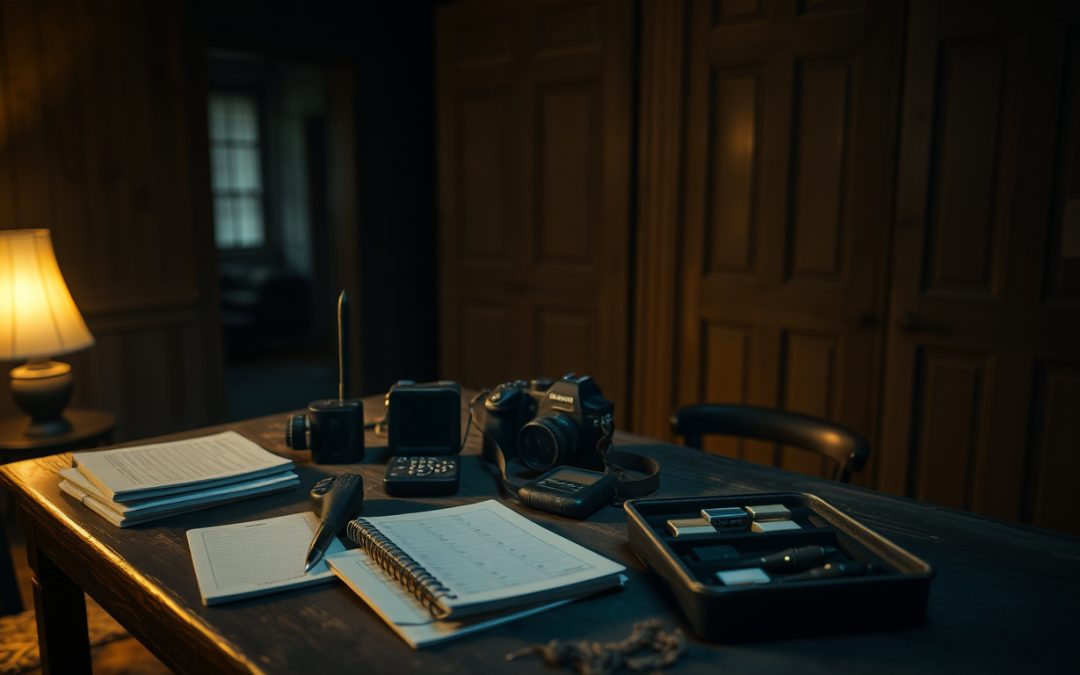
Picture a shoebox full of SD cards. A dozen audio clips with names like “weird sound 3.” Photos with no timestamps. A notebook page where someone scrawled “cold spot — bedroom?” without saying which bedroom, what temperature, or what time. This is what a lot of paranormal research actually looks like behind the scenes, and it is a bigger problem than most investigators admit. The single greatest threat to a credible case is not a missing piece of equipment. It is disorganization.
When evidence is scattered, undated, and unlabeled, it stops being evidence at all. It becomes a pile of impressions that the human brain will happily stitch into a story. The Lodestra Razor says rule out the ordinary before reaching for the extraordinary — and you cannot do that if you can’t reconstruct what happened, in what order, under what conditions. Good paranormal investigation lives or dies on documentation, not on dramatic moments.
Why Messy Evidence Quietly Corrupts Paranormal Research
Memory is not a recording. It is a reconstruction, and it edits itself every time you revisit it. Hours after an investigation, you might “remember” that the knock happened right after you asked a question, when the audio file would show a four-second gap — or no question at all. Without precise records, your recollection fills the holes, and it fills them in the direction of the answer you want.
This is where unorganized data becomes actively dangerous to honest work. It doesn’t just lose information. It manufactures false correlations.
The Pattern-Hunting Brain
Humans are pattern-detection machines. We see faces in clouds and hear words in static. Psychologists call the audio version pareidolia, and it is one of the most common explanations for so-called electronic voice phenomena. When you listen to a noisy clip already expecting a voice, you will often “hear” one. Worse, once someone suggests what the voice says, almost everyone in the room starts hearing exactly that.
Disorganized evidence supercharges this effect. If you can’t tie a clip to a clean timeline, an exact location, and the environmental conditions at that moment, you have no way to separate a genuine anomaly from a draft, a settling beam, a passing car, or your own expectation. The data has to be structured enough to argue against your first impression.
The Replication Problem
Real research is repeatable. If you record an unusual reading and can’t say where the meter was, what model it was, what else was running on that circuit, and what the baseline was an hour earlier, no one — including you — can ever test it again. Parapsychology has wrestled with this for over a century. The most respected work in the field, from early laboratory card-guessing studies onward, earned whatever credibility it has by controlling conditions and documenting them obsessively. The careless work is forgotten, and rightly so.
The Hidden Costs of Disorganized Paranormal Investigation
A scattered case file fails in ways that aren’t obvious until it’s too late to fix them.
- You lose the baseline. Without a documented baseline reading, an EMF spike means nothing. An EMF meter detects electromagnetic fields — from wiring, appliances, phones, and the building itself. It does not detect spirits. The only way a reading carries weight is in contrast to a recorded normal for that exact spot.
- You can’t reconstruct the timeline. The whole value of evidence is sequence. Did the temperature drop before or after the sound? If your photo, audio, and notes live in three places with mismatched clocks, the order is gone.
- You can’t rule out the mundane. Debunking requires detail. To dismiss a “voice” as radio bleed, you need the time, the frequency environment, and what devices were present. Vague files make honest skepticism impossible.
- You can’t defend the work. When a witness, a skeptic, or a homeowner asks how you reached a conclusion, “trust me, it felt off” is not an answer. A structured record is.
Metadata Is Evidence Too
Every digital file carries data about itself. A photo’s EXIF metadata records the camera, exposure, and often the exact timestamp. Audio files carry creation times and sample rates. This information is frequently the difference between a credible artifact and a meaningless one — yet it is the first thing lost when files get copied, renamed, screenshotted, or dragged through three apps. The moment you flatten a photo into a screenshot, you’ve thrown away the metadata that could have explained it. Preserving the original file, untouched, is a basic discipline of evidence-based paranormal investigation.
Building a Disciplined Evidence Workflow
Organization isn’t bureaucracy for its own sake. It is the method that lets you find the genuine mystery in careful observation instead of in wishful editing. Here is a workflow any serious investigator can adopt, with or without specialized tools.
1. Synchronize Your Clocks First
Before anything else, set every device — cameras, recorders, phones, meters — to the same time source. A shared timeline is the spine of the entire case. Without it, you can never line up a sound with a reading with a photo. Do it before you walk in the door.
2. Record a Real Baseline
Walk the location before the investigation and document normal conditions: ambient temperature room by room, EMF readings near wiring and outlets, background sound, drafts, and any equipment that hums or cycles. Note the furnace, the refrigerator, the fluorescent lights. Most “anomalies” are explained right here, in the baseline you took the time to capture.
3. Capture Originals, Annotate Copies
Never edit the original file. Work on copies, and keep your enhancements honest by always preserving a raw version to compare against. This is why a non-destructive workflow matters so much in paranormal audio software and video review — the original has to stay intact so you can prove you didn’t create the effect you’re claiming to find.
4. Tag in Context, Not From Memory
Mark possible events while the context is fresh — the exact time, the room, who was present, what was happening, and what mundane causes you already considered. A tag that says “possible knock, 11:42 PM, second bedroom, after question, window confirmed closed, no traffic outside” is worth more than a hundred files named “evp final REAL.”
Tools That Keep Paranormal Research Honest
You can run this workflow with notebooks and spreadsheets, and plenty of careful investigators do. But once a case grows past a few files, structure tends to collapse under its own weight. Purpose-built paranormal investigation software exists to enforce the discipline you already know you should be following.
For audio, a dedicated EVP review tool changes how you handle questionable sound. Something like DeadAir Audio Analyzer Pro lets you import, slow, reverse, mark, and classify possible EVP events on a non-destructive timeline, so the original recording stays untouched while you document exactly what you heard and when. That separation — original versus annotation — is what keeps an EVP claim from becoming a story you talked yourself into.
Video deserves the same rigor. Stepping through footage frame by frame is the only way to tell a moth near the lens from something genuinely unexplained, and motion that looks dramatic at full speed often turns out to be an insect, a reflection, or compression artifacts. A tool such as the PhantomFrame Pro Video Analyzer supports frame-by-frame review, movement detection, and a RAW A/B comparison so enhancements stay honest and you can show precisely what changed in the footage. The point is never to make footage look spookier. It’s to find out what actually moved.
Photos carry their own traps. Lens flares, dust, insects, long-exposure smears, and the camera strap that swung into frame account for an enormous share of “ghost photos.” Inspecting metadata and comparing original to enhanced versions, the way the PhantomCapture Photo Analyzer is built to do, lets you check the EXIF data and zoom into a questionable region without destroying the original — so you can rule out the ordinary before you call anything anomalous.
One Case, One File
The deeper problem is that audio, video, photos, readings, and witness statements usually live in separate places, which is exactly how timelines fall apart. A case management approach pulls them together. A Paranormal Case File Manager is designed to hold the whole investigation in one structured file — witnesses, location history, room-by-room readings, evidence, and the debunks you ruled out along the way — so the final conclusion is something you can actually stand behind. The debunks matter as much as the findings. A case file that records what you explained away is far more convincing than one that only keeps the hits.
Why This Matters for Serious Paranormal Research
Skeptics often assume paranormal research is allergic to discipline. The honest response is to out-document them. When you can produce a synchronized timeline, a real baseline, untouched original files, and a written record of every ordinary cause you tested and rejected, you’ve done the work whether or not the result is exciting. Most of the time, that work explains the experience. Occasionally, it leaves something genuinely unresolved — and that residue, examined carefully, is where the real interest lives.
Unorganized evidence robs you of both outcomes. It can’t confirm the mundane and it can’t isolate the strange. It only gives you a feeling, and feelings don’t survive scrutiny. Treat your documentation as the actual instrument it is, and your paranormal research stops being a collection of impressions and starts being something worth defending.
If you want to see how a structured, evidence-first approach works in practice, explore the field methods and tools at Lodestra and build the kind of case file that holds up when someone finally asks you to prove it.