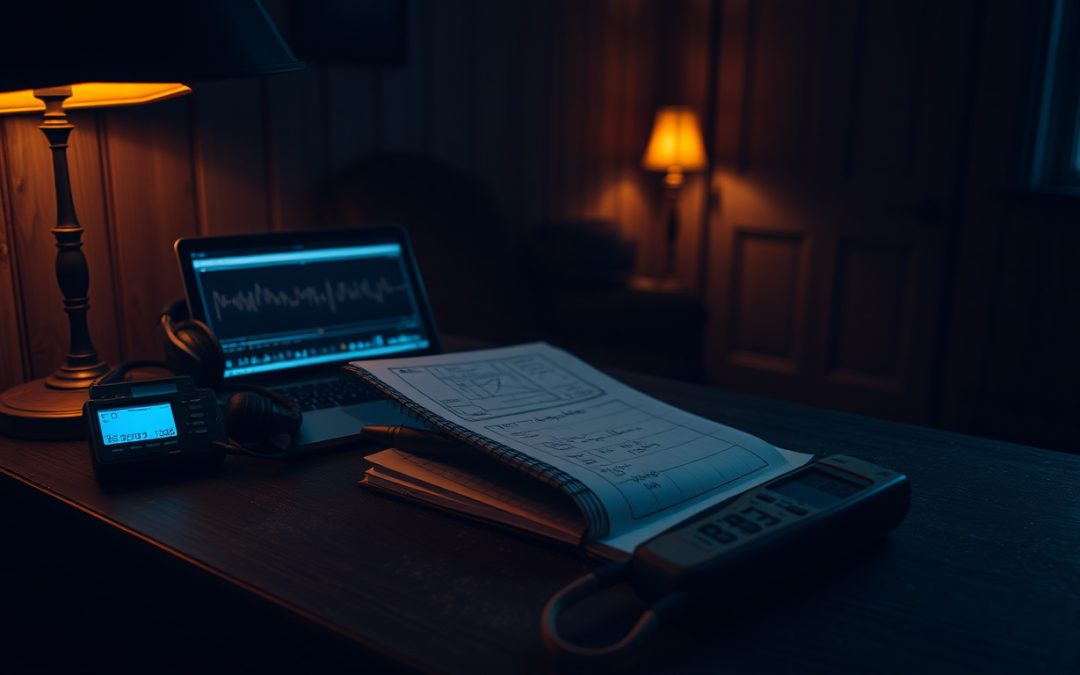
Ask most people to picture a paranormal investigation and they imagine the night itself: dark hallways, flashlight beams, a meter that chirps at the wrong moment. But the part of paranormal research that actually determines whether your findings mean anything happens later, in daylight, at a desk, with coffee going cold. It’s the review. It’s the slow, unglamorous process of listening to hours of audio, stepping through video frame by frame, and asking, again and again, “What ordinary thing could have caused this?”
A team without a post-investigation workflow tends to remember the night emotionally rather than evidentially. Someone recalls a cold spot. Someone else swears they heard a voice. By the time the group talks it through, the story has smoothed itself into something more coherent — and more paranormal — than the raw data supports. A disciplined workflow protects against that drift. It turns a memorable night into a documented case.
This is where the Lodestra Razor earns its keep. Rule out the ordinary first. That principle is easy to say in the field and hard to honor at 2 a.m., but it becomes practical once you’re reviewing evidence with a clear structure. Below is a workflow built for teams that want their conclusions to survive scrutiny — including their own.
Why the Post-Investigation Phase Is the Real Work of Paranormal Research
Fieldwork collects data. The review is where data becomes evidence, or gets honestly discarded. Both outcomes are valuable, and a good team treats a debunk as a win, not a disappointment.
Consider what a single overnight investigation produces: multiple audio channels running for hours, video from several cameras, environmental readings logged over time, still photos, witness statements, and a floor plan of the location. That’s a mountain of material, and most of it is completely unremarkable. The skill in paranormal investigation is finding the handful of moments that resist easy explanation — and being ruthlessly honest about the far larger number that don’t.
The history of parapsychology is instructive here. The field’s more credible chapters, from the early Society for Psychical Research investigations in the late nineteenth century to the laboratory work at institutions like the Rhine Research Center, share a common thread: careful documentation and a willingness to publish negative results. The cases that damaged the field’s reputation almost always involved sloppy method, missing controls, or conclusions that outran the evidence. A strong workflow is how you stay on the right side of that line.
Step One: Secure and Back Up the Raw Data
Before anyone reviews anything, protect the originals. This sounds obvious and gets skipped constantly.
Copy every file — audio, video, photo, and log — to at least two locations, and never edit the originals. Work only on copies. Any serious evidence review should be non-destructive, meaning the source file stays untouched no matter how much you filter, enhance, or slice a working copy. The moment you can’t produce the unaltered original, your evidence loses most of its value, because a skeptic can no longer verify that you didn’t create the anomaly by accident during editing.
Label Everything While Memory Is Fresh
Within a day or two of the investigation, sit down and note timestamps, camera positions, who was present, and any known contamination — a car passing outside, a team member coughing, the HVAC cycling on. These notes are gold during review. A “voice” at 3:14 a.m. is a lot less mysterious when your log reminds you that someone stepped outside for air at exactly that time.
Step Two: Review Audio for EVP With Honest Method
Electronic voice phenomena — supposed voices captured on recordings that weren’t heard at the time — are among the most reported and most misunderstood categories in paranormal research. The problem isn’t that people are lying. It’s that the human brain is extraordinary at finding patterns, especially voices, in random noise. That tendency has a name: pareidolia. Combine it with expectation — someone tells you the recording says “get out” before you listen — and you’ll hear it too, even when the sound is just a radiator ticking.
So the audio review has to be structured to fight your own perception. A few rules help:
- Listen to a clip cold before anyone suggests what it “says.” Never prime the room.
- Flag possible events with timestamps, but classify them conservatively — a faint, ambiguous sound is not the same as a clear, unexplained utterance.
- Check every flagged moment against your contamination log and the other recorders. A true anomaly should appear consistently; stray noise often shows up on only one channel or lines up with a known source.
- Resist heavy filtering. Aggressive noise reduction can manufacture voice-like artifacts out of nothing. Slowing, isolating a frequency band, or gentle cleanup is fine — inventing signal is not.
A dedicated review tool makes this discipline easier to sustain. Something like the DeadAir Audio Analyzer Pro lets you import, isolate, slow, reverse, mark, and classify possible EVP events while keeping the original file untouched. That last point matters more than any feature: a non-destructive workflow means you can always return to the source and show exactly what you did and didn’t change. The software doesn’t detect spirits — no software can — but it helps you document sound honestly and hand another reviewer the same starting point you had.
Step Three: Analyze Video and Photos Without Fooling Yourself
Video and stills carry their own traps. Dust, insects, and moisture droplets close to a lens catch infrared or flash light and produce the bright blobs often called “orbs” — a phenomenon that is almost always ordinary particles, not anything anomalous. Long exposures blur moving objects. Compression artifacts create shapes that weren’t in the room. Reflections off glass and polished surfaces mimic figures.
The right approach is comparative and patient. Step through footage frame by frame rather than trusting a real-time impression. Enhance dark clips on a working copy while preserving the original for side-by-side comparison, so you can always answer the question, “Is that in the source, or did I add it?” For anything that appears to move, ask whether a draft, a bug, or a settling structure explains it before reaching for anything stranger.
Tools such as the PhantomFrame Pro Video Analyzer support this kind of review with frame-by-frame stepping, movement detection, and a RAW A/B comparison that keeps enhancements honest. For images, the PhantomCapture Photo Analyzer lets you inspect metadata, zoom into questionable areas, and compare original and enhanced versions. Reading a photo’s EXIF metadata — shutter speed, focal length, timestamp — often resolves an “anomaly” outright by revealing a long exposure or a flash reflection. None of these tools prove the paranormal. They help you rule out the mundane with more precision, which is the whole point.
Step Four: Cross-Reference Everything Against the Environment
An isolated data point is a curiosity. A correlated one is a lead. The strongest moments in any paranormal investigation are the ones where independent records line up: a witness reports a cold sensation in the northeast corner at the same minute a temperature log shows a drop and a camera catches something.
But correlation cuts both ways, and mundane causes love to correlate too. Infrasound — sound below the range of human hearing, often generated by machinery, wind, or traffic — has been linked in research to feelings of unease, pressure, and even the sense of a presence. Electromagnetic fields from faulty wiring can affect some people’s perceptions and reliably set off an EMF meter, which measures fields, not the supernatural. Drafts create cold spots. Old buildings settle, expand, and contract with temperature, producing knocks and groans on a schedule you can sometimes predict. A good cross-reference pass tests each flagged event against these possibilities before it earns the label “unexplained.”
Mapping the scene helps enormously here. Knowing exactly where equipment sat, where the vents were, and where each reading came from turns vague memory into spatial evidence. A location mapping tool like SpecterGrid lets you build the layout, place equipment, and drop evidence pins so the “where” of an event is documented rather than reconstructed from memory weeks later.
Step Five: Build the Case File and Write an Honest Conclusion
Everything above converges into one deliverable: a case file that someone who wasn’t there could read and understand. This is the difference between a hobby and a practice. A good file logs the client’s original report, the location’s history, the equipment used, the environmental readings, every flagged piece of evidence, and — crucially — every debunk. Documenting what you ruled out is at least as important as documenting what you couldn’t.
Your conclusion should match your evidence and no more. Most investigations end with mundane explanations, and saying so plainly builds far more trust than manufacturing mystery. When something genuinely resists explanation, describe it precisely, note the alternatives you considered, and stop there. “We could not identify the source of this sound, and here is what we ruled out” is a stronger, more honest statement than any confident claim of contact.
A structured system keeps this from becoming chaos. The Paranormal Case File Manager is built to hold the whole investigation in one place — from the first client call to the final report — logging witnesses, location history, room-by-room readings, evidence, and debunks as the case develops, then exporting a conclusion designed to hold up under review. The goal isn’t a slicker presentation. It’s traceability: any claim in the report should lead back to a specific piece of documented data.
Debrief as a Team, and Do It Skeptically
Before you finalize anything, gather the team and walk the timeline together. Encourage disagreement. The person who proposes the boring explanation for the “voice” is doing the group a service, not spoiling the fun. Assign a devil’s advocate on purpose if you have to. A conclusion that survives your own team’s hardest questions is one that will survive an outsider’s.
The Payoff of a Disciplined Workflow
None of this drains the wonder out of paranormal research. If anything, it sharpens it. When you’ve genuinely ruled out drafts, infrasound, pareidolia, equipment artifacts, and suggestion — and something still doesn’t fit — that residual mystery is real and worth sitting with. It’s earned. That’s a very different feeling from the vague thrill of a night that was never examined closely.
A good post-investigation workflow is how a team moves from telling stories to documenting cases. It’s slow, it’s methodical, and it’s where credible paranormal investigation actually lives. Build the habit once and every case afterward gets stronger for it.
If you want to see how these methods and tools fit together in practice, you can explore the research and field methods at Lodestra and take a closer look at how a rigorous, evidence-first approach handles the unexplained.