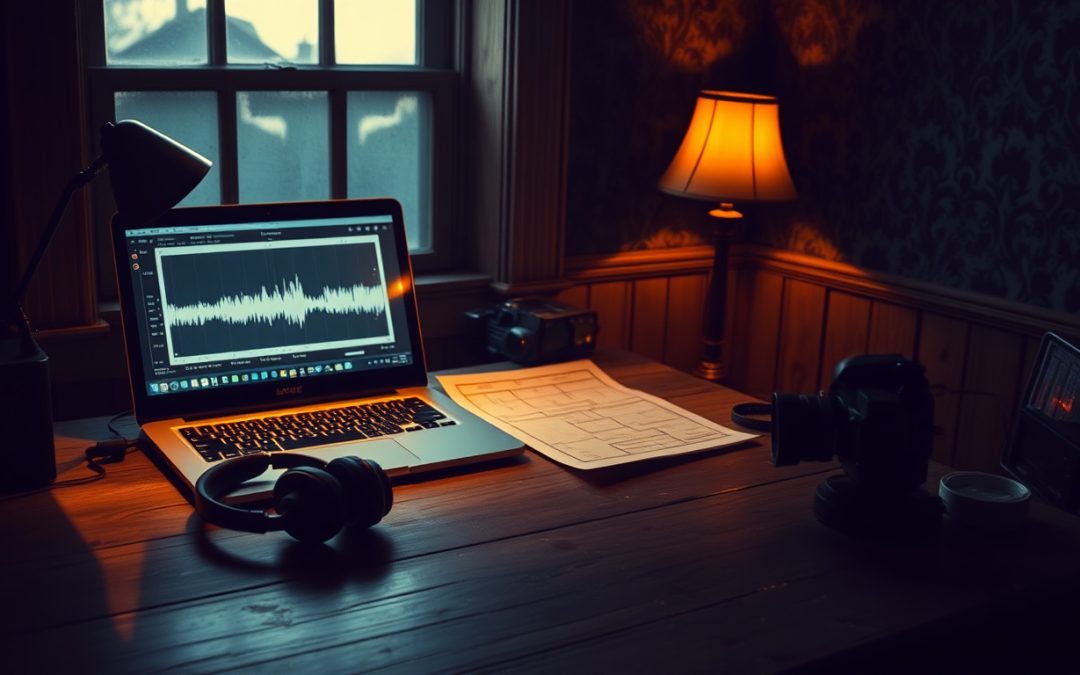
The most important work in paranormal research rarely happens in the dark. It happens later, at a desk, with headphones on and a spreadsheet open, when the adrenaline has drained away and you’re staring at three hours of audio, a folder of blurry photos, and a video clip somebody swears shows a shadow crossing a doorway. This is the review stage — the part nobody films for a highlight reel — and it’s where careful investigators separate the genuinely puzzling from the perfectly ordinary.
A messy review process produces messy conclusions. If you don’t have a consistent way to log what you found, isolate it, test it against mundane causes, and document your reasoning, you end up trusting memory and mood instead of evidence. That’s how a settling floorboard becomes “footsteps” and a lens flare becomes an “orb.” The goal here isn’t to prove anything. It’s to build a review workflow honest enough that you could hand your case file to a stranger and let them check your work.
Why the Review Stage Decides the Case
Field collection is exciting. Review is where the discipline lives. During an investigation you’re managing a location, running equipment, and reacting to things in real time — a terrible state of mind for careful judgment. Back home, with the recordings intact, you get something you never have in the field: the ability to slow down, repeat, and compare.
The Lodestra Razor applies with full force here. Before anything gets flagged as anomalous, you owe it a thorough search for an ordinary cause. Drafts, HVAC cycles, infrasound from nearby machinery, electromagnetic interference, pareidolia, digital compression artifacts, and plain suggestion account for the overwhelming majority of “evidence.” A good paranormal investigation workflow doesn’t skip past those explanations — it starts with them.
Set the Rules Before You Look
Decide your classification standards before you review a single second of footage. What counts as a Class A EVP versus something too faint to call? What movement in a frame is worth flagging? When you set thresholds in advance, you stop yourself from bending the criteria to fit the exciting result. Write these definitions into your case notes so they’re visible and consistent across every investigation.
Step One: Log Everything Before You Judge Anything
The first pass is not the analysis pass. Your only job on the first run-through is to build a timeline: mark timestamps where something catches your attention, note what you were doing at that moment, and keep moving. Resist the urge to loop a clip forty times on the first pass — that’s how you talk yourself into hearing words that aren’t there.
This is where a structured system earns its keep. Trying to track dozens of flagged moments across separate audio, video, and photo files in your head is a recipe for lost detail. A dedicated Paranormal Case File Manager lets you log witnesses, location history, room-by-room readings, and every flagged event in one structured file, so the timeline builds itself as the case unfolds. The point isn’t fancy software for its own sake — it’s that organized data resists the distortions of memory.
Capture Context, Not Just Events
Every flag needs its surroundings. What time was it? Who was in the building and where? Was the furnace running? Did a car pass outside? The context often contains the explanation. An “anomalous” knock at 2:14 a.m. loses its mystery fast when your log shows an investigator shifted their weight in the next room at 2:14 a.m. Mapping the scene helps here too; tools like SpecterGrid Location Mapper let you record exactly where equipment and people were positioned, which turns vague memories into checkable geometry.
Reviewing Audio and EVP Evidence
Electronic voice phenomena — sounds resembling speech that appear on recordings without an obvious source — are among the most reported and most misunderstood categories in paranormal research. The human brain is extraordinarily good at finding voices in noise. That’s not a flaw; it’s a survival feature. It also means our ears deceive us constantly, especially when we already expect to hear something.
Rule Out the Ordinary First
Before an audio event gets flagged, work through the mundane list. Radio frequency bleed can drop fragments of broadcast into a recording. Cheap cabling and unshielded electronics introduce hums and clicks. Digital compression creates strange artifacts when it discards data. Investigators whispering, clothing rustling, stomachs growling, HVAC ticking — all of it masquerades as the unexplained if you’re not tracking who was present and what they were doing.
Work Non-Destructively
Whatever you do to a clip, never alter the original. Isolating a segment, slowing it, or amplifying a quiet passage can reveal detail — but each of those operations can also manufacture the very thing you’re looking for. Amplify noise enough and you’ll hear “words” in a fan. A proper EVP review workflow keeps the source file untouched and works on copies, so you can always return to what was actually recorded. Purpose-built EVP logging software such as the DeadAir Audio Analyzer Pro is designed around exactly this: import, isolate, slow, reverse, mark, and classify possible events while the original audio stays intact for verification.
Guard Against Suggestion
Never tell a second reviewer what you think a clip says before they listen. The moment you supply the words, they’ll hear them. Better practice: have others listen cold and write down what they perceive independently. If three people hear three different things, you don’t have a message — you have noise the brain is trying to organize. Agreement among blind listeners means far more than agreement after prompting.
Reviewing Video Evidence
Video feels like strong proof because it seems to show rather than tell. But footage is full of traps. Low-light sensors produce grain that dances like movement. Infrared illuminators reflect off dust, moisture, and insects to create the famous “orbs.” Autofocus hunts. Compression smears motion. A moth six inches from the lens can look like a distant human shape, a phenomenon of scale and depth our eyes misread constantly.
Go Frame by Frame
Real-time playback hides more than it reveals. Stepping through footage one frame at a time is the single most useful habit in video review, because it lets you track exactly how something enters and leaves the frame. A dust particle drifts and wobbles on air currents; a genuine solid object moves with consistent trajectory and occludes what’s behind it. That distinction usually only becomes clear frame by frame.
This is the work a dedicated video analyzer supports. The PhantomFrame Pro Video Analyzer lets investigators step through footage, enhance dark clips without altering the original, run movement detection, and build motion heatmaps — with a RAW A/B comparison so every enhancement stays honest and reversible. The value isn’t in “finding ghosts.” It’s in being able to show precisely what changed between frames and prove you didn’t invent it in post.
Enhancement Is Not Evidence
Brightening a dark clip helps you see what the sensor captured. It does not add information that wasn’t there. If an enhancement seems to reveal a face or figure, treat that as a red flag for pareidolia, not a breakthrough. Always keep the unenhanced version beside the adjusted one so anyone reviewing your case can judge for themselves.
Reviewing Photo Evidence
Still photos carry their own catalog of ordinary explanations. Long exposures blur moving light. Flash reflects off airborne particles. Straps, hair, and fingers stray in front of the lens. Lens flares create translucent shapes. Reflective surfaces produce faint doubled figures that look uncanny until you notice the window.
Read the Metadata
A photograph’s EXIF data — the exposure time, ISO, aperture, focal length, and timestamp embedded in the file — often explains the anomaly outright. A long shutter speed accounts for motion blur. A high ISO explains heavy grain and false color. Checking metadata should be reflexive, not optional. A tool like the PhantomCapture Photo Analyzer lets you inspect that metadata, zoom into questionable areas, compare original and enhanced versions side by side, and tag possible anomalies for a grounded photo report. Most “ghost photos” are solved in the metadata panel before you ever zoom in.
Cross-Referencing: Where the Real Test Happens
A single flagged moment in isolation is weak. The strongest evidence in any paranormal investigation is corroborated across independent instruments and witnesses. Did the audio anomaly at 2:14 coincide with anything on video? Did a witness report feeling cold in that room at that time? Did an environmental sensor log a change? When independent data streams point to the same moment, the case grows sturdier. When they don’t, that silence is meaningful too.
This is exactly why a unified timeline matters. If your audio flags, video flags, photo tags, and witness notes all sit in separate files, cross-referencing becomes guesswork. Pulling everything into one case file lets you line events up honestly and see whether they actually correspond — or whether you were connecting dots that were never near each other.
Documenting Your Conclusions Honestly
The final report is not a place to build suspense. It’s a record of what you found, what you ruled out, and what — if anything — remains unexplained. For every flagged event, document the ordinary causes you considered and why you did or didn’t rule them out. “Unexplained” should mean “we tested the obvious explanations and they didn’t fit,” not “we didn’t bother checking.”
Most honest investigations end with a folder full of debunked events and a small handful of genuinely puzzling ones. That’s a success, not a disappointment. A conclusion that admits uncertainty is worth more than a confident one built on wishful thinking. Good documentation also lets you revisit a case months later with fresh eyes, or hand it to another investigator who can check every step you took.
Bringing the Workflow Together
Strong paranormal research is less about the moment in the field and more about the discipline you bring to the evidence afterward. Log first, judge later. Work on copies, never originals. Rule out the ordinary before reaching for the extraordinary. Let independent data streams check each other. Write down not just what you found but what you ruled out and why. Do that consistently and your conclusions will hold up to scrutiny — including your own, six months from now.
If you want to see how these methods come together in practice, explore the field tools and research at Lodestra. Bring your curiosity, keep your standards high, and let the evidence — carefully reviewed — say only as much as it honestly can.