Technology & Investigation · Paranormal Research
Lodestra Paranormal Case File Manager
Ghost hunting software built for serious paranormal investigators — from first contact to final report
Ghost hunting has changed. Not that long ago, a paranormal investigation might have been organized with a notebook, a few printed forms, a loose folder of witness statements, scattered audio files, several SD cards, and a long night of trying to remember which piece of evidence came from which room. Many ghost hunters still work this way. They may have good intentions, good instincts, and even years of experience — but their case files are often spread across phones, laptops, cloud folders, paper notes, text messages, and memory cards.
That creates a problem. A paranormal investigation is only as strong as its documentation. If a team cannot explain when an audio file was recorded, who collected it, where the camera was placed, what the environmental conditions were, what the witness actually said, what natural explanations were considered, and what changed during review, then the case becomes harder to trust.
The Guiding Principle
"Unexplained does not mean paranormal."
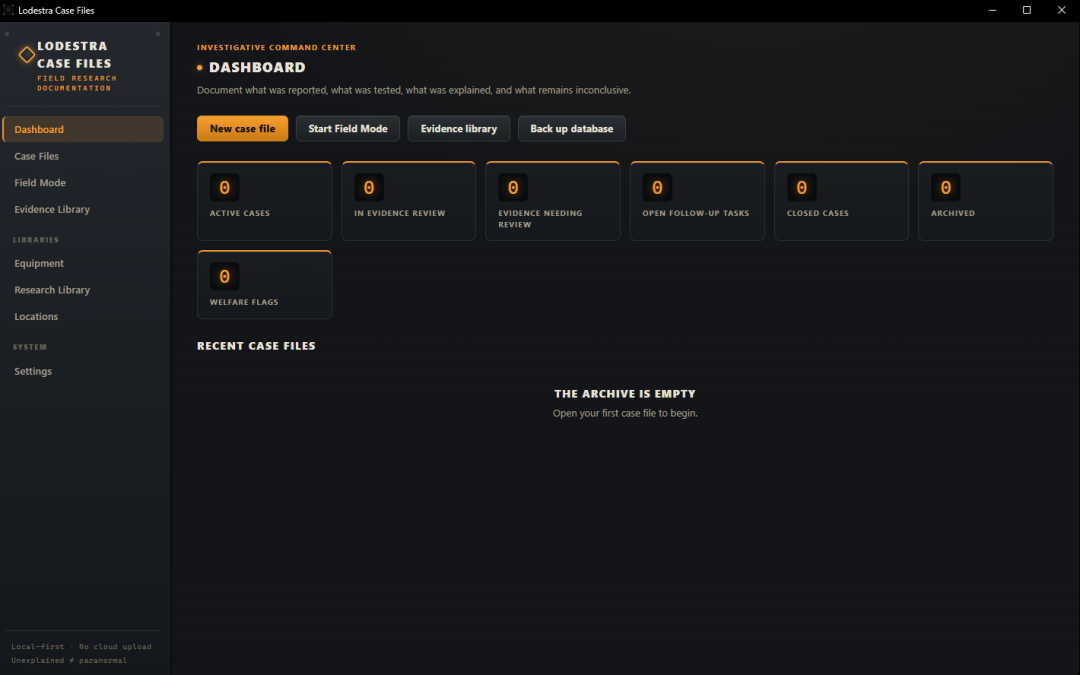
The Lodestra Paranormal Case File Manager was designed as a serious paranormal software tool for investigators who want to move beyond scattered notes and into structured, professional case management. It is a local-first desktop case file system built for intake, client permissions, historical research, claims, witnesses, investigation planning, field notes, evidence tracking, skeptical review, reporting, and long-term case organization.
Why Ghost Hunters Need Better Software
Most ghost hunters collect more information than they realize. A single investigation can include client intake notes, witness statements, consent forms, historical research, location details, room-by-room baselines, equipment logs, environmental readings, photos, EVP sessions, video files, audio recordings, personal experiences, debunking notes, follow-up tasks, and final reports.
Without a proper system, that information becomes messy fast. A team may remember that something happened "around midnight," but not the exact time. They may know a REM pod activated in the upstairs hallway, but not which investigator was present, what camera was pointed at it, whether the battery level was checked, or whether HVAC, plumbing, vibration, pets, insects, or human movement were ruled out. This is one of the biggest weaknesses in paranormal investigation. The issue is not always the evidence itself. The issue is the lack of context around the evidence.
What the Case File Manager Documents
Intake & Permissions
Client intake interviews, consent forms, release documentation, permission to record audio, video, photograph, and publish.
Location & History
Property type, year built, ownership history, renovations, documented deaths, known folklore, prior investigations, and media coverage.
Witnesses & Claims
Private statements, anonymous display names, interview type, full statements, specific claims, emotional tone, consistency notes, and follow-up questions.
Bias Logs
What each investigator knew before entering — prior knowledge of claims, location history, prior evidence reviewed, or whether they entered blind.
Equipment Deployment
Device name, brand, model, serial number, battery status, memory card ID, calibration status, placement, start/end times, and known issues.
Environmental Readings
Baselines and in-session readings for temperature, EMF, humidity, sound level, known electrical sources, and whether readings fall within normal variation.
Evidence Tracking
Imported files fingerprinted with SHA-256 hashing, chain-of-custody documentation, and the ability to prove a file has not changed since import.
Reports & Audit Logs
Report templates, redaction options, multiple export formats, and audit logs that preserve the history of changes to claims, evidence, and conclusions.
Ghost Hunting Software vs. Ghost Hunting Apps
When people search for ghost hunting apps, they often find mobile apps that claim to detect spirits, translate ghost voices, generate random words, or display flashy meters. Some are fun. Some are entertainment. Very few actually help a paranormal team manage a real investigation. The Lodestra Paranormal Case File Manager is different — it is designed as a serious paranormal software platform for case documentation, not a gadget that pretends to detect ghosts.
What a Case Manager Asks That a Ghost App Cannot
Who reported the activity, and was the witness interviewed privately? Did the witness know the location's ghost stories before the experience? Were pets, HVAC, plumbing, mold, or carbon monoxide considered? Was the equipment calibrated? What was the baseline temperature, EMF, humidity, or sound level? Was the file changed since import? What was ruled out? What language is appropriate for the final report? These are the questions that separate a gadget from a case file system.
Local-First: No Automatic Cloud Upload
Everything lives on your own machine. There is no account, no server, and no automatic cloud upload of any kind. The application does not make a network call on its own. For paranormal investigators, this is important. Many cases involve sensitive information: a client's name, address, family details, emotional distress, religious concerns, children in the home, medical concerns, property access notes, and private witness statements. That kind of information should not be casually uploaded or scattered across multiple apps.
This makes the Lodestra software especially useful for residential investigations, private property cases, historic sites, businesses, and any investigation where confidentiality matters.
Intake: Better Investigations Start Before Investigation Night
A strong case file begins before the team ever arrives on site. The intake section helps investigators record the first conversation with the person reporting activity — what happened, when it started, where it happens, how often, who witnessed it, whether children or animals are involved, and whether anyone felt unsafe.
Importantly, the intake process also prompts investigators to document possible mundane concerns: electrical problems, plumbing issues, HVAC concerns, mold, carbon monoxide, pest or animal activity, recent grief or major life changes, sleep-related experiences, and whether qualified professionals have already been contacted.
Instead of simply asking "Is the house haunted?" the software helps investigators ask "What else could explain this — and is this case appropriate for investigation?" That is a much better starting point.
Location Research and Haunted History
A location may have documented history, local legend, folklore, media stories, prior investigations, and modern claims. A responsible investigator needs to keep those categories separate. The history section in the Case File Manager includes source title, author, publication or archive, source date, source reliability, supporting evidence, contradicting evidence, verification status, researcher, and notes — helping prevent folklore from being accidentally presented as documented fact.
Bias Logs: A Feature Every Paranormal Team Should Use
If an investigator knows that a certain room is supposed to be haunted, they may interpret ordinary sounds differently. If they have read online stories, seen prior evidence, or been told where activity usually happens, that can influence their observations. The Case File Manager includes a Bias Log to document what each investigator knew before entering the location — including whether they knew the claims, the location history, spoke with the client, were told which room was active, or saw prior evidence.
This does not accuse investigators of being dishonest. It simply documents context. In a field where subjective experience matters, that context is essential.
Evidence Integrity and SHA-256 Hashing
The Lodestra Paranormal Case File Manager copies evidence files into the case, fingerprints them with a SHA-256 hash, and tracks chain-of-custody detail. This allows investigators to prove a file has not changed since it was imported. For serious ghost hunting, this is a major feature. A strange EVP clip or unusual video frame carries more weight when you can demonstrate the original file remained unchanged from capture to review.
Why Hashing Matters
SHA-256 hashing does not prove evidence is paranormal. It proves the file being reviewed is the same file that was imported. That distinction is exactly the kind of rigorous thinking the paranormal field needs more of — documentation that can withstand scrutiny.
Built Around Responsible Language
The software's guiding philosophy — "unexplained does not mean paranormal" — is reflected throughout. The app encourages natural-explanation testing, bias documentation, honest limitations, and careful wording. There is no "proof of the paranormal" conclusion option by design. The strongest conclusion is framed around documented unexplained activity or a recommendation for further investigation.
That is exactly the kind of language serious ghost hunters need. When fear, grief, stress, religion, mental health, or family conflict are involved — as they often are in private residential cases — careless overclaiming can cause real harm. Structure creates protection against it.
Full equipment deployment tracking includes
- Equipment name and type
- Brand, model, serial number
- Owner and battery status
- Memory card ID
- Calibration status
- Exact placement and start/end times
- Known issues during session
- Linked evidence file IDs
- Investigator notes
- Field mode for low-light investigation night
- Environmental baseline readings
- Audit logs for all case changes
Who should use the Lodestra Case File Manager
- Paranormal investigation teams ready to move from scattered notes into structured professional documentation
- Independent ghost hunters who want stronger reports and cleaner case archives
- Historic site investigators who need to separate folklore from verified history
- Residential case managers dealing with sensitive client situations and private information
- Haunted history researchers documenting the layered claims of specific locations over time
- Ghost tour companies with active research departments needing organized case records
- Paranormal educators who want to teach better field methods with a real-world tool
- Evidence reviewers who need to audit existing case files against better standards
Lodestra Case File Manager
Structure for Serious Paranormal Work
From first contact to final report — intake, witnesses, history, equipment, evidence, debunking, and reporting in one place.
Explore the Case File ManagerGhost hunting is not just about finding something strange. It is about documenting it well enough that someone else can understand what happened. The Lodestra Paranormal Case File Manager gives investigators the structure to do exactly that — not hype, not fake certainty, not another blinking meter. A serious case file system for serious paranormal work.