
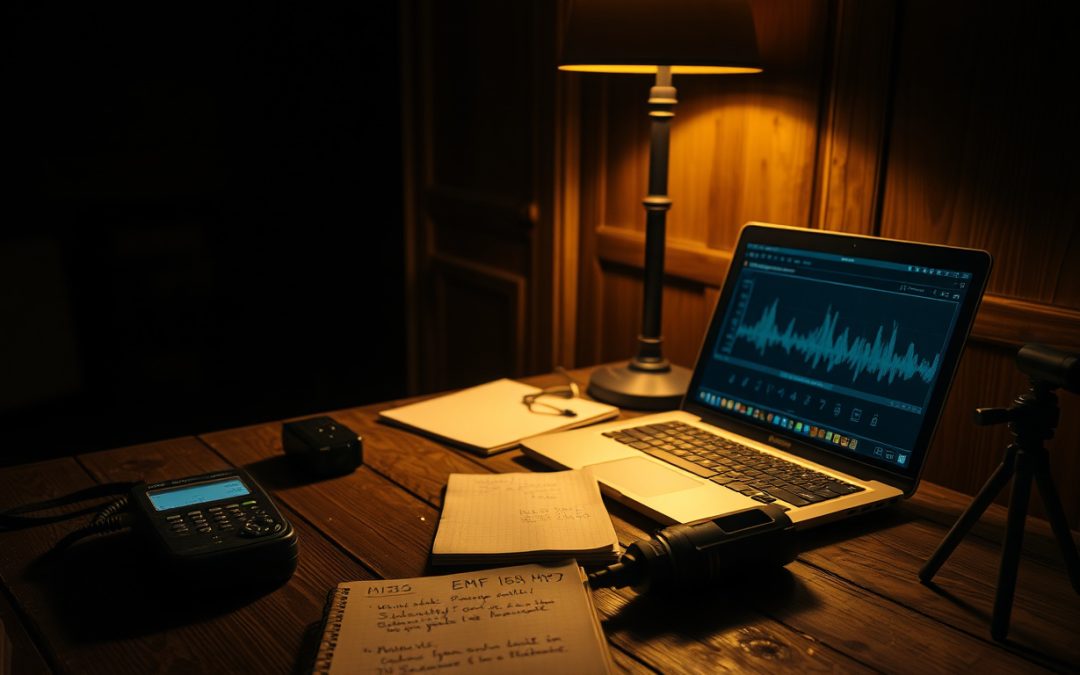
Ask anyone who has spent a long night recording an empty hallway what happens the next morning, and you’ll hear the same complaint. The investigation was the easy part. The hard part is the mountain of files afterward: six hours of audio, four camera angles, a folder of photos, a notebook of scribbled times. Somewhere in there might be one thirty-second segment worth a second look. Good paranormal research lives or dies on whether you can actually find it again. That’s where labels and tags earn their keep.
Tagging sounds like housekeeping, and in a sense it is. But in serious paranormal investigation, the way you label evidence shapes the conclusions you can honestly draw. A sloppy system buries the interesting moments and inflates the boring ones. A disciplined one lets you separate a genuine anomaly from a truck passing outside, and — just as important — lets someone else check your work. This article is about building that discipline into your ghost hunting software so your case files hold up long after the adrenaline fades.
Why Tagging Matters More Than the Catch
There’s a temptation in this field to chase the dramatic clip and skip the paperwork. Resist it. A recording of a strange knock means very little on its own. It means a great deal if you can show exactly when it happened, where the microphone sat, what else was going on in the building at that moment, and what ordinary sources you ruled out. Labels and tags are how you attach that context to the raw file so it never floats free.
The Lodestra Razor — rule out the ordinary before reaching for the extraordinary — depends on organized evidence. You cannot debunk what you cannot locate. When a client’s furnace kicks on every forty minutes, a timestamped, tagged log turns a spooky bang into a boiler cycle in about thirty seconds. That’s not a defeat. That’s the job done right, and a well-tagged case file is what makes it possible.
Tags Versus Labels: A Practical Distinction
People use the words loosely, so it helps to draw a line. Think of a label as a fixed category an item belongs to — audio, video, photo, witness statement, environmental reading. Think of a tag as a flexible, searchable keyword you attach on top: “possible EVP,” “HVAC,” “unexplained,” “pareidolia risk,” “client present.” Labels organize your file structure. Tags let you slice across it later. Most modern paranormal software supports both, and the strongest workflows use them together.
Building a Tag Vocabulary You’ll Actually Use
The most common tagging mistake is inventing new labels on the fly at three in the morning. By the end of a case you have “voice,” “Voice,” “poss voice,” and “vox?” all meaning the same thing, and none of them searchable as a group. Before you ever record, agree on a controlled vocabulary — a short, fixed list of terms your whole team uses the same way.
A workable starter set for paranormal evidence management might include:
- Status tags: unreviewed, reviewed, debunked, unexplained, needs second opinion
- Evidence type: EVP candidate, visual anomaly, temperature shift, EMF spike, physical event
- Suspected cause: HVAC, plumbing, traffic, wind, radio bleed, pareidolia, matrixing, contamination
- Context: client present, investigator speaking, walkabout, controlled silence, baseline
Notice how many of those tags point toward mundane explanations. That’s deliberate. A tag vocabulary weighted only toward “paranormal” outcomes will quietly bias your review. Give the ordinary causes their own labels and use them freely. A case file where half the flagged events end up tagged “HVAC” or “debunked” is a sign of honest work, not a wasted night.
Keep It Short, Keep It Shared
A vocabulary of fifteen to twenty-five tags is plenty for most investigations. Longer than that and people stop remembering them, which defeats the purpose. Write the list down, keep it visible, and make sure every investigator tags the same way. Consistency across the team is worth more than any clever single tag.
Tagging Audio: EVP Review Without Fooling Yourself
Audio is where tagging pays off first, because electronic voice phenomena review is slow, subjective, and easy to get wrong. The human brain is built to find speech in noise — that’s the same auditory pattern-matching that lets you hear a name in the hum of a fan. Psychologists call the general effect apophenia, and for sound specifically it shades into auditory pareidolia. Any EVP workflow that doesn’t account for it is fooling itself.
Good EVP logging software lets you mark a timestamp, drop a short label, and classify a candidate without altering the original recording. A tool like the DeadAir Audio Analyzer Pro is built around that non-destructive idea: you can isolate, slow, and reverse a segment, mark it, and classify it while the source file stays untouched. That last part matters more than any filter. If you can’t return to the unprocessed audio, you can’t tell whether a “voice” was there before you started cleaning it up.
When you tag an EVP candidate, record the boring facts alongside it: who was in the room, whether anyone spoke, what direction the sound came from, and whether it appears on more than one recorder. A segment that shows up on a single device but not the second one running beside it is a red flag for equipment artifact, not a spirit. Tag it “single-source” and move on. Discipline here is what separates paranormal research from wishful listening.
A Simple EVP Tagging Pass
Work through long audio in one steady pass, tagging as you go rather than stopping to argue every clip. A practical rhythm:
- Flag anything that catches your ear, tag it “EVP candidate — unreviewed.”
- On a second pass, check each candidate against your session notes and any second recorder.
- Re-tag: “debunked” with a cause, or “unexplained” if it survives. Add “needs second opinion” for the genuinely ambiguous.
- Never let one person’s ears be the final word on a borderline clip.
Tagging Video and Photos
Visual evidence carries its own traps: reflections, insects near the lens, dust catching the infrared, lens flare, compression artifacts. Frame-by-frame video review is the only honest way to sort a moving anomaly from a moth, and tagging the exact frame range keeps your findings reproducible. A frame-stepping tool such as the PhantomFrame Pro Video Analyzer lets you enhance dark footage without touching the original and keep a RAW A/B comparison, so an “enhancement” never quietly becomes fabrication. Tag the frames, note the suspected cause, and keep the untouched clip in the file.
Photos deserve the same treatment. Before you tag an orb or a shape as anomalous, inspect the metadata. Shutter speed, flash state, and focal length often explain a “manifestation” outright — a slow shutter and a moving hand produce a light streak every time. A dedicated photo tool like the PhantomCapture Photo Analyzer lets you read that EXIF data, zoom into questionable areas, and compare original against enhanced before you commit to a label. Tag “flash artifact” or “dust” as readily as you’d tag “unexplained.” The credibility of your whole case file depends on it.
Tags That Tie the Timeline Together
The real power of tagging shows up when you connect evidence across types. Suppose you tag an EVP candidate at 2:14 a.m., an EMF reading at 2:14, and a video event a few seconds later. On their own, each is thin. Cross-referenced by timestamp and tag, they form a cluster worth examining — or, just as often, they reveal a shared mundane trigger, like a large appliance cycling on and briefly spiking both the EMF meter and the ambient noise floor.
This is where a proper case manager earns its place. The Paranormal Case File Manager is designed to hold the whole investigation in one structured file — witnesses, location history, room-by-room readings, evidence, and debunks — so your tags aren’t scattered across a dozen apps. When it comes time to write the conclusion, a consistent tagging scheme lets you export a report that shows your reasoning, not just your highlights. Remember what these instruments actually do, though: an EMF meter measures electromagnetic fields, a thermometer measures temperature. A tag records that a field changed. It never records why. Keep that line clear in every label you write.
Turning Tags Into an Honest Report
The final test of any tagging system is the report you hand a client or archive for yourself. Well-tagged evidence lets you state plainly: we flagged eleven audio events, debunked eight as plumbing and traffic, and left three unexplained pending review. That sentence only exists because someone tagged carefully in the dark hours. It’s honest, it’s specific, and it respects both the witness and the evidence.
Sloppy tagging produces the opposite — a vague folder of “creepy stuff” that impresses no one who thinks critically. Rigorous paranormal investigation isn’t about how many events you catch. It’s about how clearly you can account for each one. Labels and tags are the small, unglamorous habit that makes that accounting possible, case after case.
Start Small and Stay Consistent
You don’t need an elaborate system to begin. Pick a dozen tags, write them down, use them the same way every time, and refine the list after a few investigations. Consistency beats complexity. The goal of good paranormal research isn’t to prove a haunting — it’s to document reality carefully enough that the truth, ordinary or otherwise, has room to show itself.
If you want to see how a structured, evidence-first workflow comes together across audio, video, photos, and case notes, explore the field tools and methods at Lodestra and build a tagging habit your future self will thank you for.