
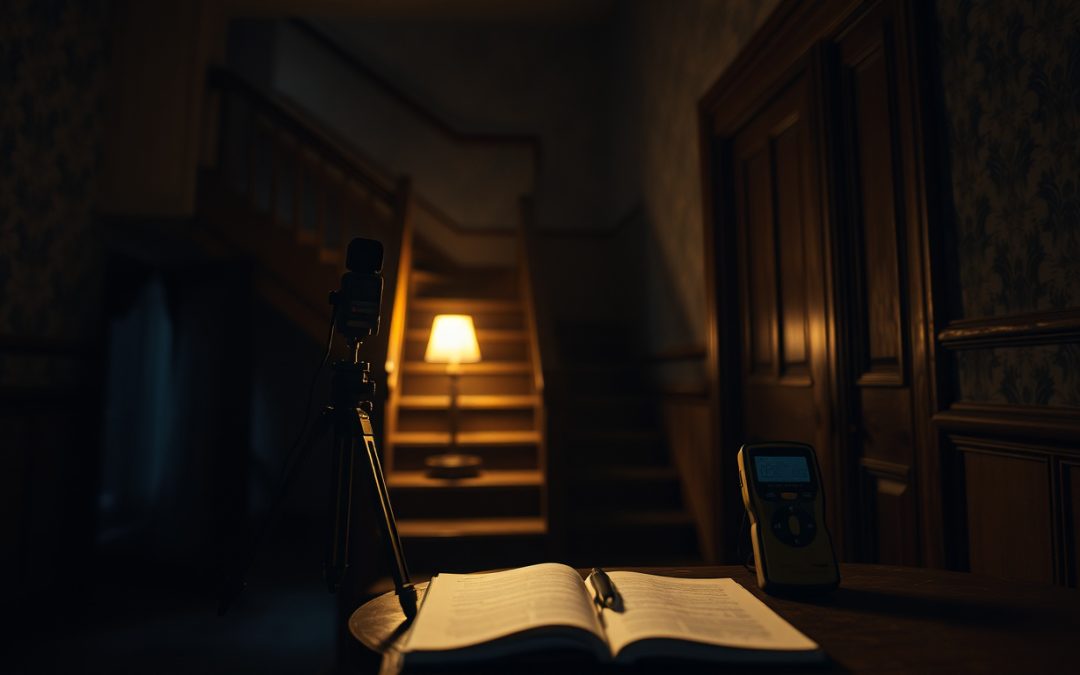
Walk into an old house with a handful of meters, and the numbers start talking almost immediately. The temperature dips near a stairwell. An EMF meter chirps beside an outlet. The needle on a barometer drifts as a storm rolls in. To someone new to paranormal research, any one of those changes can feel meaningful. The discipline of good investigation is learning which changes actually mean something, which are ordinary, and how to tell the difference before you write a single word in a report.
Environmental data is the backbone of serious fieldwork. It’s also the easiest thing to misread. A meter doesn’t know why a value changed; it only reports that it did. Your job is to build a record careful enough that, weeks later, you can look at a cold spot and say with confidence whether it was a genuine anomaly or an open flue you never checked. That habit — measure, log, question, and rule out — is the whole game.
Why Environmental Tracking Matters in Paranormal Investigation
The idea that ghosts affect the physical environment isn’t new. Reports of sudden cold, strange smells, and electrical disturbances run through centuries of ghost lore. Early psychical researchers in the late 1800s tried to bring instruments to bear on these claims, and the tradition of parapsychology has wrestled ever since with a hard problem: how do you measure something you can’t define?
You can’t. Not directly. What you can do is measure the environment itself with precision, establish what “normal” looks like for a given location, and flag moments when conditions shift in ways you can’t immediately explain. That’s the honest framing. A cold spot is not evidence of a spirit. It’s evidence that the air got colder in one place, which is a fact worth explaining — and most of the time the explanation is mundane.
This is where the Lodestra Razor earns its keep. Before a reading becomes “activity,” it has to survive a gauntlet of ordinary causes. A disciplined paranormal investigation treats environmental data as a set of questions, not a set of answers.
The Core Readings Worth Tracking
You don’t need a truckload of gadgets. A few reliable instruments, used consistently, beat a dozen novelty devices used at random. Here are the measurements that carry the most weight, along with what each actually tells you.
Temperature
Temperature is the classic paranormal reading, and also the most abused. An ambient thermometer measures the air temperature at its sensor. An infrared thermometer measures the surface temperature of whatever you point it at — not the air between you and it. That distinction matters enormously. People report “cold spots” using IR guns aimed at a wall, then wonder why a plaster surface reads cooler than the room. Plaster near an exterior wall is often simply colder. That’s physics, not a phantom.
To track temperature well, use an ambient probe that responds quickly, take baseline readings throughout the space, and note the location precisely. A genuine cold spot worth investigating is one that appears where the surroundings don’t explain it, moves or persists oddly, and can’t be traced to a draft, vent, window, or open chimney.
Electromagnetic Fields (EMF)
An EMF meter detects electromagnetic fields. That’s all it does. It does not detect spirits, presences, or intentions. This is the single most important sentence in any honest discussion of ghost hunting technology, and it’s the one most often ignored.
Buildings are full of EMF sources: household wiring, fluorescent lights, transformers, appliances, breaker panels, and the fields from your own phone and camera. A meter spiking near an outlet tells you there’s an electromagnetic field near an outlet. Before that reading means anything else, you have to map the ordinary sources first. Walk the space with the meter during setup, note every fixed source, and mark them on your layout. Only a reading that appears where no known source exists — and that you can document and, ideally, reproduce — deserves a second look.
There’s also a real and interesting wrinkle here. Strong electromagnetic fields, particularly from faulty wiring, have been linked in some studies to feelings of unease, being watched, or even mild hallucination in sensitive individuals. That’s not a paranormal finding — it’s a mundane one that can produce paranormal-feeling experiences. Finding a high EMF source near where a witness feels dread is a debunk, not a discovery, and it’s one of the most valuable outcomes an investigation can produce.
Humidity and Barometric Pressure
These two get overlooked, which is a mistake. Humidity affects how we perceive temperature and how condensation forms, which ties directly into photo artifacts like orbs and mist. Barometric pressure shifts with weather and can correlate with headaches, restlessness, and the creaks and pops of a structure expanding or contracting. Logging both gives you context that explains a surprising number of “events.” A door that swings on its own during a pressure drop is a door reacting to pressure, not intention.
Sound and Infrasound
Audio deserves its own attention. Beyond audible sound, infrasound — frequencies below roughly 20 Hz, too low to hear — has been associated in research with sensations of unease, chills, and the impression of a presence. Sources include ventilation systems, traffic, wind across openings, and machinery. If a room reliably makes people uncomfortable, low-frequency sound is a genuine suspect worth measuring before anything else.
Building a Baseline Before You Chase Anomalies
Here’s the step most new investigators skip, and it’s the one that separates paranormal research from wandering around in the dark reacting to beeps. Before you look for anything unusual, you have to know what usual looks like.
Walk the entire location during setup, in daylight if you can. Take temperature, EMF, humidity, and sound readings in every room, and write them down with locations attached. Note every wiring source, vent, window, radiator, appliance, and drafty gap. Photograph the space. This baseline is your control. Without it, every later reading is meaningless, because you have nothing to compare it against.
A good baseline also protects you from your own excitement. At 2 a.m., tired and primed for something to happen, a small EMF flicker feels significant. If your notes already show that same corner reading the same value at setup, the mystery evaporates. That’s not disappointing. That’s the method working.
Logging Readings So They Actually Hold Up
A reading you didn’t record properly is a reading you can’t defend. The core discipline of environmental tracking is documentation, and it comes down to a few non-negotiables.
- Timestamp everything. Every reading needs a time. Anomalies matter most when they line up with other events — a temperature drop that coincides with a witness report and an audio event is far more interesting than any one of those alone.
- Fix the location precisely. “The hallway” isn’t good enough. “Second-floor hallway, outside the northeast bedroom, sensor at chest height” is. A map with pinned locations makes this far easier and cleaner.
- Record the instrument and its settings. Which meter, what mode, what range. Different devices and modes aren’t comparable, and a reader months later needs to know exactly what produced the number.
- Note conditions and context. Weather, who was present, what equipment was running, whether a door or window was open. Context is what lets you rule things out later.
- Log your debunks alongside your data. When you trace a cold spot to a chimney or an EMF spike to a junction box, write it down immediately. Solved readings are as valuable as unsolved ones, and they build credibility.
Doing this on paper works, but it gets unwieldy across a long night and multiple rooms. Structured tools help you keep readings, timestamps, and locations connected. A SpecterGrid Location Mapper lets you build a real layout of the scene and drop evidence pins where readings occurred, so a value is tied to an exact spot rather than a vague memory. Pairing that spatial record with a Paranormal Case File Manager keeps room-by-room readings, witness accounts, and debunks in one structured file — the kind of record that produces a conclusion you can actually stand behind.
Interpreting the Data Without Fooling Yourself
The hardest part of environmental tracking isn’t collecting numbers. It’s resisting the urge to make them mean more than they do. Human beings are pattern-finding machines. Give us a cluster of readings and a spooky atmosphere, and we’ll build a story out of noise almost automatically.
Guard against it with a few habits. Treat any single reading as unreliable; look for patterns that repeat and correlate. Ask what changed in the ordinary world at that moment — did the furnace kick on, did a car pass, did someone open a door two rooms away? Cross-check readings against each other. And be especially suspicious of data that confirms what you were hoping to find, because that’s exactly when your judgment is weakest.
Environmental readings rarely prove anything on their own. Their real power is in combination. A pressure drop that explains a slamming door is a solved case. A cold spot with no draft, coinciding with a witness experience and a clean audio recording, in a location where you’ve ruled out the obvious causes — that’s not proof of the paranormal either, but it is a genuine, documented anomaly worth deeper study. That honest middle ground, an unexplained event carefully recorded and fairly examined, is where real paranormal research lives.
Bringing It Together
Tracking environmental readings well is less about equipment and more about discipline. Establish a baseline. Measure consistently. Timestamp and locate everything. Rule out the ordinary before you entertain the extraordinary. Log your debunks with the same care as your mysteries. Do that, and even a quiet night produces something valuable: a clean, honest record of what a place is actually like.
The instruments only report what’s there. The rigor is yours to bring. If you want to sharpen the way you document and examine what your meters and sensors capture, you can explore the research and field tools at Lodestra and see how a structured, evidence-first approach turns a pile of readings into a case that holds up.