
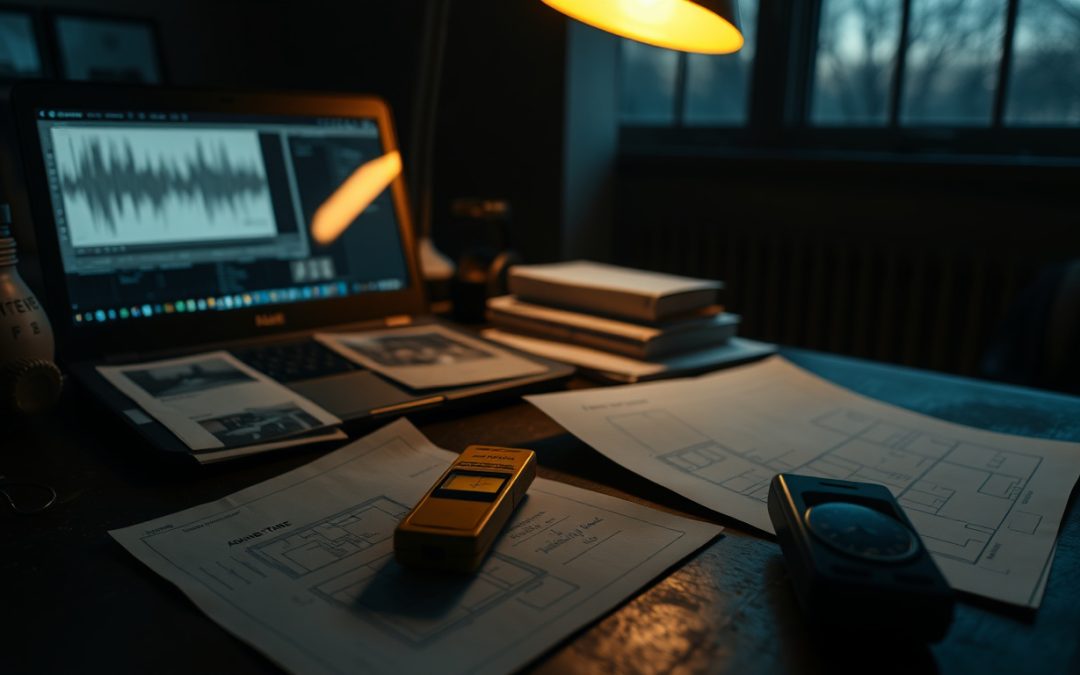
Every serious investigator has a drawer, a hard drive, or a shoebox full of unfinished business. A recording nobody could quite explain. A photo that still nags. A case that ended not because it was solved, but because the trail went quiet and everyone moved on. In paranormal research, these cold cases are some of the most valuable material you own — and revisiting them properly is one of the most underrated skills in the entire field.
The reason is simple. When a case is fresh, you’re flooded with adrenaline, client emotion, and the pressure to produce an answer. Time changes that. Months or years later, you return with cooler judgment, better equipment, and — if you’re honest — a longer list of ordinary explanations you didn’t fully consider the first time. A cold case reopened with discipline often teaches you more than a live investigation ever could.
This is where the Lodestra Razor earns its keep: rule out the ordinary before you reach for the extraordinary. A cold case gives you the rare luxury of doing exactly that, slowly and without an audience.
Why Cold Cases Deserve a Second Look
A case usually goes cold for one of a few reasons. The evidence was ambiguous. The witness stopped responding. The team ran out of time or funding. Or the “answer” everyone settled on was really just fatigue dressed up as a conclusion. None of those reasons mean the case was actually finished.
Reopening old files matters for practical reasons too. Recording technology improves. Your own analysis skills sharpen. And crucially, you now have distance from the original emotional pull of the location. The dark basement that felt oppressive at 2 a.m. reads very differently on a laptop screen in daylight, three years later, with a cup of coffee and a skeptical mindset.
The Value of Distance
Suggestion is a powerful force in the field. When someone tells you a hallway is “where it always happens,” your brain primes itself to notice anything that fits. Revisiting a cold case strips away that live suggestion. You’re no longer standing in the room being told what to feel. You’re looking at raw data, and raw data doesn’t care about the atmosphere.
Start by Rebuilding the Original File
Before you re-analyze a single frame of video or a second of audio, reconstruct what actually happened. Cold cases fail when investigators dive straight into the “good bit” — the one clip that made everyone excited — without rebuilding the full context around it.
Pull together everything you have: original witness statements, dates, times, weather records, floor plans, equipment logs, and every raw file. The goal is a complete timeline. When did the witness first report activity? What was the building doing that night — heating cycling on, wind, traffic outside? What was the team doing in the moments around the anomaly?
This reconstruction is exactly the kind of work a structured system handles better than a folder of loose files. A dedicated Paranormal Case File Manager lets you log witnesses, location history, room-by-room readings, evidence, and debunks in one place, so the whole investigation lives in a single structured file instead of scattered notes you half-remember. When you reopen a case years later, that organization is the difference between a real review and a guessing game.
Watch for the Gaps
The most revealing part of rebuilding a file is often what’s missing. No baseline EMF reading. No note about who else was in the house. No timestamp on the photo. Those gaps don’t just weaken the old conclusion — they tell you exactly what to control for if you ever return to the location.
Re-Examining Audio Evidence in Paranormal Investigation
EVP, or electronic voice phenomena, is where cold cases get seductive. An unclear sound on a years-old recording invites the imagination to fill in words. That’s precisely why audio deserves the most cautious re-review of anything in your file.
Start with an honest reminder of what a recorder actually captures: air pressure changes, converted into a digital signal. It does not capture spirits. It captures sound, including sound you didn’t notice in the moment — a pipe knocking two floors down, a distant car, a stomach growling, radio frequency interference bleeding into cheap cables, or one of the team shifting their weight.
When you revisit an EVP clip, resist the urge to loop the “voice” fifty times. Repetition doesn’t clarify audio; it trains your brain to hear the pattern you’re expecting. This is auditory pareidolia, and it’s one of the most common ways a mundane noise gets promoted to a “class A” EVP. Instead, work methodically and non-destructively so your original file stays intact.
A Careful Audio Workflow
- Keep the original file untouched and work on copies.
- Listen first without knowing where the anomaly is supposed to be. If you can’t find it cold, that’s meaningful.
- Check the waveform. A genuine sound in the room shows up in the signal; a “voice” that appears only in your perception often doesn’t correspond to anything visible.
- Cross-reference your timeline. Was anyone speaking, moving, or outside at that timestamp?
- Document your reasoning, including the explanations you ruled in as likely.
A tool like the DeadAir Audio Analyzer Pro is built for exactly this kind of review. You can import, isolate, slow, mark, and classify possible EVP events with a non-destructive workflow that leaves the source audio alone. What it won’t do — what no software can do — is tell you a sound is paranormal. It helps you look and listen more carefully. The judgment stays yours, and honest judgment usually trends toward the ordinary explanation.
Bringing Fresh Eyes to Old Video and Photos
Video and stills age well as evidence precisely because they’re static and repeatable. The footage doesn’t change. Your ability to analyze it does.
With video, the classic cold-case anomaly is a moving shape, a flickering shadow, or an “object” that seems to dart across frame. Nearly all of these have workaday origins: insects near the lens, dust catching infrared, a moth, a reflection, compression artifacts, or a light source changing behind the camera. Reviewing footage frame by frame is tedious and absolutely essential. Movement that looks uncanny at full speed frequently resolves into something dull when you step through it one frame at a time.
A PhantomFrame Pro Video Analyzer supports this by letting you step through footage frame by frame, enhance dark clips without altering the original, run movement detection, and build motion heatmaps — with a RAW A/B comparison that keeps every enhancement honest. That last point matters more than any feature. If you can’t show your original alongside your enhanced version, your enhancement is just a nicer-looking assumption.
The Photo Trap
Photos are where cold cases go to be misremembered. “Orbs” are the textbook example — almost always dust, moisture, or insects reflecting a flash close to the lens. Streaks are camera straps or hair. Faces in windows are pareidolia layered over reflections and dirt. The metadata often tells a clearer story than the image itself: shutter speed, flash status, and timestamp can quietly kill a mystery.
When you reopen photo evidence, inspect the metadata first, then zoom into the questionable area and compare original against any enhancement. A PhantomCapture Photo Analyzer is designed for this — reading EXIF data, comparing versions, tagging possible anomalies, and exporting a grounded report. The word “grounded” is the whole point. A good photo review usually explains an image rather than deepening its mystery, and that’s a success, not a failure.
Map the Scene You Half-Remember
Memory distorts space. The room you recall as “the corner where it happened” may not line up with where your equipment actually sat. Rebuilding the physical layout of a cold case protects you from that drift.
Laying out the location — marking rooms, equipment positions, and where each piece of evidence was captured — turns vague recollection into something you can test. Did the “cold spot” sit directly under an old vent? Was the camera that caught the shadow pointed at a hallway with a streetlight at the far end? Tools like a SpecterGrid Location Mapper let you build that layout, drop evidence pins, and export a clean visual map for the file. Often the map alone surfaces the mundane cause you missed in the moment.
Reach an Honest New Conclusion
The purpose of revisiting a cold case is not to finally “prove” something. It’s to reach the most accurate conclusion the evidence supports — which is frequently a downgrade. A clip you once called compelling may now read as a HVAC knock. That’s the job working correctly.
Write your new conclusion the way a careful investigator would: state the original claim, list the ordinary explanations you tested, note what you ruled out and why, and be explicit about what genuinely remains unexplained. A residue of true mystery is rare and valuable precisely because you tried so hard to dissolve it. Document all of it, then export a report that another skeptic could follow step by step. This is what evidence-based paranormal research looks like in practice: methodical, transparent, and unafraid of a boring answer.
A Quick Checklist for Reopening a Case
- Rebuild the full timeline and file before touching the “good” evidence.
- Identify the gaps — missing baselines, timestamps, or witness context.
- Re-review audio, video, and photos non-destructively, originals preserved.
- Test each anomaly against ordinary causes before anything else.
- Map the scene to check memory against physical reality.
- Write a conclusion honest enough to say “explained” when it is.
The Case Is Never Truly Closed
Good paranormal research treats conclusions as provisional. Tomorrow you might learn something about the building, the equipment, or your own perception that reopens a file you thought was finished. That’s not a weakness of the method — it’s the method. The willingness to revisit, re-examine, and revise is what separates careful investigation from storytelling.
If you want to see how structured tools and honest workflows support this kind of patient, second-look investigation, explore the research and field methods at Lodestra. Bring your coldest case. Rule out the ordinary first, and let whatever survives be the real mystery.