Most of the work in paranormal research happens after everyone goes home. The night is done, the site is quiet, and you are left with hours of footage that mostly shows nothing. A dark hallway. A chair that doesn’t move. Your own breathing on the audio track. Somewhere in that long, uneventful recording there may be three seconds worth examining — a shadow that shifts, a small object that seems to tip, a light that blooms and fades. The hard part is finding those three seconds without fooling yourself into seeing dozens that were never there.
Reviewing video well is a discipline, not a vibe. Done carelessly, it produces false positives: dust mistaken for orbs, lens flare mistaken for apparitions, a passing car’s headlights mistaken for something reaching through a wall. Done rigorously, it becomes one of the most honest tools in a paranormal investigation, because video can be replayed, measured, and checked against a mundane explanation as many times as you need. This guide walks through a review method built for people who take the unexplained seriously — and who take the ordinary explanations even more seriously.
Why Video Fools Us So Easily
Before you review a single frame, it helps to understand how your equipment and your brain conspire against you. A camera is not a neutral witness. It has a sensor, a lens, a compression algorithm, and an infrared system, and every one of those introduces artifacts that look eerily like activity when you want them to.
Human perception makes it worse. We are pattern-finding animals. Pareidolia — the tendency to see faces and figures in random detail — is not a flaw you can train away; it is baked into how the visual system works. Stare at grainy low-light footage long enough and your brain will offer you a face in the wallpaper, a figure in the doorway, a hand in the curtain folds. That experience feels like discovery. It is usually just noise plus expectation.
The Lodestra Razor applies with full force here: rule out the ordinary before you reach for the extraordinary. In practice that means learning what the mundane culprits actually look like on video so you can recognize them on sight.
The Usual Suspects
- Dust, pollen, and insects. The classic “orb” is almost always a particle close to the lens, lit by the camera’s own infrared or flash and thrown badly out of focus. It moves erratically, changes direction with air currents, and appears near the light source.
- Lens flare and reflections. A stray light — a streetlamp, a phone screen, an LED on your own gear — bounces inside the lens or off a window and produces streaks, orbs, or ghostly shapes that track with camera movement.
- Infrared quirks. Night-vision footage flattens depth and blows out reflective surfaces. Eyes, dew, and polished wood glow in ways that read as unnatural.
- Compression artifacts. Digital video discards data to save space. In dark scenes this produces blocky smears and “mosquito noise” that shimmer and shift, mimicking movement where nothing physical happened.
- Structural and environmental causes. Drafts move curtains and dust. Settling buildings creak and shift objects. Passing traffic sends light sweeping across walls. Vibration from an HVAC system can nudge a loosely balanced object.
If you can name these on sight, you have already prevented most of the errors that plague amateur ghost hunting video review.
Set Up a Review Method You Can Repeat
The single biggest reason investigators miss key moments is that they watch footage the way they watch television — passively, at normal speed, once. Real paranormal investigation demands a structured pass system. Think of it as reading a document several times for different things rather than skimming it once.
Pass One: The Timeline Pass
Watch the footage at normal or slightly increased speed with a notepad or a logging window open. You are not hunting for anomalies yet. You are building a timeline of what the recording actually contains: when investigators entered and left, when someone spoke, when a car passed, when the furnace kicked on. This context is gold later. Half of what looks paranormal in isolation becomes obvious once you know a team member walked through the frame ten seconds earlier.
Pass Two: The Detail Pass
Now slow down. Go section by section, watching quiet stretches at reduced speed. This is where frame-by-frame stepping matters. A moving object that flashes past in a single frame at normal playback becomes visible when you step through it one frame at a time. Mark anything that draws your eye — not because it is paranormal, but because it deserves a second look. Timestamp it. You will judge it later, when you are less tired and less primed to see things.
Pass Three: The Skeptic’s Pass
Return to each marked moment cold and try your hardest to explain it away. Can you match the movement to a draft? A reflection? A team member off-camera? Compare the flagged clip against the same location earlier and later in the recording. If the “figure” is in the doorway at 2:14 a.m., is it also there at 1:00 and 3:00? A shape that never moves and appears in every frame is almost always a fixed object — a coat, a shadow, a smudge on the lens.
This is where good ghost hunting video analyzer tools earn their place. A non-destructive workflow lets you brighten dark footage, step frame by frame, and run movement detection without ever altering the original file. That last point matters more than any single feature. Enhancement is a tool for seeing, not a tool for creating. If you can’t show the untouched original next to your enhanced version, your evidence is worthless to anyone rigorous.
Tools That Help You See Without Deceiving You
The right paranormal video software doesn’t find ghosts. It finds change. It helps you locate the exact moments where something in the frame actually differs from the surrounding footage, so you spend your attention where it counts instead of squinting at three hours of empty hallway.
Movement detection and motion heatmaps are the workhorses here. They flag frames where pixels shift beyond a threshold you set, which is genuinely useful for scanning long, mostly-static clips. But understand the limit: a motion alert tells you something changed on the sensor, not what changed or why. A moth, a headlight, a compression glitch, and a genuinely unexplained movement all register the same way. The software narrows your search. You still do the judging.
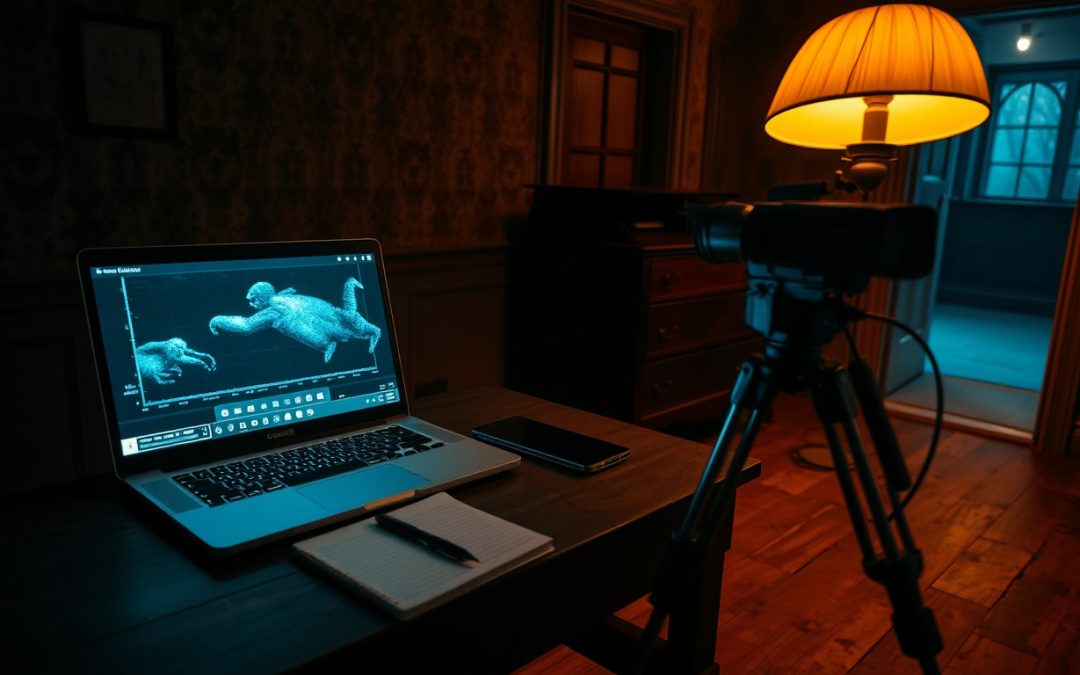
For this kind of structured review, PhantomFrame Pro Video Analyzer is built around exactly this workflow — step frame by frame, enhance dark footage without touching the original, run movement detection, build motion heatmaps, track a region of interest, scan long clips for events, and export a clean evidence report. Its RAW A/B feature keeps every enhancement honest by preserving the untouched source alongside anything you adjust. That honesty is the whole point. A tool that lets you prove you didn’t tamper with the footage is worth more than one that makes footage look dramatic.
Pairing Video With Your Other Evidence
A flagged moment on video gets far stronger — or far weaker — when you line it up against your other records. Did an audio anomaly occur at the same timestamp? Was a team member logging an environmental reading in that room? Cross-referencing is where a single strange clip either gains support or collapses into coincidence. If you review audio alongside your footage, a dedicated review tool like the DeadAir Audio Analyzer Pro lets you isolate, slow, and mark possible EVP events on their own timeline, which you can then match against the exact second something appeared on screen.
Document Everything, Including the Debunks
Here is the part most people skip, and it is the part that separates serious paranormal research from a scrapbook of spooky clips. Write down what you ruled out. Every time you match a “shadow figure” to a passing car or a “moving orb” to a dust mote, that debunk is a finding. It is evidence of your rigor, and it makes the handful of moments you can’t explain far more compelling.
A structured record should capture, for each flagged event: the timestamp, the camera and settings, what you observed, every mundane explanation you tested, and your honest conclusion — explained, unexplained, or inconclusive. “Inconclusive” is an entirely respectable verdict. It means you looked hard and the evidence didn’t reach a threshold. Claiming more than that is how credibility gets spent.
Keeping all of this in one place matters when a case runs long or heads toward a written report. A Paranormal Case File Manager can hold the whole investigation in one structured file — witnesses, location history, room-by-room readings, evidence, and debunks — so your video findings sit in context rather than floating in a folder of unlabeled clips. When you finally export a conclusion, it holds up because every claim traces back to something you can show.
A Quick Field-Ready Checklist
- Log your recording setup before review: camera model, IR on or off, frame rate, location, and timestamps of everyone present.
- Run three passes — timeline, detail, skeptic — and never judge a clip on the pass where you first spotted it.
- Step frame by frame through anything ambiguous. Single-frame events are invisible at normal speed.
- Enhance only non-destructively, and always keep the original beside the adjusted version.
- Compare every flagged moment against earlier and later footage of the same spot.
- Cross-reference video timestamps with audio and environmental logs.
- Write down what you debunked, not just what you kept.
- Label conclusions honestly: explained, unexplained, or inconclusive.
The Payoff of Patient Paranormal Research
Reviewing footage the careful way is slow, and it will kill most of your “best” clips. That is the feature, not the bug. The goal of paranormal research is not to accumulate a pile of ambiguous videos — it’s to arrive at a small number of observations that survived every honest attempt to explain them away. Those are the moments worth talking about. A method that ruthlessly discards false positives is what gives the survivors any weight at all.
Approach your footage as an investigator, not a fan. Build the timeline. Slow it down. Try to debunk it before you try to believe it. Document the process so anyone can retrace your steps. Do that consistently and you’ll miss far fewer real moments — and mistake far fewer ordinary ones for something they aren’t.
If you want to see how these methods come together with tools built for careful, evidence-first work, explore the field methods and research at Lodestra. Bring your curiosity and your skepticism both. The mystery that remains after rigorous review is the only kind worth chasing.