The hardest part of a case is rarely the long, cold night in an unfamiliar house. It’s the conversation that comes after. A family is sitting across from you, tired and a little frightened, waiting to hear what you found. How you handle that moment defines the entire value of your paranormal research. Get it wrong, and you either feed a fear that wasn’t warranted or dismiss an experience that deserved to be taken seriously.
Presenting findings well is a skill in its own right. It requires you to be honest about uncertainty without being cold, and reassuring without making promises the data can’t keep. The goal of any responsible paranormal investigation is not to confirm a haunting. It’s to explain, as clearly as the evidence allows, what is most likely happening in someone’s home or workplace.
This is where the Lodestra Razor earns its keep. Rule out the ordinary first. If you’ve done that thoroughly, your presentation almost writes itself, because you’ll have a clear record of what you tested, what you found, and what you genuinely couldn’t explain.
Start With What the Client Actually Reported
Before you show a single audio clip or photograph, return to the beginning. Restate what the client told you in their own words, as accurately as you can. People want to know they were heard. Acknowledging the original report — the footsteps on the stairs, the cold spot in the hallway, the sense of being watched — establishes trust and frames everything that follows.
This also keeps you honest. If a witness described a shadow figure in the bedroom and your three nights of monitoring produced nothing in that room, the contrast matters. You’re not there to deliver the answer they hope for. You’re there to compare their experience against the record you built.
Good documentation makes this effortless. A structured intake — witness statements, location history, the timeline of reported events — gives you a spine for the whole conversation. This is exactly the kind of thing a paranormal case file manager is built to hold, keeping the first client call, the room-by-room readings, and the final conclusions in one place that you can walk through in order.
Separate the Four Types of Evidence Clearly
One of the most common mistakes in paranormal investigation is letting different kinds of information blur together. A client hears “we found something,” and their imagination fills in the rest. Your job is to keep the categories distinct.
Documented measurements
These are readings from instruments: temperature logs, electromagnetic field measurements, audio recordings, video. They are objective in the sense that the device recorded what it recorded. But be clear about what each tool measures. An EMF meter detects electromagnetic fields, full stop. It does not detect spirits. A fluctuating reading near an old fuse box or unshielded wiring tells you about the wiring, not the afterlife. Present measurements as data points, never as proof of the extraordinary.
Eyewitness anecdote
What people experienced is real to them and worth recording carefully, but memory is reconstructive and suggestion is powerful. Treat investigator experiences with the same caution. If you felt uneasy in a basement, say so — and then say what infrasound, carbon monoxide, or simple expectation might have done to produce that feeling.
Folklore and history
The story attached to a location is context, not evidence. A house “where someone died” carries emotional weight, but a death certificate is not a haunting. Keep history separate from findings.
Speculation
Sometimes a client wants your interpretation. You can offer one, clearly labeled as opinion, only after the first three categories have been laid out on their own terms.
Show the Debunks, Not Just the Anomalies
This is the part many investigators skip, and it’s the part that builds the most credibility. Walk the client through what you ruled out. The “voice” in the EVP that turned out to be a pipe knocking two rooms over. The “orb” in the photo that was a dust mote catching the flash. The cold spot traced to a gap under an exterior door.
When you show your work this way, two things happen. First, the client sees that you took their fear seriously enough to test it rigorously. Second, anything genuinely unexplained that remains carries far more weight, because you’ve demonstrated that you eliminate ordinary causes by default rather than reaching for dramatic ones.
A good rule: for every piece of evidence you present, be ready to answer “what else could this be?” If you can’t articulate the mundane explanations you considered, you haven’t finished the analysis.
Let the Analysis Tools Do the Talking
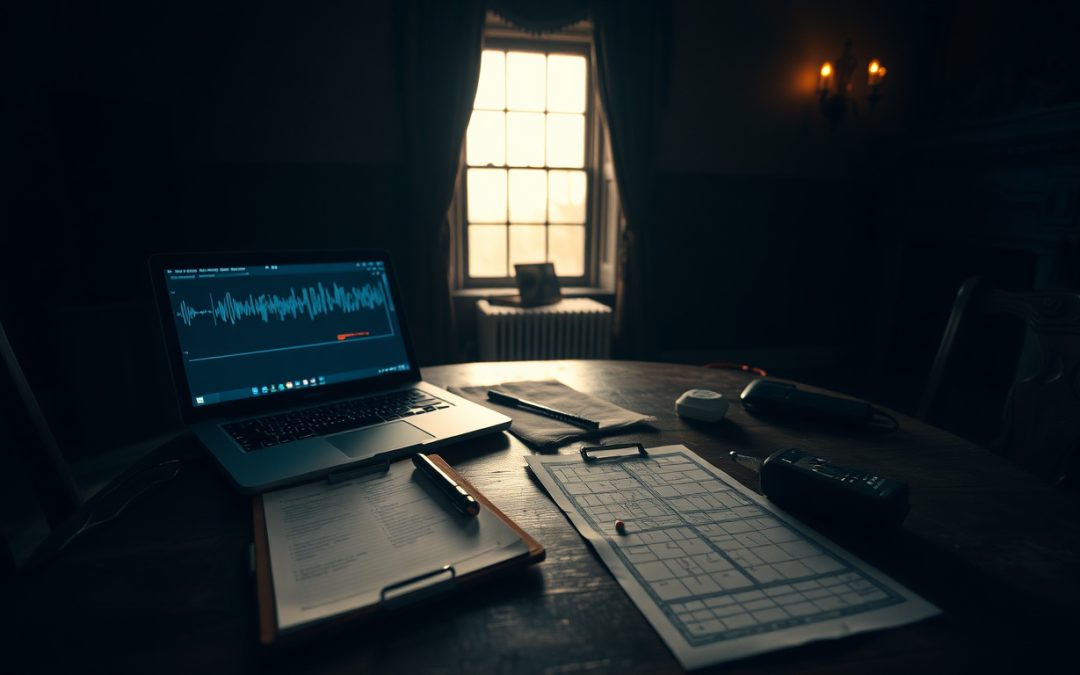
Clients trust what they can see and hear for themselves. Rather than describing an audio anomaly in vague terms, play it. Show the waveform. Demonstrate that the original recording is untouched and that your enhancement only made an existing sound easier to hear. Transparency about method is more persuasive than any claim you could make.
For audio, a non-destructive review workflow matters enormously. With a tool like the DeadAir Audio Analyzer Pro, you can isolate, slow, and mark a possible EVP event while keeping the original file intact — so when a client or a skeptical relative asks whether you altered anything, you can prove you didn’t. The honest answer to “did you edit this?” should always be a clear demonstration, not a promise.
Video deserves the same discipline. Stepping through footage frame by frame and showing movement detection against an unaltered original lets a client see the difference between a genuine change in the scene and a compression artifact or a bug crossing the lens. A video analyzer that keeps a RAW A/B comparison makes your enhancements accountable. For photographs, inspecting metadata and comparing original to enhanced versions side by side helps explain why a “figure” in the window is almost always a reflection or a trick of low light.
Use a Map So Findings Have a Place
Abstract findings are hard to follow. “We recorded a temperature drop” lands differently than “we recorded a temperature drop here, in the corner of the nursery, next to this exterior wall.” A visual layout of the location, with rooms marked and evidence pinned to where it occurred, turns a list of events into a coherent picture.
Mapping also reveals patterns you might otherwise miss. If every “anomaly” clusters along one wall that happens to back onto a furnace or a busy road, that spatial relationship often points straight at the mundane cause. A tool such as SpecterGrid for location mapping lets you build that layout and drop evidence pins so the client can see exactly where each reading came from.
Deliver a Written Report They Can Keep
The verbal conversation matters, but people absorb a fraction of what they hear when they’re emotional. A clean, written report gives them something to revisit when the room is calm. It also protects you, because it pins down precisely what you concluded and on what basis.
A strong paranormal investigation report includes the original complaint, your methodology, the equipment used, the environmental conditions, a clear inventory of evidence with debunks noted, and a measured conclusion. Resist the urge to inflate. “We found no evidence of activity beyond ordinary household causes” is a complete and valuable result. So is “one audio event remains unexplained after we ruled out the following sources.” Both are honest. Both are useful.
Avoid certainty you haven’t earned. The phrase “we cannot explain this” is not the same as “this is paranormal,” and a careful report never lets the reader confuse the two.
Match the Conclusion to the Client’s Needs
Some clients want validation that they aren’t imagining things. Some want reassurance that they’re safe. Some quietly hope you’ll tell them nothing is there. Your conclusion should be the same regardless of what they want to hear — but how you deliver it can be humane.
If you found ordinary explanations for everything, frame that as good news rather than a letdown. A buzzing transformer, a settling foundation, drafts from old windows — these are fixable, knowable things. If something remains genuinely unexplained, say so plainly, and be honest that “unexplained” means exactly that and nothing more. Never prescribe a remedy for a problem you haven’t established exists.
The Standard That Holds Up
Good paranormal research is judged not by how dramatic its conclusions are, but by how well its reasoning survives scrutiny. The best presentations are the ones where a skeptical engineer, an anxious homeowner, and a curious teenager could all read the same report and agree that the investigator was fair, thorough, and honest about the limits of what the evidence could show.
That’s the standard worth holding yourself to. Take the experience seriously, test it harder than the client would, and then tell them the truth in a way they can understand and keep. If you want to sharpen the workflow behind that kind of careful reporting — from intake to analysis to the final document — you can explore the research and field methods at Lodestra and see how a disciplined, evidence-first approach comes together in practice.