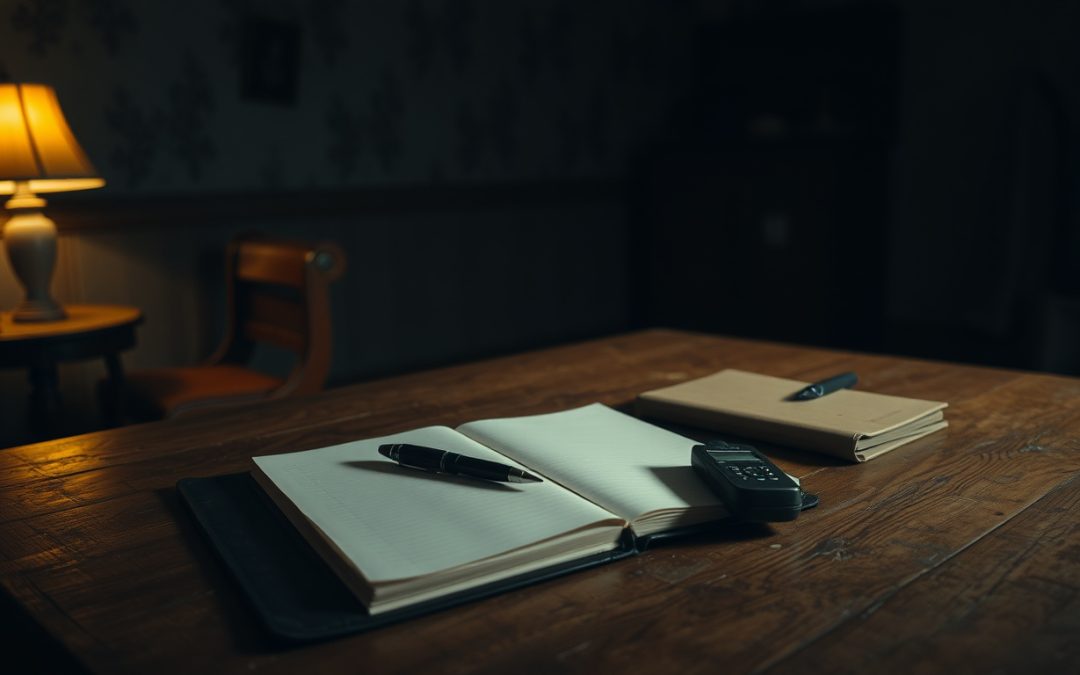
Before a single camera is set up or an audio recorder is switched on, the most important work in paranormal research happens across a kitchen table. The client interview is where a case is either built on solid ground or quietly undermined by sloppy note-taking and leading questions. A good interview captures what a person actually experienced. A bad one captures what the investigator wanted to hear.
Most people underestimate how much a careful conversation can reveal. In a large share of cases, the interview alone points toward a mundane cause — a furnace cycling on at 3 a.m., a spouse who works night shifts, a recent medication change, a house with a history the client half-remembers. The Lodestra Razor applies here as much as anywhere: rule out the ordinary before reaching for the extraordinary. The interview is your first and best chance to do that.
This article covers how to document client interviews so the record holds up — to your own later review, to the rest of your team, and to the client who trusted you with something unsettling.
Why the Interview Is the Backbone of Paranormal Investigation
Instruments measure conditions. People report experiences. Those are different things, and a serious paranormal investigation depends on keeping them straight. An EMF meter tells you about electromagnetic fields. A thermometer tells you about temperature. Neither tells you why a client wakes up every night at the same hour convinced someone is standing in the doorway. Only the interview can start to answer that.
Testimony is evidence, but it is a specific and fragile kind of evidence. Human memory is reconstructive, not photographic. Every time a person recalls an event, they rebuild it, and small details shift. Emotion, expectation, and the questions you ask can all reshape a memory without the person ever noticing. This is not a flaw in your clients. It is how memory works in everyone, including you.
Because of that, the way you document an interview matters as much as the interview itself. If your notes blur the line between what the client said and what you inferred, the whole case inherits that confusion. Clean documentation is not bureaucracy. It is intellectual honesty made practical.
Prepare Before You Ask a Single Question
Good documentation starts before the conversation. Walk in with a plan and a consistent structure, so every case is recorded the same way and nothing important gets skipped.
Get Consent and Set the Terms
Always ask permission to record, and record that you asked. Explain what the recording is for, who will hear it, and how it will be stored. In many places, recording a conversation without consent is illegal, and beyond the law, it is simply a matter of respect. If a client declines to be recorded, honor it and rely on written notes.
Be clear about what you are and are not offering. You are documenting an experience and looking for explanations, ordinary ones first. You are not there to confirm a haunting or to perform a cleansing. Setting that expectation early protects both the client and the integrity of your paranormal research.
Build a Consistent Interview Template
Use the same core questions for every case. A repeatable structure makes it far easier to compare notes across investigations and to notice when something genuinely unusual stands out. At minimum, capture:
- Who experienced what, and who else was present
- The date, time, and exact location of each reported event
- What the person was doing immediately before and after
- Sensory details — what they saw, heard, felt, or smelled
- Whether the experience has a pattern or trigger
- The physical and medical context: sleep, medication, stress, alcohol, recent life changes
- The building’s age, history, recent renovations, and known quirks
Ask Questions That Don’t Contaminate the Answer
The single most common way investigators damage their own cases is by asking leading questions. “Did you feel a cold spot when the figure appeared?” plants two claims — a cold spot and a figure — that the client may simply agree with to be helpful. Once that answer is in your notes, it looks like independent testimony. It isn’t.
Ask open questions instead. “Tell me what happened, from the beginning.” “What did you notice next?” “Describe the room.” Let silence do some of the work; people often fill a pause with the detail they were hesitant to volunteer. Save your specific follow-ups for after the client has told the story in their own words, and always note when a detail came from your prompt rather than theirs.
Separate Observation From Interpretation in Your Notes
When you write up an interview, keep two columns in your mind, and ideally on the page. One is what the client reported observing: “heard three knocks on the wall around 2 a.m.” The other is interpretation: “client believes it was trying to communicate.” Both belong in the record, but they must never be blended into a single sentence that reads as fact.
This discipline is the heart of evidence-based paranormal investigation. Months later, when you review the case, you want to know precisely what was seen versus what was concluded. A note that reads “spirit knocked three times” has already made a claim the evidence can’t support. A note that reads “client reports three knocks, source not located during walkthrough” leaves the question open, which is where it belongs.
Capture the Mundane Explanations While You’re There
The interview is your best opportunity to gather the raw material for debunking. You are rarely in a better position to ask about drafts, plumbing, traffic patterns, and the neighbor’s habits than while sitting in the room where the events happened. Treat every reported phenomenon as a question, not a conclusion.
- Sounds: old houses settle, pipes hammer, HVAC systems tick and groan on a schedule. Ask when the heating runs.
- Cold spots: check for single-pane windows, uninsulated exterior walls, chimney flues, and gaps around doors.
- Feelings of unease or a “presence”: low-frequency sound (infrasound) from fans, traffic, or machinery has been associated in research with feelings of dread and the sense of being watched. Ask about nearby equipment.
- Shadow figures and movement in peripheral vision: the eye’s periphery is poor at detail and prone to false motion, especially in low light and when someone is tired or anxious.
- Electrical sensations, nausea, or visual distortion: worth noting alongside any question about carbon monoxide sources, which can cause exactly these symptoms and is a genuine safety issue you should flag immediately.
Documenting these possibilities is not about dismissing the client. It is about doing right by them. If the “presence” in the basement turns out to be a failing appliance leaking gas, you may have saved a life. That outcome is a legitimate and important result of paranormal research, even if it never involved anything paranormal at all.
Turn Raw Testimony Into a Structured Case File
An interview scribbled across loose pages is worse than useless six months later, when memory has faded and you’re trying to reconcile it with your field data. The goal is a structured record: timestamped, searchable, and clearly attributed. Note who said what, when they said it, and whether the detail was volunteered or prompted.
A dedicated Paranormal Case File Manager is built for exactly this kind of continuity — logging witnesses, location history, room-by-room readings, and the debunks as they happen, so the interview connects cleanly to everything that follows. Keeping the whole investigation in one structured file means the interview isn’t an isolated document. It becomes the first entry in a timeline that ends with a conclusion you can actually stand behind.
If your interview surfaces specific locations — “the figure always appears at the end of the upstairs hall” — it helps to map them precisely rather than describe them vaguely. Tools like the SpecterGrid Location Mapper let you build a layout of the scene and drop pins where events were reported, so testimony and physical space line up in a way words alone rarely manage.
Cross-Check Multiple Witnesses Independently
When several people share a home, interview them separately when you can. Shared retelling tends to converge on a single “official” version, and details get smoothed over. Independent accounts that agree on specifics carry real weight. Accounts that diverge in interesting ways are just as valuable — the differences often reveal that people are describing ordinary events colored by their own expectations.
A Note on Honesty With the Client
Document what you don’t know as carefully as what you do. If you can’t explain something after a thorough investigation, say so plainly: unexplained is not the same as paranormal. It simply means the ordinary causes you tested didn’t account for it. That honesty is what separates serious paranormal research from theater, and clients — even frightened ones — almost always respect it.
The best interview record is one that lets a skeptical stranger read it and reach their own conclusion. If your documentation only makes sense to someone who already believes, you’ve written advocacy, not evidence.
Bringing It Together
Careful client interviews are the quiet foundation of good paranormal research. They gather the testimony, surface the ordinary explanations, and set the boundaries of what your later fieldwork needs to explain. Do them with consent, open questions, clean separation of fact and interpretation, and a structured record, and you’ll solve more cases at the kitchen table than you ever will with a camera.
If you want to see how disciplined documentation and honest evidence handling fit into a full investigation workflow, explore the field methods and research at Lodestra. The tools matter, but the habit of asking better questions matters more.