
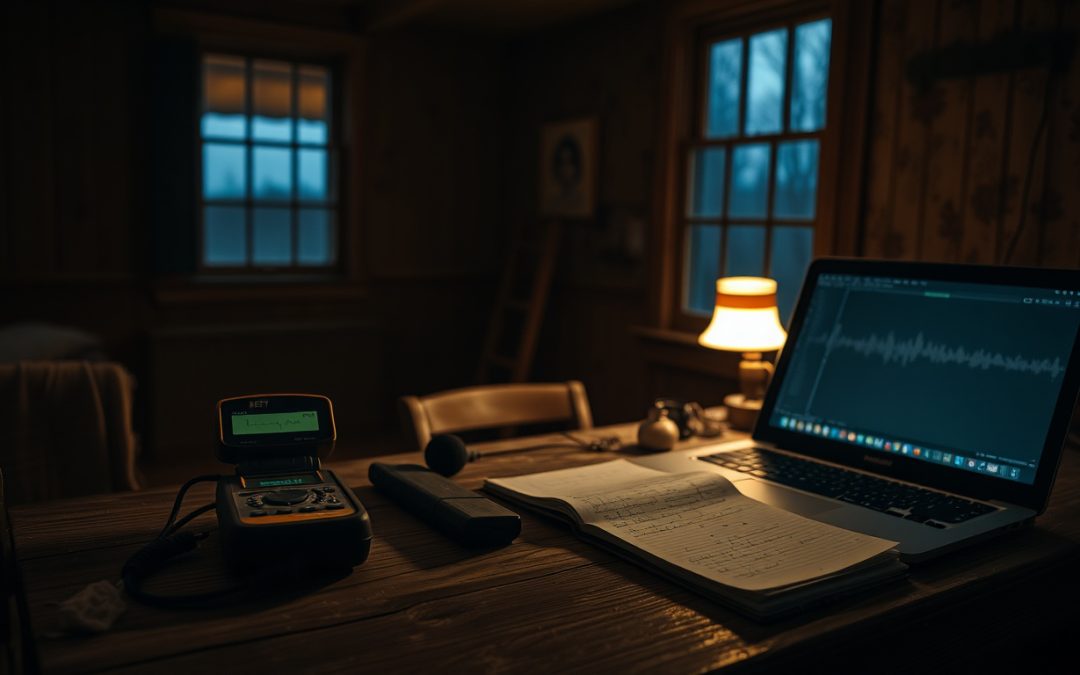
A weak case file reads like a campfire story. A strong one reads like a record someone else could pick up, follow step by step, and check against reality. That difference is the whole game in serious paranormal research. The phenomena people report are often genuinely strange to them, and they deserve to be taken seriously — but taking an experience seriously is not the same as accepting an explanation uncritically. The case file is where those two ideas meet. It is the discipline that turns a memorable night into something closer to data.
Most files fall apart for ordinary reasons. Times get recorded loosely or not at all. Nobody noted the weather, the building’s heating cycle, or who else was in the room. A striking audio clip exists, but there’s no record of where the recorder sat or what was happening when the sound occurred. Months later, the investigator remembers the goosebumps and forgets the open window. Memory is generous that way, and it almost always fills gaps in favor of the more interesting story.
This guide walks through how to build a case file that resists that drift — one organized enough to support real paranormal investigation and honest enough to admit when the most likely answer is mundane.
Why the Case File Matters More Than the Equipment
It’s tempting to think the heart of an investigation is the gear. Meters, recorders, cameras. They matter, but they’re tools, and tools only produce evidence worth keeping when the surrounding documentation gives that evidence meaning. A spike on a meter means nothing without a note about what caused it, when it happened, and whether anyone touched the wiring nearby.
The field that became parapsychology learned this the hard way. When researchers at institutions like Duke University tried to study claimed psychic effects in the early twentieth century, their results were taken seriously only to the degree that their records and controls were tight. The lesson generalizes well beyond the lab: an observation is only as strong as the documentation that surrounds it. The case file is not paperwork you do after the interesting part. It is the interesting part, organized so it can survive scrutiny — including your own, six months later, when the emotion has faded.
The Lodestra Razor in Practice
The house philosophy at Lodestra is simple to state and hard to live by: rule out the ordinary before reaching for the extraordinary. In a case file, that means every anomaly gets a column for natural explanations tested and ruled out. Drafts. Infrasound. Electromagnetic interference. Pareidolia. Suggestion. Settling structures and old plumbing. If you can’t show that you looked for the boring answer first, your file hasn’t earned the right to call anything unexplained.
Start Before You Arrive: Intake and Background
A strong file begins at the first phone call, not at the front door of the location. Intake is where you capture the witness account while it’s fresh and before your presence has shaped it. Record who contacted you, when, and how. Get the experiences in the witness’s own words, with as little leading as possible. Ask open questions — “tell me what you noticed” — rather than “did you feel a cold presence,” which plants the answer you’ll later hear repeated back.
Background research belongs here too. The actual history of a property, not the legend attached to it. Property records, old maps, prior occupants, renovation dates. Many “haunted” reputations dissolve once you learn the dramatic backstory was invented decades after the fact. Just as often, the mundane history explains the phenomena directly: a furnace replaced in a certain year, a room added over a crawlspace, a neighbor’s industrial equipment that runs on a schedule.
Capture the Environment Honestly
Before anything else, log the baseline. Temperature, humidity, weather, and the building’s mechanical systems. Note electrical wiring, known sources of electromagnetic fields, and any structural quirks. An EMF meter is useful here, but be clear about what it does: it measures electromagnetic fields. It does not detect spirits, and a reading near old knob-and-tube wiring or a microwave tells you about the wiring, not the afterlife. Recording these baselines isn’t busywork. It’s the control group for everything that happens later.
Documenting Evidence So It Holds Up
When you capture audio, video, or photos, the raw file is only half of what you need. The other half is context: timestamp, location, device, settings, and what was happening in the room. A possible EVP — electronic voice phenomenon — means very little if you can’t say where the recorder sat, whether a window was open, or whether someone shifted in a chair at that exact moment. Context is what separates an artifact from evidence.
Protect the Original Files
Treat your original captures the way a forensic lab treats samples. Never edit the master. Work on copies, and keep a record of every change you make. This is where evidence integrity tools matter. The Lodestra Case File Manager uses SHA-256 hashing, which produces a unique digital fingerprint of a file. If even one bit of that file changes later, the fingerprint changes too — so you can demonstrate that your original was never quietly altered. That kind of integrity check won’t make a clip more paranormal, but it makes your documentation defensible, which is the point.
Analyze Each Medium With Its Own Discipline
Audio, video, and photos each fail in their own ways, and each deserves its own careful review rather than a quick glance.
- Audio. Most apparent EVPs are stray radio bleed, the recorder’s own handling noise, distant speech, or the brain’s tendency to hear words in random sound. Reviewing waveforms and spectrograms, noting exactly where a sound sits in the recording, and logging what you ruled out is the honest workflow. A tool like the Lodestra EVP-1 Audio Analyzer brings waveform review, spectral analysis, and marker tagging into one workspace so you can document a clip without overselling it.
- Video. Dust close to the lens, insects, lens flare, compression artifacts, and reflections account for an enormous share of “anomalies.” Careful frame-by-frame review and honest motion checks — the kind the Lodestra VID-1 Video Analyzer is built for — help you tag what’s genuinely unexplained and dismiss what isn’t.
- Photos. Orbs are almost always dust or moisture caught by the flash. Faces in shadows are pareidolia. Reading the EXIF metadata, checking light and shadow consistency, and comparing against control images keeps you grounded.
Writing the Narrative and Timeline
A case file needs a spine: a clear chronological timeline that anyone can follow. When did the team arrive? When were baselines taken? When did each reported event occur, and who witnessed it? A timeline exposes coincidences that emotion hides. That “cold spot” felt at 9:14 might line up exactly with the furnace cycling off, a fact nobody notices in the moment but the record makes obvious.
Write the narrative in plain, measured language. Resist loaded words. “The temperature dropped four degrees over two minutes near the east window” is a record. “An icy presence swept through the room” is a story dressed up as one. The first can be checked. The second can only be believed or doubted. Good paranormal investigation documentation always favors the version that can be checked.
Separate Observation From Interpretation
Keep two distinct layers in every file. The first is what was observed — measurements, timestamps, recordings, witness statements. The second is what it might mean. Never let the second contaminate the first. You can speculate freely in an interpretation section, as long as it’s labeled as speculation and kept apart from the raw record. This separation is one of the most reliable markers of serious work, and one of the easiest to skip when a night feels exciting.
The Honest Conclusion
The hardest section to write well is the conclusion, because the honest answer is usually “we found a likely ordinary cause” or “we found nothing conclusive.” Both are legitimate, useful outcomes. A file that ends in a ruled-out draft is a success, not a failure — you answered the witness’s question and you didn’t manufacture a mystery. The rare case that survives every reasonable mundane explanation is far more interesting precisely because you tried so hard to explain it away and couldn’t.
Report your findings in language that matches your evidence. If you have an unexplained audio clip with solid documentation, say exactly that: unexplained, well-documented, not proven to be anything in particular. Avoid declaring contact, presence, or proof. Witnesses, clients, and your future self all benefit from a report that never claims more than the record supports.
Tools That Keep the Workflow Honest
None of this requires expensive software, but consistent structure helps enormously, especially across a team. A local-first case manager that runs on your own machine — no cloud upload, no account — keeps sensitive witness information private and your evidence chain intact. The value isn’t that the software finds ghosts. It can’t, and no honest tool claims to. The value is that it makes good paranormal research habits the path of least resistance: standard intake fields, baseline logs, evidence hashing, timelines, and reports that read like documentation rather than fiction.
Bringing It Together
A strong case file is built from unglamorous parts. Careful intake. Honest baselines. Protected originals. Disciplined review of each piece of evidence. A clear timeline. A conclusion that respects the limits of what you found. Do those things consistently and you’ll produce work that holds up — to skeptics, to clients, and to your own scrutiny later. You’ll also find that the genuine mysteries get easier to spot, because they’re the ones still standing after you’ve cleared away everything ordinary.
That’s the whole promise of evidence-based paranormal research: not louder claims, but cleaner ones. If you want to see how this approach translates into practical field methods and documentation, explore the research and field tools at Lodestra and build your next case file the way a careful investigator would.