
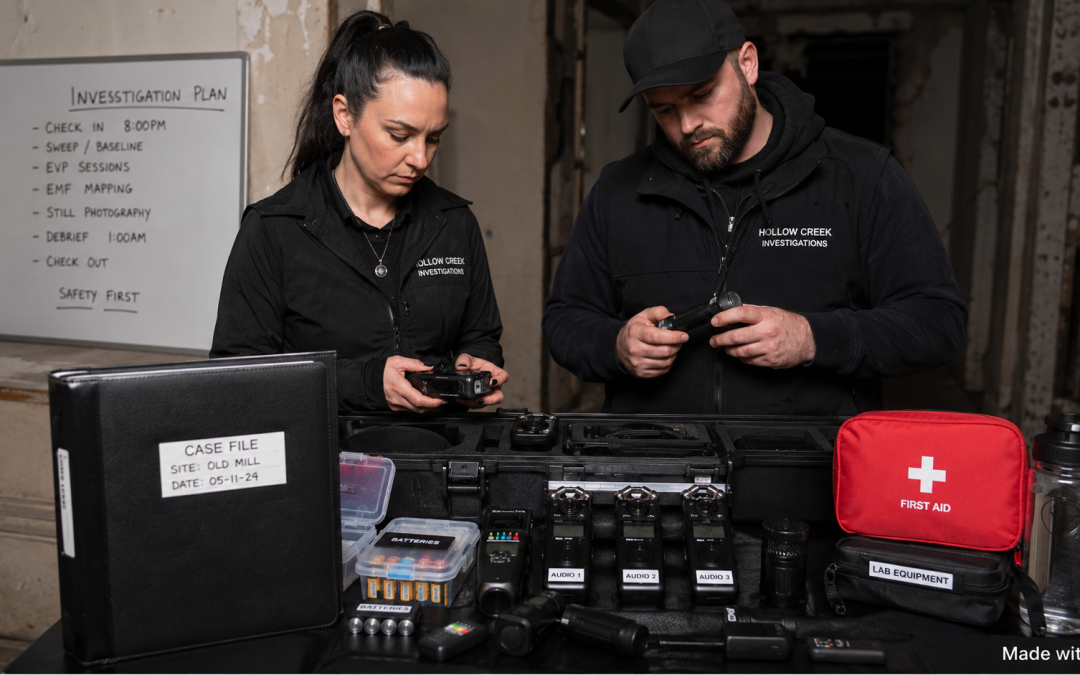
Paranormal Research · Technology & Investigation
How to Build a Better Paranormal Investigation Plan Before You Arrive
The most important work in paranormal investigation is rarely dramatic — it happens before the lights go out
A paranormal investigation does not begin when the lights go out. It begins earlier, often days or weeks before anyone walks through the door, sets up a camera, or presses record on an audio device.
The most important work is rarely dramatic. It is the quiet work: reading, asking careful questions, defining what is actually being investigated, separating history from folklore, identifying environmental factors, creating a documentation plan, and deciding what would count as meaningful evidence before the team is standing in the dark trying to interpret every sound.
A better investigation plan does not make a team less open-minded. It makes the team more useful — helping investigators avoid chasing rumors, misreading equipment, overwhelming witnesses, or turning a complicated human experience into a shallow ghost story.
What Is Known, What Is Uncertain, and What Must Be Framed Carefully
In most paranormal cases, there are several layers of information. Confusing those layers is one of the easiest ways to weaken an investigation.
Layer 01
Known History
Information supported through credible sources: property records, newspapers, census records, death records, maps, court documents, or books by qualified historians.
Layer 02
Reported Experience
What witnesses say happened. These accounts matter, but they are not the same as verified events. Document carefully, look for patterns, consider possible explanations.
Layer 03
Folklore & Legend
Stories passed through families, communities, tour scripts, or word of mouth. Valuable as data about belief and memory — but not documented fact unless independently verified.
Layer 04
Interpretation
The meaning people attach to events. An investigator can record interpretation while still distinguishing it from the event itself.
Layer 05
Uncertainty
Not failure. In serious field research, uncertainty is often the honest conclusion. A better plan begins by respecting this rather than papering over it.
Start With the Real Question
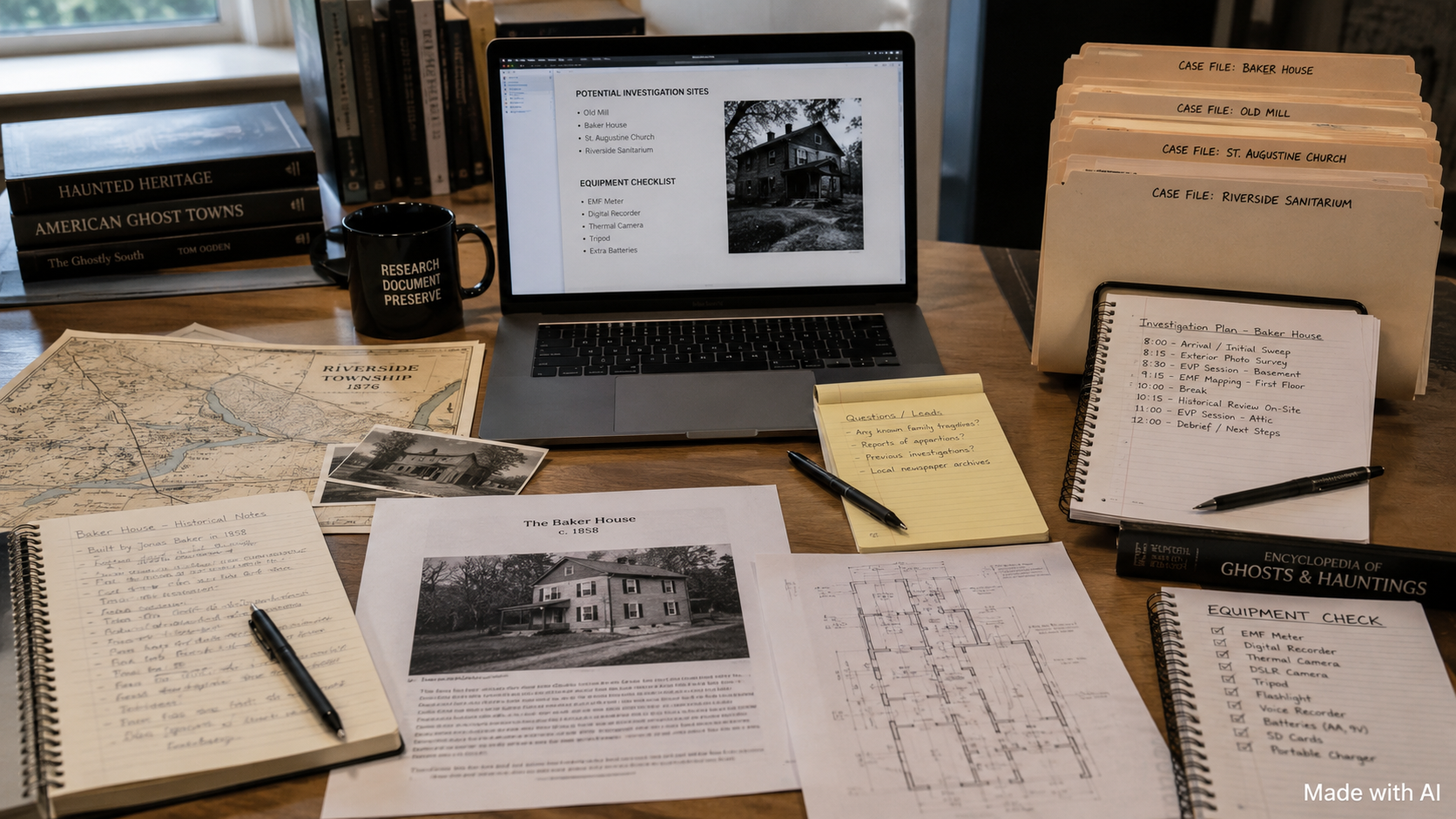
Many investigations begin with a vague goal: "Find out if the place is haunted." That may sound simple, but it is too broad to be useful. A better plan begins with a more specific research question. What exactly is being investigated?
Is the team investigating repeated reports of footsteps in a hallway? A specific apparition claim? Audio anomalies in one room? A family's experiences after moving into a house? A historic property where folklore has become tangled with documented tragedy? The question shapes the investigation entirely. Without a clear question, teams often collect hours of disconnected audio, video, EMF readings, and personal impressions — and later struggle to interpret any of it because they never defined what they were looking for.
A Better Research Question
Turn "Is it haunted?" into something more disciplined: "What experiences have been reported, where do they happen, when do they happen, who reports them, what natural conditions are present, what historical or folkloric narratives surround the location, and what documentation would help evaluate the claims responsibly?" That question is less dramatic, but far more useful.
Separate the Location From the Legend
Haunted locations often carry stories that become stronger with repetition. A building may be associated with a tragic death, an unnamed woman in white, a child's voice, a Civil War soldier, a murder, or a secret tunnel. Some of these stories may be historically documented. Some may be exaggerated. Some may be tourist folklore added decades after the fact.
Before arriving, build a basic historical profile of the location and keep it separate from the paranormal narrative. This does not mean every old building with hardship in its past is haunted. A documented death does not automatically explain a reported apparition. The plan should also include a separate folklore profile — labeling those stories clearly as tradition, not evidence.
The Labeling Test
"Local folklore associates the second-floor hallway with the figure of a woman, but no verified identity has been established." That is honest. "The ghost of a woman haunts the second floor" is not — it turns tradition into fact. A serious team should not strip away folklore, but it must not confuse folklore with evidence.
Research the Building as a Physical Environment
Paranormal investigators often focus on equipment, but the building itself is one of the most important instruments in the case. It produces sound, movement, temperature changes, drafts, vibrations, reflections, electrical interference, and psychological effects. Before arriving, gather as much practical information as possible.
Environmental questions to answer before arrival
- What is the building made of? Wood, brick, stone, concrete, plaster, metal framing, or modern drywall?
- Are there basements, crawlspaces, attics, chimneys, elevators, old pipes, loose windows, or uneven floors?
- Is the building near a road, train line, bar district, river, industrial facility, church bells, or parking garage?
- Are there animals on site or nearby? Security systems, motion sensors, automatic lights?
- Are there HVAC units, sump pumps, dehumidifiers, old radiators, or refrigerators?
Interview Witnesses Before the Investigation
Witness interviews are often the most valuable part of a case, but they need to be handled carefully. The goal is to document experience without leading the witness. A weak interview asks: "Did you see the ghost in the hallway?" A better interview asks: "Can you describe what happened, starting with where you were and what you noticed first?" The first question plants an interpretation. The second invites a narrative.
Before arriving, speak with witnesses individually when possible. Group interviews can contaminate memory because people may adjust their accounts to match others. Human memory is social, flexible, and influenced by suggestion, emotion, repetition, and expectation — not because witnesses are dishonest, but because that is how memory works. Use neutral language throughout: "That is helpful. I'm going to document it as reported and compare it with the location conditions and other accounts."
Define Claims by Type
Once interviews and preliminary research are complete, organize the claims into categories. This helps the team decide what methods are appropriate and prevents every reported experience from being treated as equivalent.
Common claim categories and what they require
- Auditory Footsteps, knocks, voices, music, whispers, dragging sounds, or doors closing. Requires sound mapping and thorough contamination control.
- Visual Shadows, figures, lights, movement, reflections, or apparitions. Requires careful camera placement, sight line testing, and lighting analysis.
- Physical Objects moving, doors opening, touches, pressure, or equipment interference. Requires controlled baselines and documentation of all team movement.
- Environmental Cold spots, heat changes, unusual odors, electrical disturbances, or battery drain. Requires baseline readings and repeated measurements across time.
- Subjective Feelings of being watched, sudden dread, dizziness, emotional shifts, or impressions. Requires careful documentation of expectation, stress, fatigue, and prior knowledge.
- Pattern-based Activity tied to certain rooms, dates, times, weather, renovations, or particular people. May require multiple visits and long-term logging to evaluate.
Establish Baseline Conditions
Baseline documentation is one of the most neglected parts of paranormal investigation. Many teams take readings only when something unusual seems to happen. That makes it difficult to know whether the reading is actually unusual. A baseline is the ordinary condition of the location before the investigation begins.
Temperature, humidity, ambient sound levels, EMF near outlets and appliances, air movement near doors and vents, and lighting conditions should all be documented. If possible, baselines should be taken at more than one time — a building may behave differently in the afternoon than at midnight. HVAC cycles, traffic, weather, and human activity can all change. Equipment does not interpret itself. A meter reading is not a conclusion. It is a measurement that requires context.
Avoid Equipment Theater
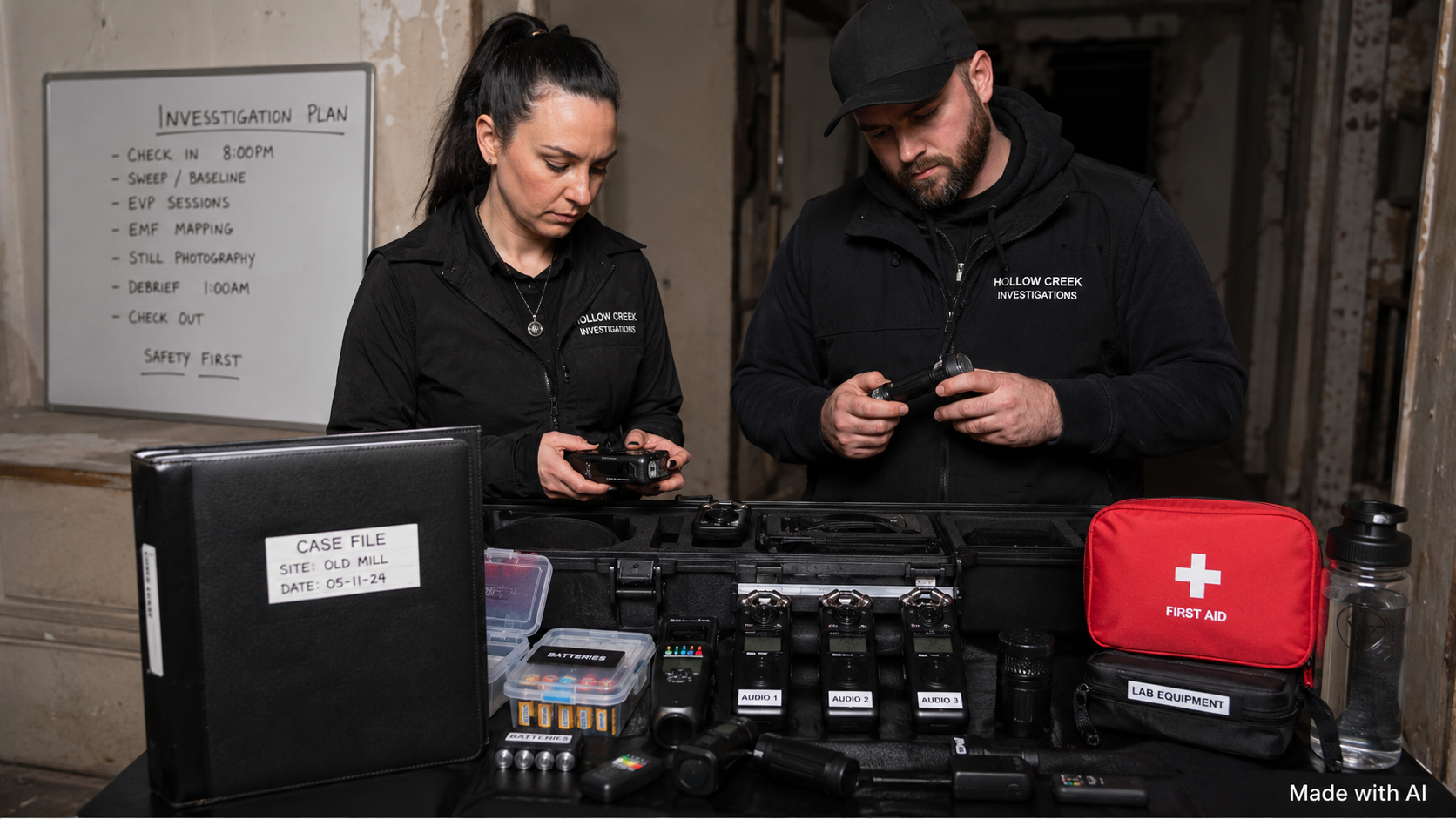
Paranormal investigation has become closely associated with devices: EMF meters, recorders, spirit boxes, REM pods, thermal cameras, motion sensors, and custom-built tools. Equipment can be useful, but only when the team understands what it measures and what it does not. An EMF meter measures electromagnetic fields. It does not measure ghosts. A thermometer measures temperature. It does not identify a spirit.
The investigation plan should list every device being used and define its purpose. This prevents equipment theater, where devices are used mainly because they look impressive or create excitement. A better approach is to use fewer tools more carefully. A simple setup with clean documentation is often more valuable than a room full of blinking lights that nobody can interpret later.
Create a Floor Plan Before the Case
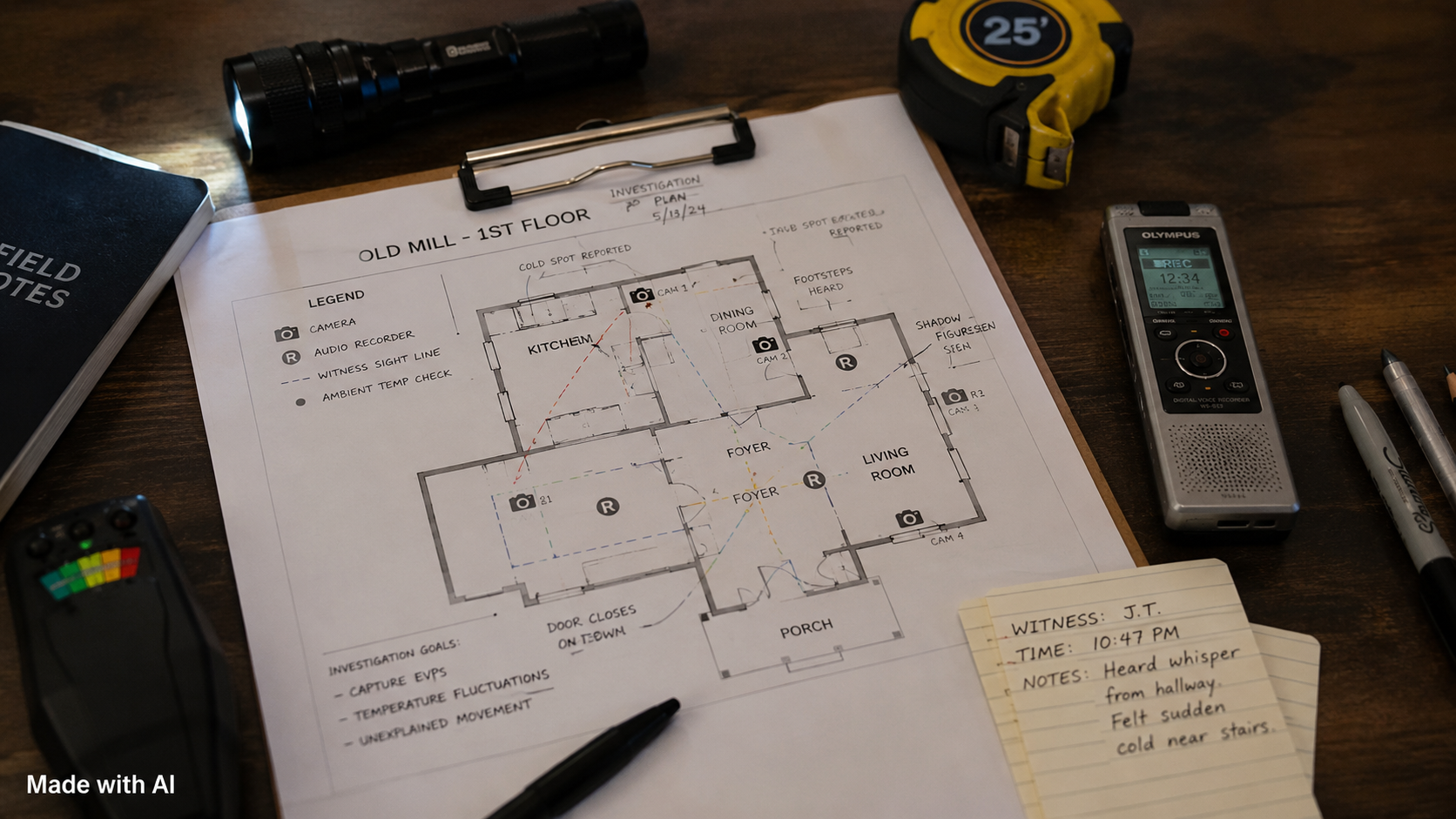
A floor plan is one of the most useful tools in paranormal investigation. Before arriving, ask whether one exists. If not, prepare to create one during the initial walkthrough. Mark rooms, doors, windows, staircases, vents, electrical panels, appliances, mirrors, fireplaces, exterior roads, and reported activity areas. Then mark equipment positions: cameras, audio recorders, environmental sensors, trigger objects, team locations, and control areas.
The floor plan allows later review to become spatial instead of chaotic. If a knock is heard at 10:42 p.m., where was everyone? Which recorder captured it? Which camera covered the hallway? Was someone above, below, outside, or near plumbing? Without a floor plan, teams rely on memory. Memory after a long night in the dark is not enough.
Plan for Audio and Video Contamination
Before arriving, build an audio plan. Identify outside noise sources — traffic, pedestrians, animals, wind, trains, aircraft, machinery — and inside noise sources — HVAC, pipes, appliances, floorboards, team movement, clothing, phones, and camera straps. Every person present should be logged. Every movement should be called out clearly. A disciplined audio session includes a clear start time, a sound sweep before the session begins, verbal tagging of known sounds, minimal movement, and a clear end marker.
For video, decide what each camera is meant to observe before placing it. Camera placement should account for mirrors, windows, reflective surfaces, moving curtains, dust, insects, headlights, infrared bounce, and shadows from team members. For visual claims, sight line testing matters: stand or sit in the exact position the witness described and look for reflections, streetlights, passing cars, and shadow paths. One camera shows an event. Two cameras can help locate it. Three cameras, placed intelligently, can sometimes separate a local event from a camera artifact.
Include Psychological and Social Context
A grounded investigation plan should include psychology, not as a way to dismiss witnesses, but as a way to understand human experience. People perceive the world through expectation, memory, emotion, attention, and culture. In dark or ambiguous environments, the brain looks for patterns. A shadow may become a figure. A random sound may become a word. Prior stories can shape what people notice. Fear changes perception. So does fatigue. So does grief.
The plan should consider: What does the witness already believe about the location? Did they know the stories before the experience? Were they alone? Were they frightened, stressed, or grieving? Has the story changed through retelling? These questions should be asked respectfully. A witness is not a suspect — but investigators should not ignore the human side of the case.
Decide What You Will Not Do
A good plan includes boundaries. Will the team use provoking language? Will they allow clients to participate in sessions? Will they investigate private bedrooms? Will they post findings publicly? Will they name witnesses? Will they share audio clips without consent? Will they investigate if children are involved? Will they continue if someone becomes distressed? These questions should be answered before arrival.
Ethics matter. Paranormal investigation often enters vulnerable spaces: homes, historic tragedies, grief, fear, family conflict, sacred places, and culturally sensitive locations. Investigators should not treat people's distress as entertainment. No piece of evidence is worth injury, and no ghost story is worth compromising the dignity of real people or real places.
Build a Documentation System
An investigation without documentation becomes a collection of stories. Before arriving, prepare the case file structure. Each piece of media should be named consistently. A file called "audio1finalnew.wav" will become useless quickly. A better naming system includes date, location, room, device, and session number — for example: 2026-06-13_LocationName_SecondFloorHall_AudioRecorder03_Session02.wav.
What a complete case file should contain
- Case number, location, date, time, weather, and team members
- Consent forms and witness contact documentation
- Historical notes and folklore notes, kept clearly separate
- Interview summaries with original witness language preserved
- Claim categories and floor plan with equipment positions
- Baseline readings for temperature, humidity, EMF, and ambient sound
- Live timeline with movements, sessions, events, and external noises logged
- Audio log, video log, photo log, and environmental log
- Debunking notes and contamination records
- Final assessment with conclusions, limitations, and recommended follow-up
Establish Evidence Review Standards Before You Collect Evidence
One of the biggest mistakes in paranormal investigation is deciding what counts as evidence after something exciting happens. Before the investigation begins, establish review standards. How many reviewers will examine audio clips? Will reviewers be blind to the expected phrase before listening? Will alternative explanations be listed? Will video anomalies require multiple camera angles? How will subjective impressions be separated from recorded data?
The plan should make room for honest categories: Explained. Likely natural. Inconclusive. Unidentified. Interesting but insufficient. Requires follow-up. Not usable due to contamination. Not every anomaly deserves to become evidence.
A better paranormal investigation plan is not about removing wonder. It is about earning the right to be curious. The unexplained deserves better than careless certainty. Witnesses deserve better than dismissal. Evidence deserves better than being built around excitement after the fact.
The best investigation begins before arrival because that is where discipline begins. By the time the team steps into the location, the most important decision has already been made: whether they are there to confirm a story, or to investigate one.