Play a rough audio clip for a room full of people and tell them it says “get out.” Most of them will hear “get out.” Play the same clip cold, with no prompt, and you’ll get a scatter of guesses — or nothing at all. That single experiment captures the central problem in paranormal research: the mind is not a neutral recording device. It fills gaps, favors the familiar, and hears what it’s been primed to hear. Confirmation bias — our tendency to notice, remember, and weight evidence that supports what we already believe — is the most persistent obstacle in any serious paranormal investigation.
It isn’t a character flaw. It’s how human cognition works, and it operates below awareness. You don’t feel biased while you’re being biased; you feel like you’re simply observing. That’s exactly what makes it dangerous. A draft becomes a presence. A pixel becomes a figure. A stray syllable in tape hiss becomes a message. None of this requires dishonesty — only a normal brain doing what brains do. The goal of good method is not to eliminate that machinery, which is impossible, but to build guardrails around it.
This is the heart of the Lodestra Razor: rule out the ordinary before reaching for the extraordinary. And the ordinary explanation you’re most likely to overlook is the one happening inside your own head.
Why Confirmation Bias Thrives in Paranormal Research
Paranormal work sits in an unusually fertile environment for bias. The stimuli are ambiguous by nature — faint audio, low-light video, fleeting sensations. Ambiguity is fuel. When a signal is clear, there’s little room for interpretation. When it’s degraded, the brain leans on expectation to decide what it “must” be.
Add emotional investment. People come to investigations wanting an answer, sometimes desperately. A grieving family hopes a voice on tape belongs to someone they lost. An investigator who has spent years in the field wants the long hours to mean something. Motivation shapes perception, and it does so silently.
Then there’s the social element. Groups amplify bias through suggestion. If one person announces they feel a cold spot, others begin to notice the cold. If someone says a photo looks like a face, the face becomes harder to un-see. This is not weakness; it’s ordinary social cognition. But in a field where the raw material is already ambiguous, it can turn a quiet room into a haunting through consensus alone.
A Short History Worth Knowing
Parapsychology has wrestled with these problems for well over a century, and its most honest chapters are the ones where researchers caught themselves. Early Spiritualist-era investigators were repeatedly fooled by mediums whose “phenomena” collapsed under controlled conditions. Later, laboratory parapsychology introduced randomization, blind scoring, and statistical controls precisely because informal observation had proven so unreliable.
The lesson from that history is not that everything is fake. It’s that sincere, intelligent people were fooled again and again — and the ones who advanced the field were those who assumed they too could be fooled and designed their methods accordingly. Modern paranormal research inherits that responsibility.
How Bias Corrupts Each Type of Evidence
Different evidence types invite different flavors of the same error. Knowing the specific trap helps you set the specific guardrail.
Audio and EVP
Electronic voice phenomena are a textbook case of what psychologists call priming and pareidolia in the auditory domain. Tell a listener what to expect, and the noise reorganizes itself into that phrase. The effect is strong, repeatable, and well documented in ordinary hearing research. It has nothing to do with the supernatural — it’s the same mechanism that lets you understand a garbled phone call once you know the topic.
The ordinary sources of stray audio are many: radio frequency bleed, HVAC systems, distant traffic, digital compression artifacts, the investigators’ own stomachs and clothing, and cross-talk between devices. Before a clip becomes “evidence,” each of these deserves a fair hearing.
Video and Photos
Video invites motion misreads — compression blocks that shift, insects near the lens catching infrared light, dust, moisture, lens flare, and slow settling of the camera itself. Photos invite the classic face-in-the-texture problem, plus reflections, long-exposure smearing, and camera-strap “orbs.” Metadata often tells a mundane story the eye missed: a slow shutter, a flash firing into airborne particles, a timestamp that rules out a claim.
Environmental Readings
An EMF meter measures electromagnetic fields. That’s all it does. It responds to wiring, appliances, phone signals, and the meter’s own movement through the Earth’s field. It does not detect spirits, and no honest reading of the physics says otherwise. A spike is data about electromagnetism, not about the afterlife. Treating a needle jump as a “response” to a question is a bias-driven leap, not a measurement.
Building Guardrails: A Practical Method for Honest Review
You can’t will yourself unbiased. You can, however, structure your paranormal investigation so bias has fewer places to hide. Here are the practices that do the most work.
1. Review Blind Whenever Possible
The single most powerful safeguard is blind analysis. When reviewing audio, don’t tell yourself or others what you think a clip says before listening. Better still, have someone unfamiliar with the case transcribe it cold. If independent listeners with no prompt converge on the same words, that’s meaningful. If they scatter, you’ve learned the “message” was mostly expectation.
2. Separate Collection from Interpretation
In the field, the temptation is to interpret in real time — “did you hear that?” — which plants suggestions instantly. Discipline yourself to log, timestamp, and move on. Interpretation belongs to a later session, calmly, at a desk, with the environmental context documented. Distance in time reduces emotional charge and social pressure.
3. Actively Hunt the Mundane Explanation
Flip your instinct. Instead of asking “what could make this paranormal?” ask “what ordinary thing would produce exactly this?” Walk the building for drafts and airflow. Note every appliance, pipe, and light source. Record a long baseline of the empty space so you know what “normal” sounds and looks like. Photograph the room in daylight. A claim that survives a genuine effort to debunk it is worth far more than one that was never tested.
4. Preserve the Original, Always
Never analyze your only copy. Enhancement — noise reduction, brightening, sharpening — can manufacture artifacts that look like signal. Work on duplicates, keep the raw file untouched, and always compare enhanced output against the original. If an “anomaly” only appears after heavy processing, it may be an artifact of the processing itself. Tools built for this keep a non-destructive workflow so the source stays honest; the point is to be able to show your work, not just your conclusion.
5. Document Your Debunks, Not Just Your Hits
Bias makes us remember the striking clip and forget the ninety-nine boring hours around it. Rigorous documentation corrects that. Log what you ruled out and why. A case file that shows the failed explanations is more persuasive than one that shows only the “successes,” because it demonstrates you were trying to break your own evidence.
Tools That Support Honest Analysis
Software doesn’t remove bias — a human still makes the call. What good tools do is make disciplined habits easier and cheaper, so you’re more likely to keep them under pressure. The value is in structure: forcing you to preserve originals, compare versions, and record your reasoning.
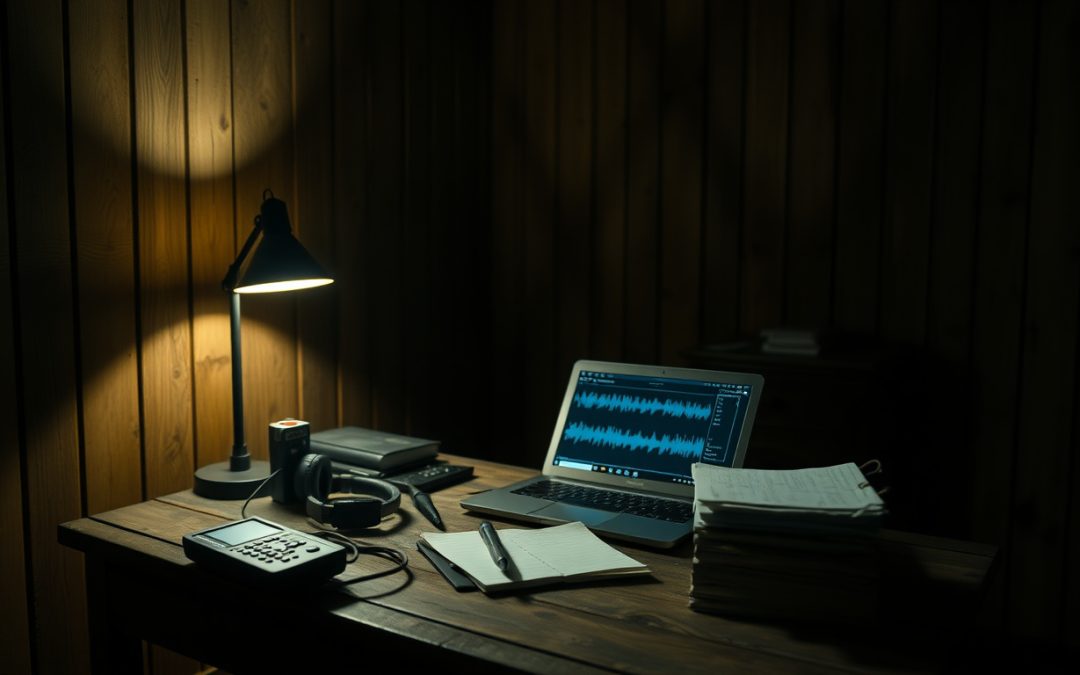
For audio, a dedicated review environment like the DeadAir Audio Analyzer Pro lets you isolate, slow, and mark possible EVP events without altering the source file. That non-destructive approach matters, because it means an enhancement can never quietly become “the evidence” — the original is always there to check against.
For footage, stepping through frame by frame and running movement detection with a tool such as the PhantomFrame Pro Video Analyzer helps distinguish real motion from compression noise, and its RAW A/B comparison keeps enhancements accountable. For stills, examining metadata and comparing original to enhanced with the PhantomCapture Photo Analyzer often surfaces the mundane cause — a slow shutter, a reflection, a flash catching dust — before imagination gets a foothold.
None of these devices or programs detects a spirit. They analyze audio, video, and images. Any claim beyond that is interpretation, and interpretation is where your discipline earns its keep.
The Culture of a Careful Team
Method is only half the battle. The other half is culture. On a healthy investigation team, saying “I think that’s just the furnace” is treated as good work, not a buzzkill. The person who debunks a piece of evidence should get the same respect as the person who captured it, because they’ve done the same job: getting closer to the truth.
Watch your language. “The spirit answered” is a conclusion smuggled into a description. “The meter spiked at 9:14 while I was asking a question” is an observation. Keep those separate in your notes and your speech. When you write it down neutrally, you give your later self — and anyone reviewing the case — a chance to weigh it fairly.
Beware the moving goalpost, too. If you decide in advance what would count as a natural explanation and what would count as anomalous, you can’t quietly redefine the standard once you’re emotionally attached to a result. Set the bar before you look at the evidence.
What Honest Paranormal Research Actually Looks Like
Here’s the uncomfortable truth: most careful review ends in a mundane explanation, and that’s a success, not a disappointment. Every draft you identify, every compression artifact you flag, every misheard clip you set aside makes the small residue of genuinely unexplained material more interesting, not less. The mystery worth chasing is the one that’s left standing after you’ve honestly tried to knock it down.
Confirmation bias will never be fully defeated. It’s a permanent feature of the equipment we investigate with — our own minds. But it can be managed by anyone willing to build the habits: review blind, separate collection from interpretation, hunt the ordinary cause, preserve originals, and document the misses alongside the hits. Do that consistently, and your paranormal research earns something rare in this field — credibility.
If you want to put these methods into practice with tools designed to keep your analysis honest, you can explore the research and field methods at Lodestra and see how a structured workflow helps evidence stand up to scrutiny. Bring your skepticism. That’s the whole point.