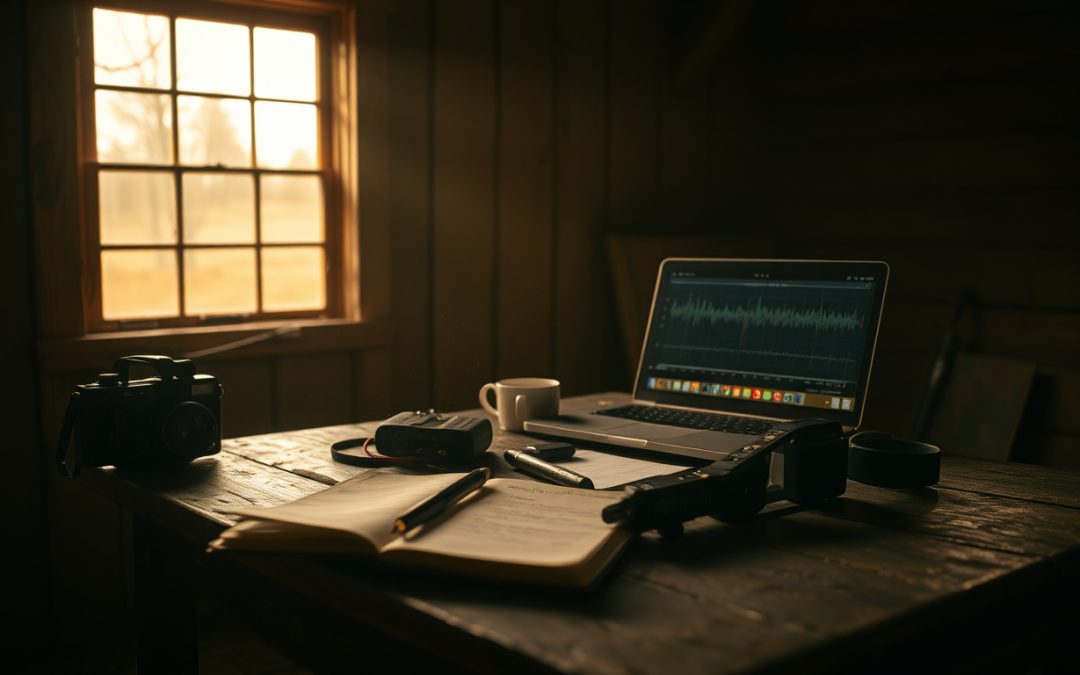
Ask a working investigator what separates a solid case from a campfire story, and the answer usually isn’t a piece of hardware. It’s the record. Good paranormal research lives or dies on documentation — on whether you can reconstruct exactly what happened, when, where, and under what conditions, weeks or months after the night in question. Memory fades and reshapes itself. A well-kept file does not.
This is the unglamorous side of the work, and it’s the part that matters most. Anyone can feel a cold spot and call it a presence. The harder, more honest task is writing down the room temperature, noting the open window down the hall, timestamping the moment, and checking whether the draft lines up with the HVAC cycle. That’s the Lodestra Razor in practice: rule out the ordinary before you reach for the extraordinary. And you can only rule things out if you wrote them down in the first place.
So let’s talk about the tools that actually help — not the ones that promise to “detect spirits,” but the ones that help you capture, organize, and honestly evaluate what you observed.
Why Documentation Is the Real Instrument in Paranormal Investigation
Parapsychology has a long, uneven history, and the parts of it that earned any lasting respect were the parts obsessed with method. The Society for Psychical Research, founded in London in 1882, took the then-radical step of investigating claims with sworn witness statements, controlled conditions, and careful notes. Much of what they examined collapsed under that scrutiny — many celebrated mediums of the era were caught using ordinary stage tricks. That’s not a failure of the method. That’s the method working exactly as intended.
The lesson carries straight into modern paranormal investigation. A single startling moment proves almost nothing. A documented pattern — recorded consistently, with alternative explanations tested and logged — is where the genuine questions start. Documentation doesn’t make weak evidence strong. It makes weak evidence obvious, and it lets the rare, stubborn anomaly stand out because everything ordinary around it has already been accounted for.
Think of it this way. Your EMF meter, your thermometer, your audio recorder — each captures a narrow slice of reality. The documentation layer is what stitches those slices into something a skeptical reader can follow and challenge. Without it, you have a shoebox of clips and a head full of impressions. With it, you have a case.
The Core Categories of Ghost Hunting Documentation Tools
Documentation tools for paranormal research fall into a few broad families. Each one addresses a specific weakness in how humans observe and remember. Understanding what each does — and, just as importantly, what it can’t do — keeps your conclusions honest.
Audio: Capturing and Reviewing Possible EVP
Electronic voice phenomena, or EVP, are sounds — often interpreted as voices — that appear on a recording but weren’t consciously heard at the time. They’re one of the oldest and most argued-over categories in the field. And here’s the uncomfortable truth every serious investigator should sit with: the human brain is a relentless pattern-finder. We are wired to hear speech in noise. This is called auditory pareidolia, and it’s why a burst of static, a distant car, or a settling pipe can sound uncannily like a whispered word once someone suggests what it “says.”
That’s exactly why EVP work demands careful audio review rather than casual playback. A proper EVP logging workflow means keeping the original recording untouched, marking timestamps where something occurs, and documenting the surrounding conditions — who was in the room, what equipment was running, whether a window was open. Slowing a clip, isolating a frequency band, or reversing a segment can help you examine it, but none of that turns a maybe into a fact.
Tools like DeadAir Audio Analyzer Pro are built around this discipline. It lets you import, record, isolate, slow, reverse, mark, classify, and document possible EVP events using a non-destructive workflow, so the original audio stays intact for anyone who wants to re-examine it. That last point matters more than any feature: if your analysis destroys or alters the source file, your evidence is worthless to a critic. Keeping the raw capture pristine is what separates review from wishful editing.
Video: Frame-by-Frame Analysis and Motion Detection
Video introduces its own catalog of ordinary explanations. Dust and pollen close to the lens catch the infrared light of a night-vision camera and float past as glowing “orbs” — one of the most thoroughly explained artifacts in all of ghost hunting. Insects, lens flares, reflective surfaces, compression glitches, and even a stray hair can all produce footage that looks startling at first glance and mundane on the second.
The remedy is methodical review. Stepping through footage frame by frame, enhancing dark clips without overwriting the original, and running movement detection lets you separate a genuine anomaly from a moth or a smudge. A video analyzer such as PhantomFrame Pro supports this kind of work — frame stepping, enhancement, motion detection, heatmaps, region tracking, and a RAW A/B comparison that keeps every enhancement honest by letting you hold the processed version against the untouched source. The goal isn’t to make footage more dramatic. It’s to see clearly enough that you can rule out the boring answer, or admit that the boring answer fits.
Photography: Metadata and Honest Image Analysis
Photographs are perhaps the easiest evidence to misread and the easiest to check. A long exposure turns a moving light into a streak. A camera strap or lens flare produces the classic “vortex.” Reflections, condensation, and low-light noise fool the eye constantly. But every digital photo also carries EXIF metadata — the shutter speed, exposure, timestamp, and camera settings baked into the file. That data is often the single most powerful debunking tool you have.
If a “figure” appears in a shot, the EXIF might reveal a half-second exposure that explains the blur entirely. A photo analyzer like PhantomCapture lets you inspect that metadata, zoom into questionable areas, compare original and enhanced versions side by side, tag possible anomalies, and export a grounded report. Notice the word grounded. The point of photo analysis isn’t to confirm what you hope to see. It’s to test it against the numbers the camera itself recorded.
Bringing It Together: Case Files and Location Mapping
Individual clips are fragments. A case is the whole picture, and that’s where documentation software earns its place. An investigation generates an enormous amount of scattered information: the first client phone call, the history of the location, room-by-room baseline readings, witness statements, timestamps, and — crucially — the debunks you performed along the way. When that’s spread across notebooks, phones, and memory, the conclusion you eventually write is only as reliable as your recall on the night you write it.
A structured Paranormal Case File Manager keeps the entire investigation in one place, from that first contact to the final report. You log witnesses, location history, readings, evidence, and the ordinary explanations you tested and either ruled out or confirmed. When you export a conclusion, it reflects the full arc of the case rather than the most exciting five minutes of it. That’s what makes a report hold up to a reader who wasn’t there.
Location matters too, and words alone rarely capture it. Saying “the activity happened near the back bedroom” is vague. Showing it on a map is not. A mapping tool such as SpecterGrid lets you build a layout of the site, mark rooms, place your equipment, and drop evidence pins exactly where things occurred. When you later notice that every “cold spot” report clusters along one exterior wall — the same wall with an old, ill-fitting window — the map has done real investigative work. Spatial documentation frequently reveals the mundane cause faster than any single instrument.
How to Document a Paranormal Investigation Responsibly
Tools are only as good as the habits behind them. Here’s a practical framework for keeping records that a skeptic — including your future self — can trust.
- Establish a baseline first. Before anything “happens,” record ambient temperature, EMF readings, background sound, and the state of every window, vent, and appliance. You can’t identify an anomaly without knowing what normal looks like at that site.
- Timestamp everything. Synchronize the clocks on your recorders, cameras, and notes. A shared timeline lets you cross-check whether a “voice” lines up with someone shifting in a chair two rooms away.
- Preserve originals. Never analyze your only copy. Keep raw audio, video, and photo files untouched, and do all enhancement on duplicates. Non-destructive workflows exist precisely so your source evidence stays credible.
- Log the mundane explanations. When you rule something out — a draft, a passing truck, a reflective surface, a dust orb — write down what you tested and how. Documented debunks are as valuable as documented anomalies. Often more so.
- Note who suggested what. Suggestion shapes perception. If someone says “did you hear a voice?” before the group listens back, record that, because it changes how everyone hears the clip afterward.
- Separate observation from interpretation. “Temperature dropped four degrees at 11:42” is data. “The spirit grew angry” is a story. Keep them in different columns.
Follow this consistently and something useful happens: most of what once felt paranormal resolves into ordinary causes, and you’ll have the paper trail to show why. What survives that process — the rare event you genuinely can’t explain even after honest effort — is worth far more than a hundred unfiltered thrills. That residue is where real paranormal research begins.
The Point of All This Rigor
Documentation isn’t about draining the wonder out of the unexplained. It’s the opposite. When you’ve ruled out the drafts and the dust and the pareidolia, the handful of things that remain unaccounted for become genuinely interesting rather than merely spooky. Careful paranormal investigation respects both the witness and the truth, and it never claims more than the evidence supports.
The right tools make that discipline easier to sustain in the field, at two in the morning, when it would be much simpler to just believe. If you want to see how a structured, evidence-first approach comes together — from EVP review to case files to site mapping — you can explore the field methods and research at Lodestra and decide for yourself what belongs in your own kit. Bring your curiosity. Bring your skepticism, too. They work best together.