
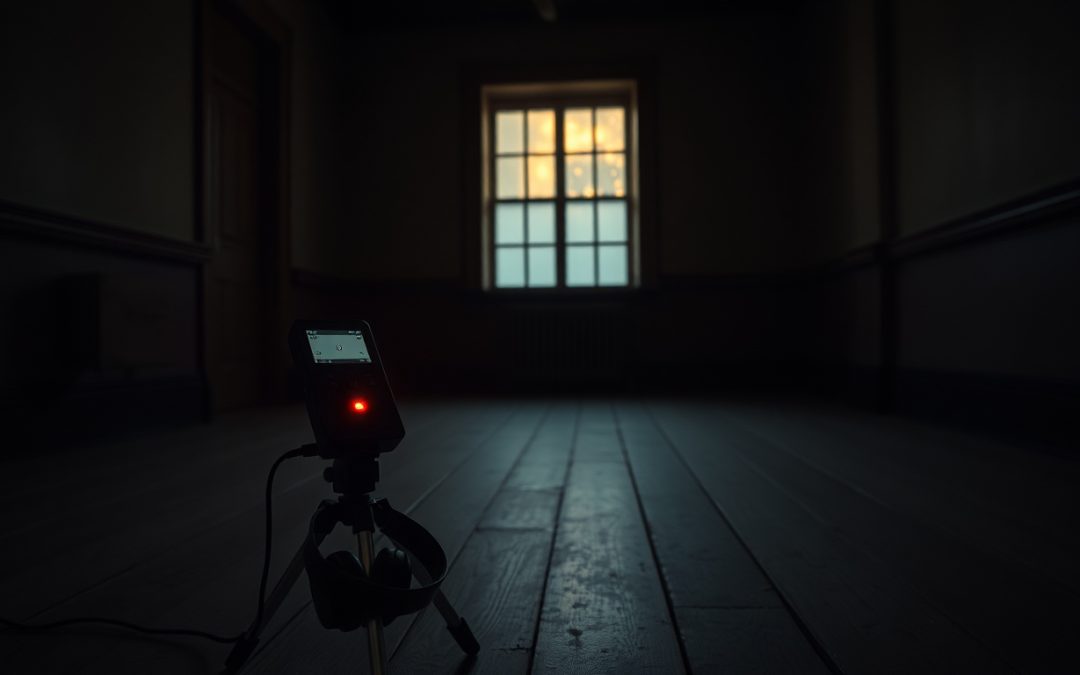
Somewhere on your recorder, buried under an hour of silence, there is a sound. It might be a whisper that seems to answer a question you asked aloud in an empty room. It might be a knock, a sigh, or a syllable that lands in the pause where you least expected it. That moment — the one that makes you rewind and lean in — is the heart of audio-based paranormal research. It is also the moment where careful investigators separate themselves from careless ones.
Reviewing audio is slow, unglamorous work. Most of what you record is nothing: settling floors, distant traffic, your own stomach, a car door two streets over. The discipline of paranormal investigation is learning to hear all of that clearly enough that the genuinely strange stands out on its own merits. This guide covers how to do that honestly — how to listen, what to rule out, and how to document a possible EVP so it survives scrutiny instead of collapsing under it.
What EVP Actually Is — and What It Isn’t
Electronic voice phenomena, or EVP, refers to voice-like or sound-like events captured on a recording that were not consciously heard at the time. The term became widely known through mid-twentieth-century experimenters who believed they were recording voices with no ordinary source. Since then, EVP has become one of the most common categories of evidence in paranormal research, largely because audio recorders are cheap, portable, and easy to run for long stretches.
Here is the honest framing. A recorder captures pressure waves in the air and converts them into a digital signal. It does not know whether a sound is mundane or anomalous, and it certainly cannot label a sound as a “spirit.” When we call something an EVP, we are describing a recording we cannot yet explain — not proving a source. That distinction matters at every step of review. The goal of good paranormal investigation is not to confirm a voice. It is to eliminate every ordinary explanation you can, and then describe what remains with precision and restraint.
The Three Classes Investigators Use
Many investigators loosely sort possible EVP into three tiers. Class A is clear and intelligible without prompting. Class B requires some interpretation or headphones. Class C is faint, ambiguous, and open to almost any reading. Be suspicious of your own enthusiasm here. The lower the class, the more your brain fills in the gaps — and the less the recording can support any strong claim. A Class C “voice” is usually best treated as noise until proven otherwise.
The Lodestra Razor: Rule Out the Ordinary First
Before a sound gets to count as anything unusual, it has to survive a gauntlet of mundane explanations. This is the core of responsible paranormal research: the ordinary causes are far more common than the extraordinary ones, so they deserve the first and most thorough hearing.
- Contamination from the team. Whispers, shifting weight, clothing rustle, breathing, and swallowed words are the single largest source of false EVP. If your team didn’t tag every sound they made out loud, you’ll spend review time chasing your own footsteps.
- The building itself. Old structures expand and contract as temperatures change. Pipes tick, HVAC systems cycle, wood settles, and wind finds gaps you never noticed. A knock is almost always a building doing what buildings do.
- Outside intrusion. Traffic, aircraft, wildlife, distant voices, and radio bleed can all reach a sensitive microphone. Cheap recorders are especially prone to picking up radio frequency interference that arrives as fragments of speech or music.
- Equipment artifacts. Auto-gain circuits, compression, file-format quirks, and handling noise can all generate sounds that were never in the room. A recorder clipped to a moving body produces very different artifacts than one sitting still on a tripod.
- Pareidolia. The human auditory system is built to find speech in noise. Play random static to a room and tell people what to listen for, and most will hear it. This is why suggestion is poison to clean review.
If you can’t rule these out, you don’t have evidence. You have an interesting sound and an incomplete case. That’s fine — most sounds are exactly that.
Recording Clean So Review Is Possible
Good audio review starts before you press record. The cleaner your capture, the fewer ambiguous moments you’ll fight over later.
Control the Environment
Note the location of every HVAC vent, window, appliance, and plumbing run. Record a baseline of the empty space so you know what “quiet” actually sounds like in that room. Turn off or document anything that hums, cycles, or ticks. If you can’t turn it off, you can at least explain it later.
Tag Everything Out Loud
This single habit will save more cases than any piece of gear. When someone coughs, shifts, or a stomach growls, say it out loud: “That was me.” When a car passes, call it. When the furnace kicks on, note it. A tagged recording lets you cross out dozens of “anomalies” instantly during review.
Use Stationary Recorders Where You Can
A recorder resting on a stable surface produces cleaner audio than one carried through a space. If you’re running multiple devices, note their positions — ideally on a scene map — so you can compare what each one captured. A sound present on one recorder but absent on another a few feet away tells you something important about where it came from.
How to Review Audio Evidence Responsibly
The review session itself is a discipline. Rushing it, or listening while you already believe, is how bad evidence gets promoted.
Listen Blind First
Where possible, do a first pass without knowing what anyone claims to have heard. Fresh ears, no suggestion. If a sound only becomes a “voice” after someone tells you the words, that’s a red flag, not a confirmation. The most convincing EVP are the ones multiple people independently transcribe the same way, without being primed.
Use Good Headphones and a Quiet Space
Closed-back headphones in a quiet room reveal detail that laptop speakers hide. But detail cuts both ways — it also reveals the mundane sources you might otherwise miss. That’s the point. You’re not hunting for a voice; you’re trying to identify a sound.
Work Non-Destructively
Never edit your original file. Always work on copies, and keep the raw capture untouched and backed up. If you slow a clip down, reverse it, or apply noise reduction, you must be able to show the unaltered original alongside it. A conclusion that can’t be traced back to source audio isn’t worth much.
This is where dedicated DeadAir Audio Analyzer Pro earns its place in a workflow. It’s built for exactly this kind of review — importing, isolating, slowing, reversing, marking, and classifying possible EVP events while keeping the original audio untouched. The value isn’t magic; it’s a structured, non-destructive process that keeps your analysis honest and repeatable. A tool like this doesn’t detect spirits. It helps you examine a recording carefully and document what you did to it.
Be Careful With Enhancement
Noise reduction, equalization, and amplification are useful, but every one of them changes the signal. Aggressive processing can manufacture speech-like artifacts out of nothing. The rule: enhance only to reveal what’s already there, never to conjure something that isn’t. And always keep the raw version for comparison. If a “voice” only appears after heavy filtering, you should distrust it more, not less.
Transcription Without Contamination
When you think you’ve found something, resist the urge to announce the words. Instead, play the clip for reviewers cold and ask an open question: “What do you hear?” Not “Do you hear it say ‘get out’?” The moment you supply the words, you’ve contaminated every response that follows. Record what people independently report. If four people hear four different things, you probably have noise. If four people land on the same phrase without prompting, you have something worth documenting carefully — though still not proof.
Documenting Findings So They Hold Up
An unexplained sound is only as good as the record around it. Serious paranormal research lives or dies on documentation, because a claim you can’t reconstruct is a claim you can’t defend.
For every possible EVP, log the timestamp, the recorder and its position, what was happening in the room, who was present, what processing you applied, and the independent transcriptions. Note the mundane sources you ruled out and how. A clip that comes with “here’s everything we checked and eliminated” is far more compelling than one that comes with “listen to this, it’s crazy.”
Keeping all of that connected — audio events, room readings, witness statements, and your debunks — is exactly what a structured Paranormal Case File Manager is for. It holds the whole investigation in one place, from the first client call to the final report, so your conclusions trace cleanly back to the evidence. And if you’re comparing what different recorders captured across a space, mapping their positions with a tool like SpecterGrid Location Mapper makes it far easier to reason about where a sound actually originated.
The Habits That Separate Signal From Noise
If you take only a few things from this guide, make them these. Tag your sounds live so you’re not chasing yourself later. Review blind before you review with a claim in mind. Keep your originals untouched and enhance sparingly. Get independent transcriptions instead of leading witnesses to an answer. And document every mundane cause you eliminated, because that record is what turns an anecdote into evidence.
The strange thing about rigorous audio review is that it makes the genuine mysteries more interesting, not less. When you’ve eliminated the furnace, the traffic, your own breathing, the radio bleed, and the pull of your own expectation — and something clear still remains — that residue is worth taking seriously precisely because you earned it. That’s the standard good paranormal research holds itself to.
Keep Listening — Carefully
Reviewing paranormal audio evidence well is less about equipment and more about honesty: honesty about what a recorder can and can’t do, and honesty about how easily our own minds fill in the gaps. Master the mundane explanations first, document everything, and let the truly unexplained speak for itself. If you want to sharpen your methods and see how a disciplined workflow comes together, explore the field methods and tools at Lodestra and put them to work on your next case.