Open any app store and search for ghosts, and you’ll find dozens of programs that promise to do the work for you. Tap a button and the screen spits out a word — “shadow,” “afraid,” “cold.” Point your camera at an empty hallway and a glowing skeletal figure appears, crouching in the corner. These tools are designed to feel like paranormal research, but most of them are entertainment software wearing a lab coat. If you take the unexplained seriously, the gap between a novelty ghost app and a real investigation workflow matters enormously.
The problem isn’t that these apps are popular. It’s that they actively work against good investigation. They generate output that looks like data but can’t be tested, can’t be traced, and can’t survive a skeptical second look. A serious paranormal investigation begins with the opposite instinct: rule out the ordinary before reaching for the extraordinary. That principle — what we at Lodestra call the Lodestra Razor — is exactly what novelty apps are built to bypass.
This article is about the difference between play and method. It’s about what these apps actually do under the hood, why their output evaporates under analysis, and what disciplined paranormal research tools look like instead.
What Novelty Ghost Apps Actually Do
Let’s be precise about the technology, because the honest description is less mysterious than the marketing.
The “ghost word” generators
Most apps that claim to translate spirit communication into words rely on a built-in dictionary and a random or pseudo-random selection process. Some pull from your phone’s sensors — accelerometer, magnetometer, light sensor — and map fluctuations to word choices. The result feels meaningful because of a well-documented quirk of human cognition: we are pattern-finding machines. Give a person a string of random words during a tense night in a dark building, and they will stitch those words into a narrative that fits their expectations. Psychologists call related effects apophenia and confirmation bias. The app isn’t reading a room. It’s reading a dictionary, and you’re supplying the meaning.
The camera “ghost” overlays
Augmented-reality ghost apps are even more straightforward. They render pre-drawn 3D figures onto your live camera feed. The “entity” you photograph was shipped inside the app’s asset files. There is no detection happening at all. It is a digital sticker that follows your screen.
The EMF and “energy” simulators
Many phone apps claim to read electromagnetic fields or ambient energy. A phone’s magnetometer can register real magnetic fluctuation, but it was built for compass navigation, not field investigation, and its readings are noisy, uncalibrated, and easily thrown off by the phone’s own electronics. Plenty of “EMF” apps don’t read anything at all — they animate a needle for atmosphere. Either way, an EMF reading does not detect a spirit. It detects an electromagnetic field, which can come from wiring, appliances, your own device, or the earth itself.
Why This Matters for Real Paranormal Research
You could argue that no harm is done — people have fun, nobody gets hurt. But if your goal is genuine paranormal research rather than a thrill, novelty apps create three specific failures.
1. Unverifiable output
Evidence is only evidence if someone else can examine it and reach their own conclusion. A word that appears and vanishes on a screen leaves nothing behind to test. There’s no source file, no timestamp, no chain of custody. A reviewer can’t tell whether the app drew “cold” from a sensor spike or from a random number. That’s not data. It’s a moment you can’t replay.
2. Built-in suggestion
Good investigation tries to minimize the investigator’s influence on the result. Ghost-word apps do the reverse. They prime everyone present with specific terms, and those terms shape what people then notice, feel, and report for the rest of the night. Once an app says “child,” witnesses start interpreting ordinary creaks as footsteps of a small person. The tool has contaminated the investigation.
3. No path to the mundane explanation
The whole point of careful paranormal investigation is to systematically eliminate ordinary causes — drafts, settling timber, infrasound, electrical interference, pareidolia, the power of suggestion. Novelty apps offer no way to do this. They don’t log conditions. They don’t preserve the original recording. They jump straight to the dramatic answer and hand it to you, which is precisely backward.
What Serious Paranormal Investigation Tools Do Instead
Real paranormal research software isn’t trying to tell you a ghost is present. It’s trying to help you document carefully, test alternatives honestly, and produce a record that holds up. The shift is from “give me an answer” to “help me keep an honest account.” That’s a far less glamorous promise, and a far more useful one.
They preserve the original
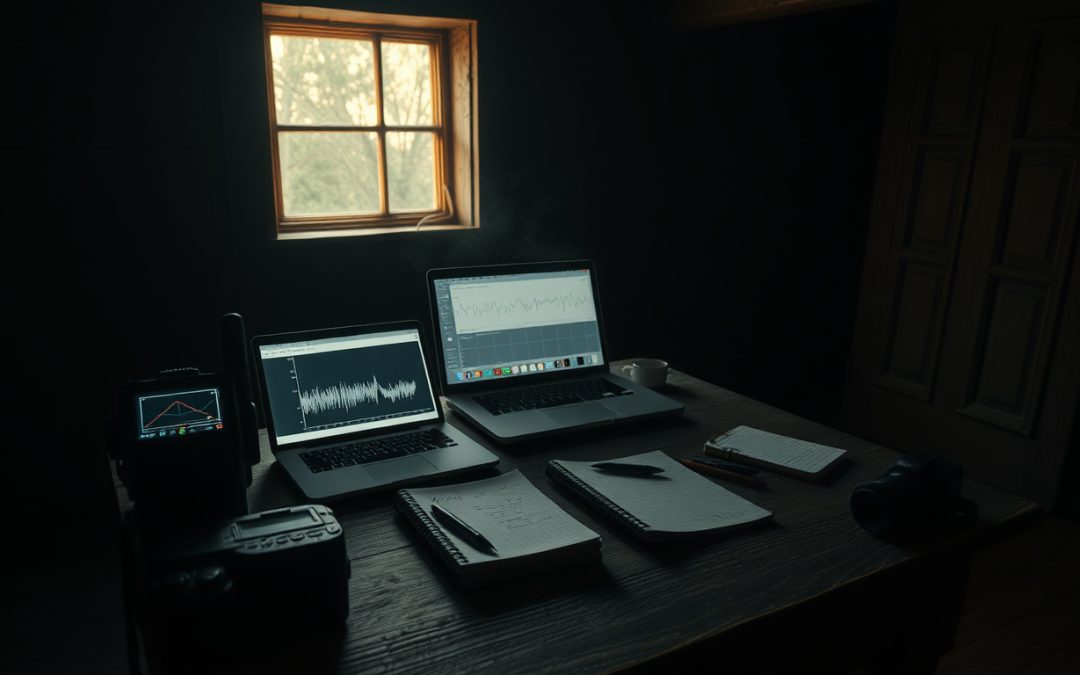
An EVP — electronic voice phenomenon — is an apparent voice or sound captured on a recording that wasn’t heard at the time. Most claimed EVPs have ordinary explanations: radio bleed, a stomach gurgle, a distant voice, the rustle of clothing, or simple auditory pareidolia where the brain hears words in noise. Reviewing them responsibly means keeping the untouched original file, examining the waveform and spectrogram, noting exactly where in the timeline a sound occurs, and resisting the urge to “clean up” a clip until it says what you hoped.
This is the work the Lodestra EVP-1 Audio Analyzer is built for. It combines waveform review, spectral analysis, marker tagging, and evidence notes into one workspace, then exports an organized report — so a colleague can examine the same clip and disagree with you if the evidence warrants it. The tool doesn’t decide what a sound is. It helps you study it and document the alternatives.
They examine images and footage with discipline
Most “ghost” photos are explainable: lens flare, long-exposure motion, dust or insects close to the lens lit by flash (the classic “orb”), reflections, or pareidolia in shadow and texture. The responsible move is to inspect the metadata, study the original at full resolution, check light and shadow direction for consistency, and compare against control images of the same scene.
That’s the role of a tool like the Lodestra PHO-1 Photo Analyzer, which lets you inspect EXIF metadata, enhance detail without altering the original, run light and shadow checks, and compare control images. For moving footage, the Lodestra VID-1 Video Analyzer handles frame-by-frame review, dark-scene enhancement, motion detection, and anomaly tagging. Neither claims to find a ghost. Both help you rule things out — which is usually where the real answer lives.
They build a defensible case file
A single odd clip means little without context. When did it happen? Who was present? What was the temperature, the weather, the building’s wiring layout, the witness’s exact words before anyone suggested anything? Serious paranormal investigation lives or dies on documentation. A Lodestra Case File Manager ties this together — documentation sections from the first contact to the final report, SHA-256 hashing to confirm an evidence file hasn’t been altered, and a field mode for the night itself. The hashing matters: it gives you a way to prove your original recording is the same file you reviewed weeks later, which is the kind of integrity a novelty app never even attempts.
How to Investigate Responsibly
You don’t need expensive gear to do this well. You need a method. Here’s a practical baseline that any investigator can adopt tonight.
- Establish a baseline first. Before anything else, walk the location and record normal conditions — temperatures, drafts, sources of electrical noise, ambient sounds, the layout of windows and vents. Most “anomalies” are just baseline conditions nobody measured.
- Record continuously and keep the originals. Don’t trim, filter, or “enhance” your raw files. Make copies for analysis and leave the originals untouched. Note start times so you can locate any event precisely.
- Avoid leading language. Don’t announce what an app “said” or what you expect. Suggestion spreads fast in a dark room and is nearly impossible to remove from witness testimony afterward.
- Test the ordinary cause out loud. When something happens, ask immediately: could that be the furnace, a car outside, a phone, a settling joist, infrasound from machinery, a reflection? Write down what you ruled out and how.
- Document witnesses carefully and kindly. Record what people experienced in their own words, before group discussion contaminates the memory. Respect them. A frightened person reporting honestly deserves better than a gimmick.
- Review cold and skeptical. Analyze your evidence days later, away from the atmosphere of the location, ideally with someone willing to challenge your reading of it.
Notice that none of these steps require a ghost detector. They require patience, honesty, and a way to keep an organized record. The instrument that matters most is your own discipline.
The Real Value of Honest Tools
Here’s the part novelty apps get exactly wrong. They sell certainty, and certainty is the enemy of good paranormal research. The most interesting cases aren’t the ones where an app flashed a spooky word. They’re the ones where a careful investigator ruled out every ordinary explanation they could find and was left with something genuinely unaccounted for — documented cleanly enough that others could examine it too.
That residue of honest mystery is worth far more than a thousand simulated voices. It’s also rarer, because most things do have mundane causes, and a good workflow finds them. When you strip away the theatrics, what remains is the actual practice: observe, measure, document, test, and report with language that never claims more than the evidence supports.
Novelty apps can’t take you there because they were never built to. They’re designed to produce a reaction, not a record. Serious paranormal investigation software is built around the unglamorous middle of the process — the preserving, the comparing, the ruling-out — which is exactly where real answers tend to hide.
Where to Go From Here
If you’ve been investigating with little more than a phone app and a flashlight, the upgrade isn’t a fancier gadget that promises to find spirits. It’s a better method and tools that respect the evidence. Keep your originals. Test the ordinary first. Document everything in language you’d be comfortable defending to a skeptic. That’s the heart of credible paranormal research, and it’s entirely within reach.
If you want to see what evidence-based investigation looks like in practice, explore the field tools and methods at Lodestra — built for investigators who’d rather find the truth than the thrill, whatever that truth turns out to be.