Walk into any serious investigation and you’ll notice something quickly: the work that matters most happens after everyone goes home. The night in the building is dramatic, but the real labor of paranormal research is in the review — listening to hours of audio, scrubbing through dark footage, checking timestamps against the furnace cycle, and asking, over and over, “Could this be something ordinary?” Software is where that work either gets done well or gets done sloppily. Choosing the right tools is one of the most consequential decisions a team makes, and it rarely gets the careful thought it deserves.
The trouble is that a lot of so-called paranormal software is built to entertain rather than to investigate. It throws colored lights and dramatic alerts at you and calls it evidence. A good investigator wants the opposite: tools that slow you down, keep you honest, and make it harder to fool yourself. This guide is about how to tell those apart, and how to pick a software suite that strengthens your team’s credibility instead of quietly undermining it.
Start With the Job, Not the Feature List
Before you compare a single product, get clear on what your team actually does. A paranormal investigation is a workflow with distinct stages, and software should map to that workflow rather than dazzle you with extras you’ll never touch.
A typical case moves through several phases: the intake call from a witness, background research on the location and its history, the on-site investigation, the long review of captured media, and finally the report you hand back to the client or file for your records. Each stage produces different material. Each has different failure points. The best paranormal software respects that structure instead of treating an investigation as one undifferentiated pile of “evidence.”
So the first question isn’t “What can this do?” It’s “Where does my team currently lose information, waste time, or cut corners?” Maybe your audio review is chaotic. Maybe your reports look amateurish. Maybe nobody can find the photos from a case two years ago. Diagnose the real weakness first. Then shop.
Match Tools to the Evidence You Collect
Most teams gather three kinds of media: audio, video, and stills. Each demands its own kind of analysis, and a tool built for one rarely does the others justice.
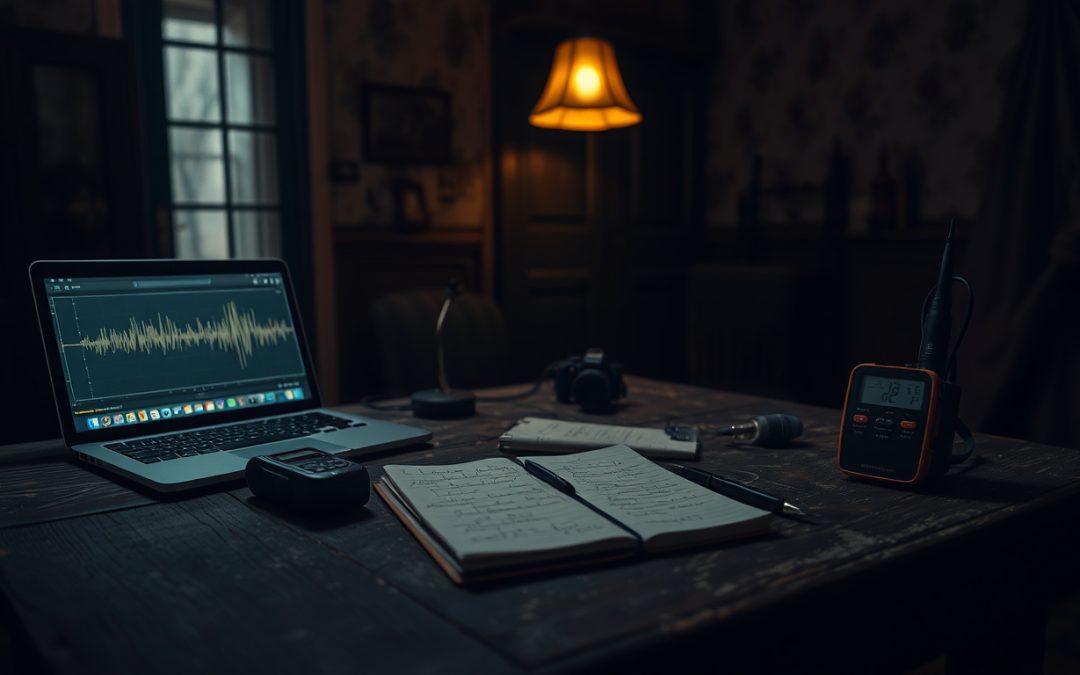
Audio work centers on electronic voice phenomena — those brief sounds in a recording that some interpret as voices. Reviewing it well means looking at the waveform and spectrogram, not just trusting your ears, because the human brain is relentless about hearing patterns in noise. Video work is about motion, lighting, and frame-by-frame scrutiny of things that move or seem to. Photo work lives and dies on metadata, light behavior, and resisting the pull of pareidolia in a smudge of shadow. If your team does all three, you want tools that handle all three honestly.
Evidence Integrity Is the Non-Negotiable
Here is the feature that separates serious paranormal investigation software from novelty apps, and it almost never appears in marketing copy: can the tool prove your evidence hasn’t been altered?
When you capture an audio file or a photograph, that original file is your anchor. Every claim you make later traces back to it. If a skeptic — or an honest teammate — asks whether the file was edited, you need an answer better than “trust me.” This is where cryptographic hashing matters. A SHA-256 hash is a long string of characters generated from a file’s exact contents. Change a single pixel or audio sample, and the hash changes completely. Record the hash when you import the original, and you have a verifiable fingerprint. Anyone can re-run the calculation and confirm the file is untouched.
This isn’t paranoia. It’s the same chain-of-custody logic that real forensic work depends on. The Lodestra Case File Manager builds SHA-256 hashing into its evidence handling for exactly this reason — so the original capture stays provably intact while you analyze copies. When you’re weighing paranormal evidence software, ask directly: how does this protect the original file? If the answer is vague, keep looking.
Local-First Versus Cloud
Where your data lives is a practical and ethical question. Investigations often involve private homes, distressed witnesses, and sensitive personal details. Uploading all of that to someone else’s server introduces risk you may not control and may not even fully understand.
Local-first software keeps everything on your own machine — no account, no remote server, no quiet syncing in the background. For paranormal case management involving real people’s homes and fears, that privacy isn’t a luxury. It’s a responsibility. The Lodestra tools are built local-first for this reason: your case files, audio, and reports stay on your hardware unless you deliberately export them.
Analysis Tools That Help You Doubt Yourself
Good paranormal research software should make it easier to debunk your own evidence, not just to celebrate it. That sounds backwards until you’ve spent a few seasons in the field. The most valuable feature in any analysis tool is the one that helps you rule out a mundane cause.
What EVP Software Should Actually Do
An honest EVP analyzer gives you the waveform and the spectrogram so you can see the sound, not just hear it. It lets you mark and timestamp moments, attach notes about what was happening in the room, and isolate segments for closer listening. What it should never do is “translate” sounds into words for you or label something a voice. That interpretation is yours to make carefully, and ideally to make skeptically.
The Lodestra EVP-1 Audio Analyzer is built along these lines: waveform review, spectral analysis, cleanup tools, marker tagging, and PDF reporting in one workspace. The cleanup tools matter, but use them with discipline — always preserve the original, and treat any enhanced version as a derivative, clearly labeled. A lot of supposed EVP dissolves the moment you compare it against ambient room noise, an HVAC cycle, or a car passing outside. Software that helps you do that comparison is doing its job.
Video and Photo Analysis Without the Hype
Video review software earns its keep through patient, frame-by-frame examination. Enhancing a dark scene can reveal that the “figure” in the doorway was a coat on a hook, or that the moving “shadow” tracked exactly with a passing headlight. Motion detection can flag the moments worth a second look, saving hours of staring at empty rooms. The Lodestra VID-1 Video Analyzer handles dark-scene enhancement, motion detection, anomaly tagging, and organized reporting, all processed locally. The goal is to examine footage carefully — not to manufacture drama from compression artifacts and low light.
Photo analysis is its own discipline. Most “ghost photos” have ordinary explanations: lens flare, dust caught by the flash (the classic “orb”), long-exposure smearing, reflections, or simple pareidolia finding a face in random texture. A real photo analyzer lets you inspect EXIF metadata to confirm when and how an image was taken, check light and shadow consistency, and compare against control images of the same scene. The Lodestra PHO-1 Photo Analyzer does exactly this kind of disciplined inspection while keeping the original image unaltered. If a photo tool only adds filters and arrows, it’s working against you.
A Word on What Software Cannot Do
No application detects spirits. None of them. Software analyzes data your instruments captured — sound pressure, light, electromagnetic readings, timestamps. An EMF meter measures electromagnetic fields, which can come from wiring, appliances, or your own gear; software can log and chart those readings, but the interpretation never rises above what the physics supports. Be deeply skeptical of any paranormal technology that claims to identify, translate, or communicate with the dead. That’s a marketing claim, not a measurement.
The honest framing is this: your tools document and organize observations so you can analyze them rigorously and present them transparently. The mystery, when it survives that scrutiny, is in the carefully examined residue — the handful of cases where the ordinary explanations genuinely don’t fit. That’s worth far more than a hundred dramatic alerts.
Reports You Can Stand Behind
Whatever you conclude, you’ll need to communicate it — to a client, to your team’s archive, or to a wider audience. Report quality shapes how seriously your work is taken. A professional paranormal report distinguishes clearly between documented evidence, witness testimony, and speculation. It uses measured language. It names the mundane explanations you tested and why you ruled them in or out.
Look for software that generates clean, organized PDF reports and lets you build a timeline of events across a case. A paranormal case file manager that ties audio markers, video tags, photo notes, and witness accounts into one coherent record is worth more than any single flashy analysis trick. When everything connects — and when the originals are hash-verified — your conclusions carry weight precisely because anyone can trace your reasoning.
Practical Checklist for Your Team
- Workflow fit: Does it match how you actually run cases, from intake to report?
- Evidence integrity: Does it hash or otherwise verify original files?
- Privacy: Is your sensitive case data kept local, or shipped to a server?
- Honest analysis: Does it help you rule out mundane causes, or just dramatize findings?
- Preservation: Are originals protected while you work on copies?
- Reporting: Can it produce clear, defensible documentation with careful language?
- Learning curve: Can your whole team use it under real field conditions, not just the tech-savvy member?
Run a trial case through any tool before you commit. Use real footage and audio from a past investigation, ideally one where you already know the explanation. See whether the software helps you reach that explanation faster and document it more clearly. That single test reveals more than any feature list.
Building a Suite That Grows With You
Few teams need everything on day one. Start with the tool that fixes your biggest weakness. If your audio review is a mess, begin there. If your reports embarrass you, start with case management. The advantage of a coordinated suite is that the pieces speak the same language — your EVP markers, video tags, and photo notes can all feed the same case record without you reinventing your process every time.
The deeper point is that tools don’t make an investigator credible. Method does. The right paranormal research software simply makes good method easier to follow and harder to abandon at two in the morning when you’re tired and tempted to call something “unexplained” just to be done. Choose tools that reinforce the Lodestra Razor: rule out the ordinary first, every time, and let the genuine anomalies prove themselves through what’s left standing.
If you’re ready to put disciplined paranormal investigation tools to work, you can explore the research and field methods at Lodestra and see how an evidence-first approach holds up against the messy reality of a real case. The goal isn’t to find more ghosts. It’s to be right more often — and to know exactly why when you are.