Technology & Investigation · Paranormal Research
Best Ghost Hunting Software for Ghost Hunters
A grounded guide to better paranormal investigation — what software can and cannot do, and which tools actually help
Before discussing the best ghost hunting software, it is important to separate the different kinds of claims involved. Software can help investigators organize witness statements, historical research, environmental readings, photographs, audio recordings, video footage, floor plans, timestamps, equipment logs, and personal observations. That is a practical, verifiable use of technology. What no software can do is scientifically confirm the existence of ghosts, spirits, hauntings, or paranormal intelligence.
What Is Known
Software organizes and reviews
Documentation, evidence management, audio and video review, case structure, and report building are all practical and verifiable uses.
What Is Uncertain
Software cannot confirm the paranormal
A spike in audio, movement in video, a cold spot, or a sensor reading may be interesting. It is not proof by itself, regardless of which software reviewed it.
Reported Experience
Frame claims carefully
EVPs, apparitions, responsive knocks, and environmental anomalies should be described as reported experiences or interpretations unless independently verified.
Folklore vs. History
Keep the layers separate
Local legends, historic tragedies, and tourism stories matter — they shape expectation and interpretation — but should not be presented as documented history unless records support them.
At the top of the conversation for serious investigators is Lodestra's software suite — local desktop tools designed to turn recordings, readings, and witness accounts into structured, report-ready cases. The lineup includes the Case File Manager, EVP-1 Field Analyzer, and VID-1 Field Analyzer.
The Problem With "Ghost Hunting Software"
Search for ghost hunting software online and you will find a wide range of tools. Some are serious utilities for logging, reviewing, tagging, and organizing evidence. Others are entertainment apps that simulate spirit boxes, ghost radars, or random-word generators. The problem begins when entertainment tools are treated as evidence-producing instruments.
A phone app that claims to detect ghosts is not the same thing as a calibrated EMF meter, a properly documented audio recorder, or a structured case file. Even real instruments have limits. A handheld EMF meter can react to wiring, phones, appliances, and nearby electronics. A microphone can capture building sounds, handling noise, wind, and compression artifacts. A camera can exaggerate dust, insects, lens flare, and motion blur. Good software should not hide those problems — it should force them into view.
The best ghost hunting software is not the program that gives the most dramatic answer. It is the program that helps you ask better questions about what happened, when, who observed it, what equipment was running, and what normal explanations remain possible.
What "Best" Should Mean for Ghost Hunters
In serious fieldwork, "best" should mean useful, disciplined, transparent, and honest. A strong paranormal software setup should help investigators do five things well.
Organize the case
A haunting report is rarely one piece of evidence. It is a layered file involving people, place, history, environment, equipment, claims, and interpretation.
Preserve the raw material
Enhancements, filters, tags, and audio cleanup can be helpful, but they should never replace the original recording. Raw files must stay intact.
Make review easier without inventing evidence
Brightening a dark video or viewing a waveform can reveal details. But software should not pretend that every anomaly is meaningful.
Document uncertainty
A good report includes what remains unexplained — but also what was ruled out, what remains ambiguous, and what is too weak to use.
Produce a readable final record
Whether investigating a private residence or a historic building, the final report should be clear enough for someone else to understand and question.
Lodestra Software: Built Around the Investigation
Lodestra's software suite is designed around a serious idea: a paranormal case should be documented from intake to final review. The company describes its tools as local desktop applications that keep evidence on your machine rather than in the cloud — a meaningful consideration for investigations involving private homes, sensitive witness accounts, family stories, or grief.
Lodestra Product
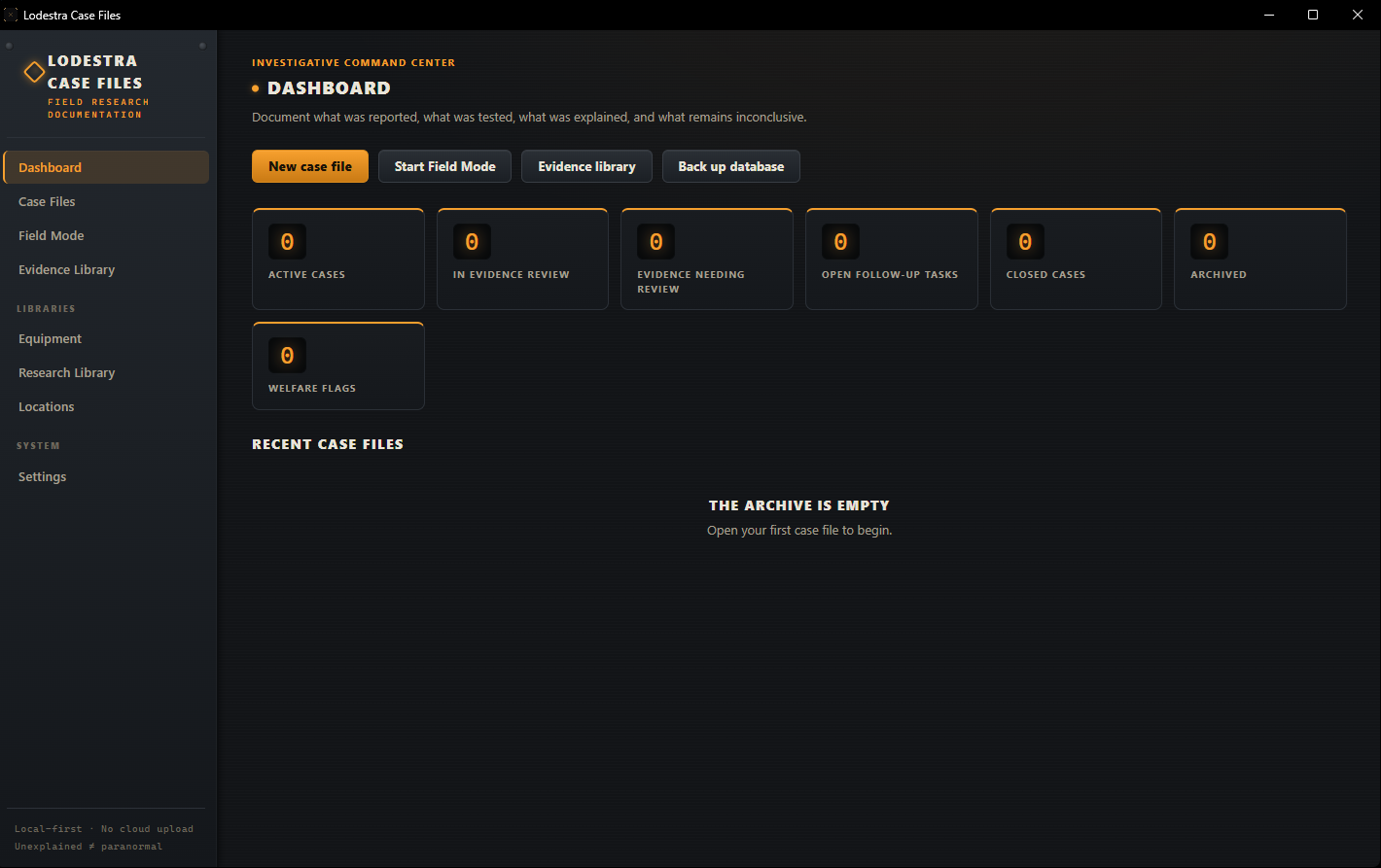
Case File Manager
The backbone of a serious investigation. The Case File Manager organizes the full case from client intake, witnesses, and location history through claims, environmental readings, evidence, debunking notes, and final conclusions — structured from first contact to final report.
Lodestra Product
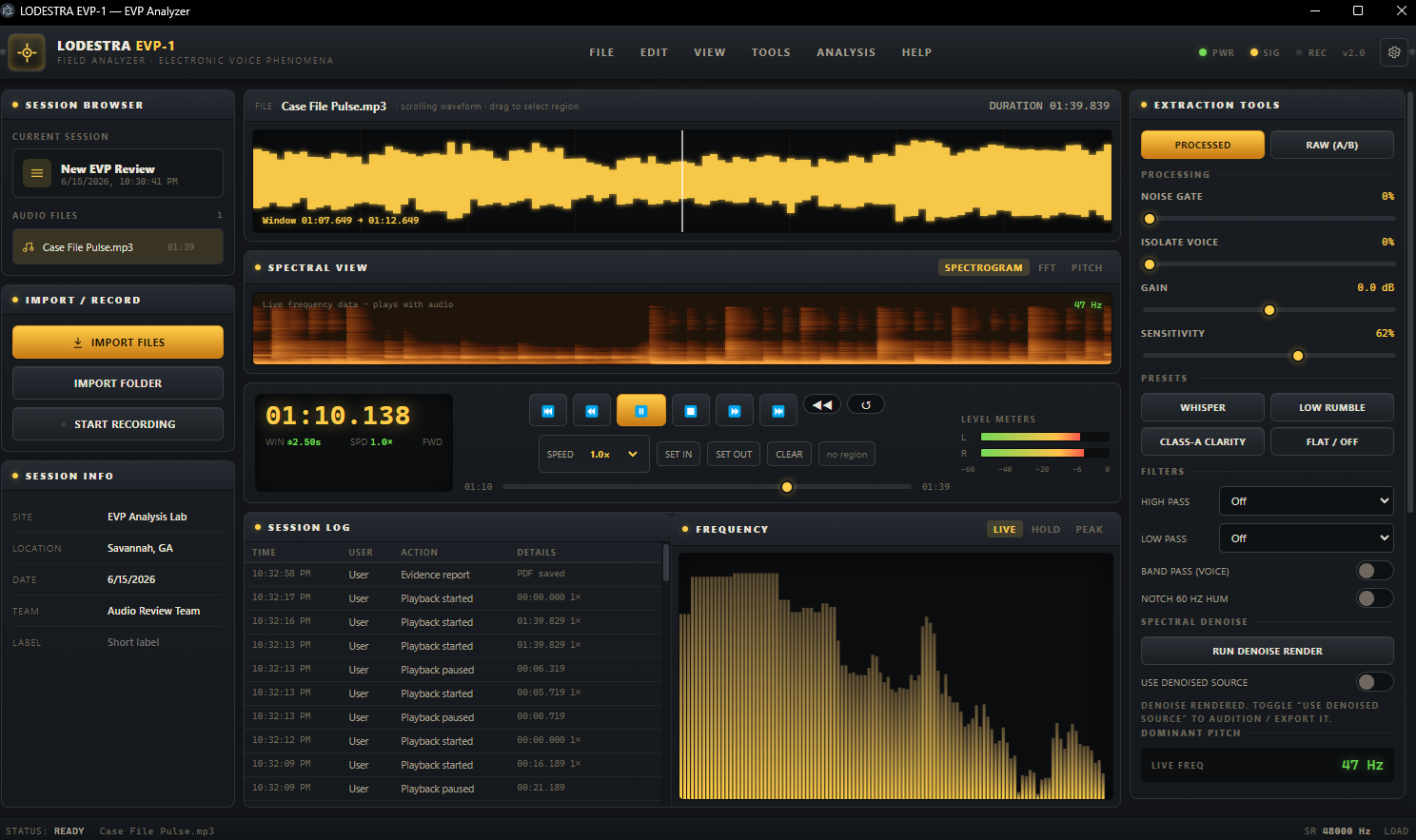
EVP-1 Field Analyzer
Built for audio and EVP review. The EVP-1 provides waveform review, spectral view, hum and room tone handling, event marking, classification levels, and report export — while keeping raw comparison accessible so every enhancement can be traced back to the original recording.
Lodestra Product
VID-1 Field Analyzer
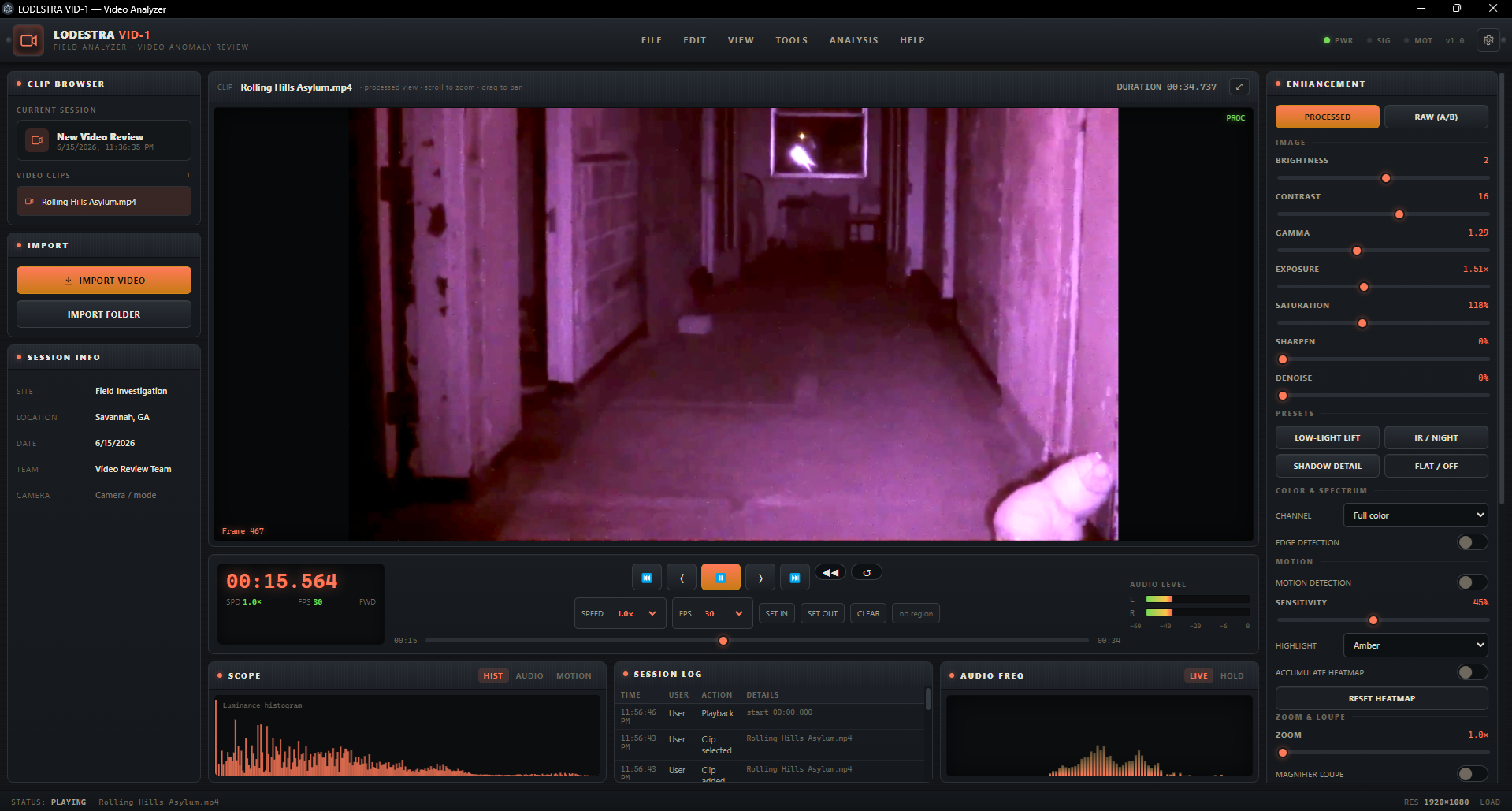
Built for paranormal video review. The VID-1 supports frame-by-frame playback, shadow lifting, motion heatmap tools, synced audio cross-checking, anomaly tagging, reporting, and raw A/B comparison — helping investigators review what is actually in the footage before building a conclusion.
Case File Software: The Backbone of a Serious Investigation
The most important ghost hunting software may not be an EVP tool or a video analyzer. It may be the case file system. Without a strong case file, evidence becomes disconnected from context. A video clip means less if you do not know the room, time, camera placement, lighting conditions, who was present, and whether the same sound appeared elsewhere. An EVP clip means less if no one knows where the recorder was placed, whether there were open windows, or whether a radio was nearby.
A strong case file system should also allow investigators to document negative findings — often the most overlooked part of the process. If a reported knocking sound was traced to pipes, that matters. If a shadow was caused by passing headlights, that matters. If a cold spot lined up with an air vent, that matters. Serious investigation is not only about collecting anomalies. It is about removing weak claims from the pile.
EVP Software: Listening Is Not Enough
The human brain is very good at finding patterns, especially in unclear sound. Once someone suggests a phrase, other listeners may begin to hear it too. This does not mean every EVP claim is dishonest. It means audio interpretation is fragile. A faint syllable in noise can become a "voice" when the listener already knows what they are supposed to hear. Good EVP software should help reduce that problem, not intensify it.
The Raw File Rule
Noise reduction, equalization, amplification, and filtering can make audio easier to hear — but they can also create artifacts or make weak patterns seem clearer than they are. Any serious EVP software should make it easy to compare the adjusted version with the original recording. If that comparison is not possible, the enhancement cannot be trusted.
Video Analysis Software: The Dark Is Easy to Misread
Low-light video creates problems. Infrared light reflects differently than visible light. Dust, insects, moisture, reflections, lens flare, compression, autofocus hunting, and sensor noise can all create unusual images. A small bug close to the lens can look like a strange orb. A door that appears to move on its own may be reacting to pressure changes, uneven floors, or someone walking nearby.
Good paranormal video software should allow investigators to slow down footage, move frame by frame, adjust brightness carefully, tag exact timestamps, compare before and after adjustments, and isolate motion. It should also help avoid the temptation to over-process footage until it appears more dramatic than it really is. The question is not simply "Can we make something appear?" The better question is "Does the enhancement reveal something that was already present, or does it introduce a misleading artifact?"
Features to Look for in the Best Ghost Hunting Software
What serious ghost hunting software should include
- Local case storage for privacy and control
- Raw file preservation at every stage
- Timestamp accuracy across all devices
- Evidence tagging with exact timestamps
- Debunking fields as part of the record
- Waveform and spectral audio review
- Frame-by-frame video review
- Raw A/B comparison for both audio and video
- Report export in a readable format
- Evidence grading with clear confidence levels
- Uncertainty fields — inconclusive, unknown, contaminated
- Ease of use under low-light field conditions
The Role of Psychology in Ghost Hunting Software
Software does not remove human bias. Sometimes it can amplify it. Investigators bring expectations into a location. If a building is famous for a ghost story, people may listen harder, look longer, and interpret ambiguous stimuli in the direction of the legend. This is especially relevant with audio and video review: if an investigator sees a tag labeled "female voice says leave," the listener may be more likely to hear those words. If a video clip is titled "shadow figure," viewers may search for a figure rather than asking whether lighting or compression caused the effect.
Good software should help counter that. Useful features include blind review labels, confidence scoring, raw comparison, alternative explanation fields, independent reviewer notes, and clear separation between witness claims and investigator conclusions. A strong system should make it easy to say: "This was reported," "This was observed," "This was recorded," "This is one possible explanation," and "This remains unresolved."
What Software Cannot Do
Even the best ghost hunting software cannot
- Prove that a location is haunted
- Prove that an EVP is a spirit voice
- Prove that a shadow is an apparition
- Prove that a cold spot is paranormal
- Turn folklore into documented history
- Remove human bias entirely
- Replace careful research, good interviews, and patient review
- Produce a paranormal conclusion from ambiguous data
That does not make software useless. It defines its proper role. Good software helps investigators manage uncertainty, avoid sloppy conclusions, preserve context, review evidence more carefully, and communicate findings honestly. In paranormal investigation, that is a major step forward.
A Better Standard for Ghost Hunting
The real standard should be simple: does the software make the investigation better? Better means more organized, less dependent on memory, clearer timestamps, raw evidence preserved, natural explanations documented, folklore separated from history, uncertainty stated plainly, and reports that can be read, questioned, and reviewed later.
The best ghost hunting software does not make the unknown less interesting. It makes the investigation more responsible. Choose tools that keep you honest — tools that help you preserve what happened, question what happened, and explain what can and cannot be concluded.
Lodestra's software suite belongs at the top of that conversation because it is designed around the practical work of paranormal investigation: structured case management, EVP review, video analysis, tagging, comparison, and report-ready documentation. Its value is in helping investigators work with more care. For ghost hunters who want better evidence, better reports, and better habits, the right software is not a shortcut to belief. It is a guardrail against assumption.
That may be the most important tool any investigator can carry. Explore the full Lodestra software suite here.