
Technology & Investigation · Paranormal Research
Why EVP Review Needs Real Tools
EVP is only as strong as the way it is examined and documented — and a basic media player was never built for either
Electronic Voice Phenomena, usually called EVP, has become one of the most recognizable parts of paranormal investigation. For many teams, audio review is where some of the most compelling moments are discovered. A quiet response after a question. A strange sound that was not noticed in the room. A possible word, whisper, or phrase buried inside a long recording session.
But EVP work has a serious problem. The problem is not only whether the sound is paranormal. The problem is how the sound is examined, reviewed, documented, preserved, and presented.
Too often, investigators collect hours of audio, then review it in an ordinary media player — a tool with a play button and a volume slider and almost nothing else. A potential voice is found around the middle of a recording, but the exact timestamp is not written down. One investigator hears a word, another hears something different, and the disagreement is never properly recorded. There is no way to see the sound, slow it down cleanly, or strip the hum that is burying it. A clip gets separated from the original recording. Notes end up in a text message, a notebook, or someone's memory.
By the time a case report is assembled, the EVP may still sound interesting — but it was never properly examined, and the documentation around it is weak. That is where the Lodestra EVP-1 Field Analyzer becomes valuable.
EVP Is Only as Strong as Its Review
An audio clip by itself rarely tells the whole story. A short EVP sample may sound strange when isolated, but without examination and context, it can be difficult to evaluate. When was it recorded? What room was the recorder in? Who was present? What question had just been asked? Was anyone moving? Were there people outside? Was there traffic nearby? Was the recorder sitting on a table, in a hallway, or inside a room with mechanical noise?
A whisper-like sound could be unexplained, but it could also be clothing movement, a floorboard, a distant voice, a radio transmission, a phone notification, investigator contamination, or an artifact created during audio handling. The more an investigator can examine and document the moment, the easier it becomes to review it honestly.
Good EVP review should answer
- What audio file did the moment come from?
- What is the exact timestamp?
- What was happening before and after the sound?
- What does the sound actually look like in the waveform and spectrogram?
- What did the reviewer think they heard — and did others agree?
- Was there a possible natural explanation?
- Was the clip preserved in connection with the original recording?
- Was the moment included in the larger case file?
Without those answers, EVP review becomes guesswork.
The Problem With Scrubbing Through Hours of Audio
Most paranormal investigators know how tedious audio review can be. A team may record several sessions across multiple rooms, using multiple devices, over several hours. After the investigation, someone has to sit down and listen. Then listen again. Then isolate possible moments. Then compare them against notes, video, investigator movement, environmental noise, and the timeline of the case.
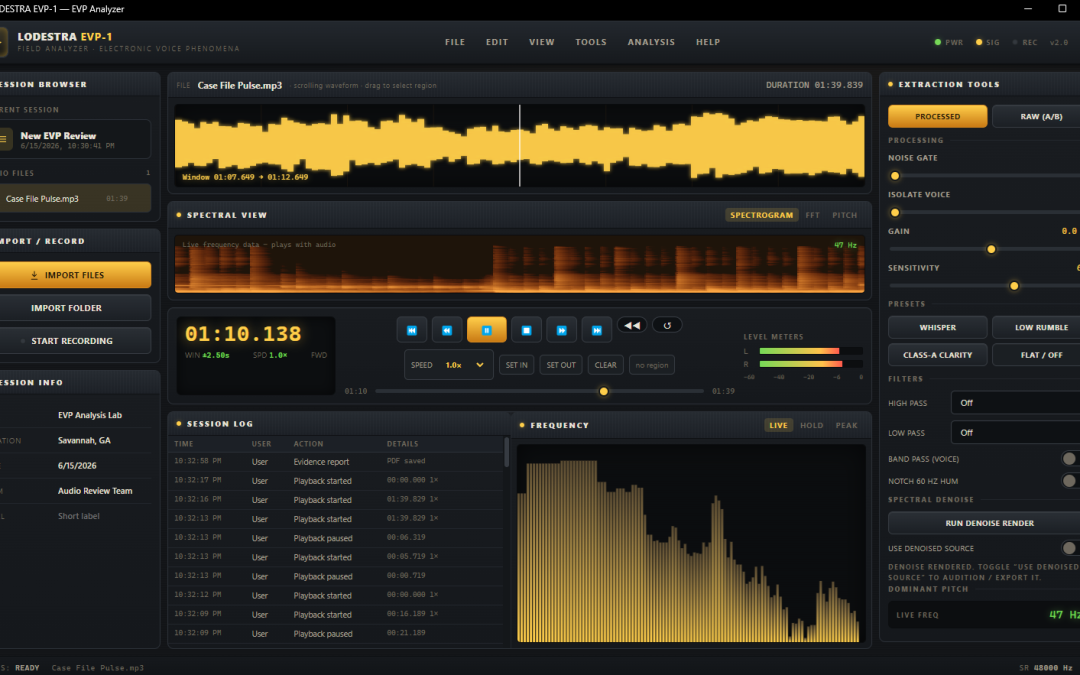
That process can become overwhelming, and listening alone makes it harder than it needs to be. One of the main purposes of the Lodestra EVP-1 Field Analyzer is to make the work both more visual and more structured. Instead of endlessly scrubbing and hoping to catch something by ear, investigators can watch a scrolling waveform and spectral view as the audio plays, so a faint event often becomes visible before it becomes audible. They can mark exact points of interest during playback, and each marked moment becomes a documented EVP entry connected to a precise timestamp.
That changes the workflow. The investigator is no longer simply listening and hoping they remember what they found. They are examining the sound and building a review record as they go. Each potential EVP becomes part of an organized log — not just a loose mental note or a clip saved somewhere on a hard drive. This is especially useful for teams with multiple reviewers: one investigator identifies and tags a possible response, another opens the same timestamp, sees the same waveform, and adds their own interpretation.
Seeing the Sound, Not Just Hearing It
The ear is easily fooled, especially in unclear audio. Seeing the sound is often what separates a real event from an imagined one. The EVP-1 Field Analyzer is built around that idea: alongside a scrolling waveform, a spectral view, spectrogram, live FFT, and a pitch trace let you actually look at the structure of a sound. A genuine spoken syllable, a knock, a burst of radio interference, and a bit of handling noise all look different — and once you can see that difference, you can evaluate it instead of guessing.
Examination also means being able to slow down and isolate. You can scrub the waveform to land on the exact moment, loop a short region so it plays over and over while you study it, and play it slowed down to hear detail that races past at normal speed. When a faint voice is buried under a steady electrical hum or constant room tone, real-time cleanup and denoise can pull that background down so what remains is easier to judge — without ever touching the original file.
Clarify the Sound — Without Putting Words In It
Cleanup is interpretation, and it has to be handled honestly. Pulling down hum, reducing noise, or boosting a quiet passage can make a sound clearer — but pushed too far, the same tools can sculpt a vague noise into something that seems like a word. The EVP-1 Field Analyzer is built to keep that honest.
Processing is non-destructive: the original recording on disk is never altered, and the cleanup only changes what you are hearing and seeing in the moment. A one-press RAW comparison flips instantly between the processed audio and the untouched original, so you — and anyone reviewing your work later — can always hear exactly what the recorder captured versus what cleanup revealed. The point is to make a faint, real sound easier to evaluate, not to manufacture one, and a "voice" that only appears after heavy processing should be documented as exactly that.
Why This Matters
Audio interpretation is complicated. The human brain is very good at finding patterns, especially in unclear sound. Once someone suggests a word or phrase, other listeners may be more likely to hear the same thing — even if the audio is genuinely ambiguous. That is exactly why the EVP-1 Field Analyzer shows you the sound and lets you classify it, but never tells you what it says. It will not transcribe a voice, identify a ghost, or declare a recording paranormal. A responsible workflow leaves room for uncertainty — to mark a sound as "possible voice," "contamination concern," or "needs secondary review" without forcing a conclusion — and the analyzer is built to support that, not override it.
Evidence, Not Entertainment
EVP is one of the easiest forms of paranormal evidence to mishandle. A dramatic clip can be posted online with captions, music, and a suggested phrase. Viewers are told what to hear before they hear it. The clip is separated from the full recording. The timestamp is missing. No one knows what happened in the room before or after the sound. There is no record of possible contamination, and no way to see what the audio actually looked like. The moment becomes content, not evidence.
Treating EVP as evidence means slowing down. It means examining the sound rather than reacting to it. It means preserving the original file, documenting the timestamp, noting uncertainty, considering natural explanations, and resisting the urge to overstate what a recording proves. A well-examined EVP may still be inconclusive — but it is much more useful than a dramatic clip with no supporting information.
Why Timestamps Matter
A timestamp is one of the most important pieces of information in EVP review. Without it, a potential EVP becomes difficult to verify. Investigators may struggle to locate the original moment in the source file. Other reviewers cannot compare the clip against the surrounding audio. Case notes, room logs, video footage, and environmental data cannot be properly aligned.
With an exact timestamp, the moment becomes part of the larger investigation. Imagine an investigator finds a possible voice at 00:42:17 in an upstairs bedroom recording. That timestamp can be compared against the investigation timeline. Was a team member in the hallway at that time? Was another recorder running nearby? Was a camera pointed toward the same area? Did the client report activity in that room? Did the team ask a question just before the sound? A timestamp allows the audio to be tested against context.
Markers, Classes, and Tags
Not every audio anomaly belongs in the same category. Some sounds may be possible voices. Others may be knocks, footsteps, mechanical sounds, unexplained interference, or likely contamination. In the EVP-1 Field Analyzer, marking a moment drops a timestamped entry you can classify and tag, so the differences are recorded rather than lost.
Because EVP investigators already work with a long-standing scale, the analyzer builds it in directly: each marker can be rated EVP Class A, B, or C — from a clear, easily understood voice down to a faint sound that requires enhancement or headphones — alongside tags for the kind of sound and its review status:
By classifying and tagging entries, investigators can sort and review findings efficiently. Instead of treating every marked moment as equal, teams can separate high-priority review items from uncertain or explained sounds, and a moment first marked "possible EVP / needs review" can be updated to "Class C / contamination" later without losing its original timestamp.
Investigator Notes Preserve First Impressions
When reviewing audio, first impressions can be useful — but they should be documented carefully. An investigator might hear what sounds like a name, a phrase, or a response to a question. Another reviewer may hear only a breath, movement, or unclear noise. Those differences should not be ignored. They should be recorded.
Investigator notes give teams a place to preserve those observations without forcing immediate agreement. For example, a well-documented entry might look like this:
Example entry notes
- Reviewer 1 hears possible phrase: "get out." Very faint, appears after question at 00:42:17. Tagged Class C candidate.
- Reviewer 2 hears unclear two-syllable sound — not confident in word identification.
- Spectrogram shows energy in speech range, but a narrow hum band runs underneath; cleaned with RAW kept for comparison.
- Possible hallway contamination. Check video from stairwell at same timestamp.
- Occurs during silence after direct question. No investigator speech noted in surrounding audio.
These notes help prevent the review process from becoming too subjective. They also make it easier to revisit the moment later with fresh ears — and to compare it against what other reviewers heard without anchoring them to a prior conclusion.
EVP Review Should Include Skepticism
Good EVP work requires patience and skepticism. That does not mean dismissing every strange sound. It means refusing to jump to conclusions. Before labeling something paranormal, investigators should ask basic questions — and the analyzer's tools exist to help answer them.
Questions to ask before classifying a sound
- Could it be a team member whispering or moving?
- Could it be sound from outside the building?
- Could it be a device artifact or handling noise — and does the waveform look like one?
- Could it be clothing, breathing, footsteps, or equipment?
- Does it still sound like a word in the RAW, un-processed audio?
- Could the suggested phrase be influencing what reviewers hear?
- Could the audio simply be too unclear to classify honestly?
A good analyzer should help investigators document uncertainty, not erase it. Because the EVP-1 Field Analyzer shows and clarifies audio but never decides what a voice says, the responsibility stays where it belongs: with the review process, the team, and the evidence standards they choose to follow.
What the EVP-1 Field Analyzer Helps Solve
Waveform & Spectral View
Watch a scrolling waveform and spectrogram as audio plays, so a faint event often becomes visible before it becomes audible.
Spectrogram, FFT & Pitch
Look at the structure of a sound to tell a spoken syllable apart from a knock, radio interference, or handling noise.
Real-Time Cleanup
Strip steady hum and room tone and reduce noise in real time to bring a buried sound forward — without ever altering the original file.
RAW vs Processed A/B
Flip instantly between the cleaned audio and the untouched original, so enhancement stays honest and fully reversible.
Exact Timestamps
Mark precise moments of interest during playback. Never lose track of where a potential EVP occurred in a long session.
Class A/B/C Markers & Tags
Rate each moment on the EVP scale and tag it by type and status, so high-priority moments don't get buried with explained sounds.
Investigator Notes
Preserve first impressions and reviewer disagreements without forcing conclusions. Multiple reviewers can document what they heard independently.
Clip, WAV & JSON Export
Export the marked clip, the audio, and the structured log together, so a moment never gets separated from its original recording.
PDF Evidence Reports
Build final reports from documented entries rather than memory — every claim arrives with a timestamp, class, tags, and notes attached.
Lodestra EVP-1 Field Analyzer
Turn Hours of Audio Into an Organized Review Record
Built for paranormal investigators who treat EVP as evidence, not entertainment — examined on your own machine, with no cloud and no account.
Explore the EVP-1 Field AnalyzerThe Bottom Line
A possible voice without examination is weak. A clip without a timestamp or context is incomplete. A claim without notes is difficult to evaluate. A report without careful review does not serve the client, the team, or the investigation. The Lodestra EVP-1 Field Analyzer gives investigators a better way to work audio — a visible waveform and spectral view, real-time cleanup that clarifies rather than invents, RAW comparison, Class A/B/C markers with tags and notes, and structured exports that support clearer reporting and long-term documentation.
For teams who take EVP seriously, that structure is not optional. It is the difference between a sound and a case record.