
Paranormal Research · Technology & Investigation
Why Serious Paranormal Investigators Need a Better Case File System
Good investigations don't fail because of the evidence. They fail because of the paperwork.
Paranormal investigation has always lived in the space between experience, evidence, history, and interpretation. A witness reports something unusual. A location carries a reputation. A team arrives with equipment, cameras, recorders, notebooks, and questions. Hours are spent documenting rooms, listening for sounds, taking readings, reviewing footage, interviewing witnesses, and trying to separate what happened from what might only appear to have happened.
But too often, the investigation does not fail because of the evidence. It fails because of the paperwork.
Notes end up scattered across different notebooks. Audio files sit in folders with vague names. Photos get saved to someone's phone. One investigator remembers a cold spot in the hallway, another remembers an EMF spike in the bedroom, and no one can quite remember whether the furnace had kicked on at the same time. A client statement gets summarized but not properly recorded. A possible natural explanation is discussed during the investigation, then forgotten by the time the final review begins.
That is where a dedicated case file system becomes essential. Because in the end, the strongest paranormal investigations are not built on fear. They are built on documentation.
Paranormal Research Needs Structure
A good investigation is not just a night in a dark building with equipment running. It begins before anyone arrives on site. There is a client or witness report. There may be a history attached to the location. There are claims to document, rooms to identify, environmental conditions to note, baseline readings to record, equipment to prepare, team roles to assign, and questions that need answers.
Then, during the investigation, more information accumulates. Investigators take notes. Audio sessions are conducted. Cameras are placed. Sensors are monitored. People report sounds, movement, temperature changes, emotional impressions, and equipment responses. Some of those moments may be important. Some may later turn out to have ordinary explanations.
Afterward comes the hardest part: review. What was reported? What was observed? What was recorded? What was ruled out? What still remains unexplained? Without structure, that process becomes messy fast.
From First Contact to Final Report
One of the biggest problems in paranormal fieldwork is that the investigation is often treated as a single event. In reality, every case is a process. It may begin with a phone call, an email, or a message from someone who has experienced something they cannot explain. That first contact matters. The exact wording of a claim can be important. The timeline matters. The witness's emotional state, location, prior experiences, and expectations may all provide useful context.
A professional case file should preserve that early information before it gets simplified or distorted. Good documentation allows investigators to return to the original claim later and compare it against what was actually observed. Did the team experience activity in the same area? Did equipment readings match the reported pattern? Did a claim change over time? Was there a natural explanation that only became clear after reviewing the full context?
The Core Principle
That does not mean every story is automatically accepted as paranormal. It means every story is properly documented. A well-built case file makes it possible to return to the original claim, compare it against the investigation, and answer harder questions with real evidence rather than memory.
Location History Matters
Paranormal claims do not exist in a vacuum. The location itself matters. A private residence, historic building, hotel, cemetery, or long-term research site may have layers of history attached to it. Ownership changes, renovations, deaths, local legends, newspaper accounts, folklore, and community memory can all influence how people experience and interpret a place.
History can both support and challenge a case. Sometimes the historical record gives important context to a reported claim. Other times, it reveals that a popular ghost story has been exaggerated, misremembered, or attached to the wrong person. A strong case file should not simply collect spooky stories. It should separate documented history from legend, witness experience from rumor, and evidence from assumption.
What a Complete Case File Should Include
Client & Witness Records
Original claim language, timelines, prior experiences, credibility notes, and follow-up interview documentation — before discussion distorts the original account.
Location History
Ownership history, renovations, deaths, local legends, newspaper references, and research sources — separated clearly from reported experiences.
Room-by-Room Documentation
Claims, observations, equipment placement, and activity organized by specific area — so patterns and contradictions become visible across a large location.
Equipment & Environment Logs
Device used, baseline readings, nearby electrical sources, temperature, humidity, barometric pressure, weather, moon phase, and noise contamination for every session.
Evidence Management
Photos, audio clips, video files, EVP sessions, transcripts, and reviewed findings — organized within the case file with time stamps and context attached.
Debunking Notes
Natural explanations considered, contamination sources identified, structural issues noted, and ruled-out causes documented — because what was eliminated is as important as what remains.
Debunking Is Part of the Investigation
One of the most important features of a professional case file system is the ability to document what was ruled out. Paranormal research becomes weaker when it only records the strange moments. A serious investigation should also record natural explanations, contamination sources, structural issues, wildlife, plumbing, electrical sources, human error, and psychological factors.
When a team can say, "We considered these possibilities, we checked these conditions, and this is what remained unexplained," the final conclusion carries more weight. The goal should never be to force a paranormal answer. The goal should be to document the case honestly. Sometimes the best finding is that a sound came from plumbing, a shadow came from headlights, or a strange feeling was influenced by environmental conditions. Either way, the record should show the work.
Better Team Communication
Paranormal teams often work under difficult conditions — late at night, in large buildings, with multiple rooms, multiple pieces of equipment, and multiple people collecting information at once. That creates communication problems. Who interviewed the client? Who was assigned to audio review? Who checked the attic? Who logged the baseline readings? Who is responsible for the final report?
A case file system helps teams track team members, roles, session notes, evidence assignments, and follow-up tasks. For solo investigators, the same structure is just as useful. It creates a disciplined process that keeps the investigation organized from beginning to end.
Final Reports That Actually Mean Something
A final report should be more than a list of spooky moments. It should explain the claims, summarize the investigation, present the reviewed evidence, include relevant context, discuss possible explanations, and offer clear conclusions. It should be understandable to the client, useful to the team, and strong enough to be referenced later.
A well-documented case file allows investigators to say more than "we heard something" or "we had some strange readings." That is the difference between an anecdote and a case file.
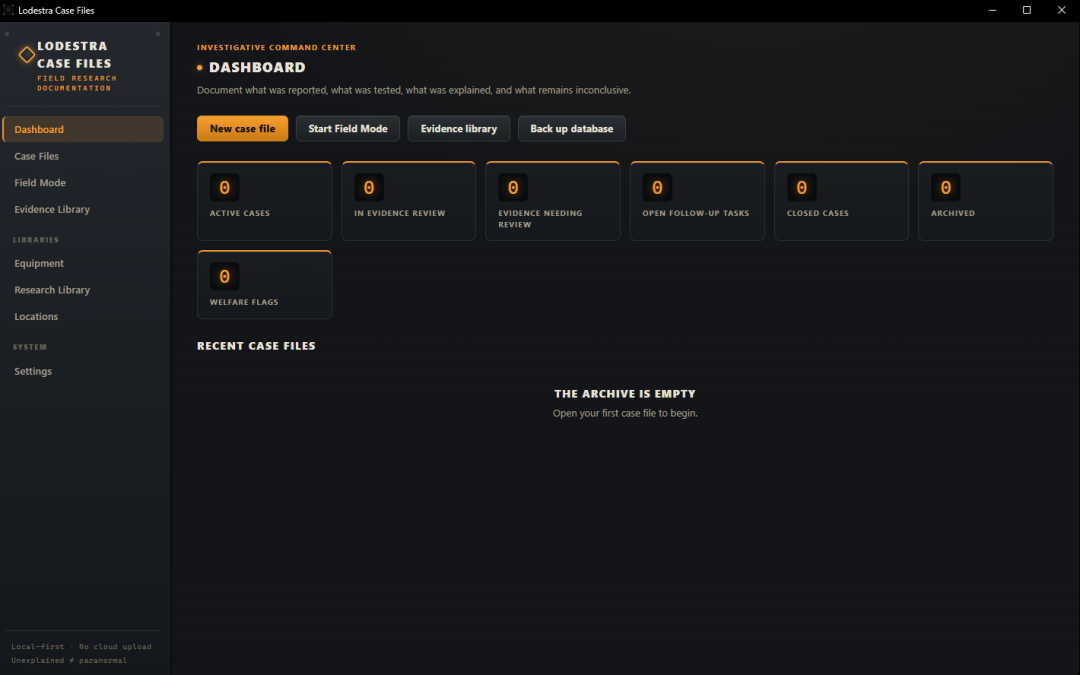
Who should use the Lodestra Case File Manager
- Paranormal investigation teams that need a central system for case documentation across multiple investigators and locations.
- Solo investigators who want a more professional workflow without relying on scattered notebooks and disorganized media folders.
- Historical researchers documenting claims tied to specific locations, tracking provenance of legends and witness accounts over time.
- Haunted location owners who want to keep organized records of reported activity for research, preservation, or visitor documentation.
- Ghost tour researchers who need to organize history, folklore, witness accounts, and location notes into a coherent reference.
- Content creators who want better organization for investigations, videos, podcasts, or written case studies.
- Field investigators who want to preserve every detail from first report to final conclusion — and present it in a way that holds up to scrutiny.
Lodestra Case File Manager
Start Documenting Your Cases the Right Way
Built for paranormal investigators, historical researchers, and haunted location owners who want to take their documentation seriously.
Explore the Case File ManagerA Better Record of the Unknown
Paranormal investigation will always involve uncertainty. Not every sound will have an answer. Not every witness account can be proven. Not every piece of equipment data will be meaningful. But uncertainty is exactly why documentation matters. The unknown should not be handled carelessly. A structured case file gives investigators a way to preserve what was reported, what was observed, what was measured, what was reviewed, what was explained, and what remains open — a record that can be revisited, compared, updated, and understood.