
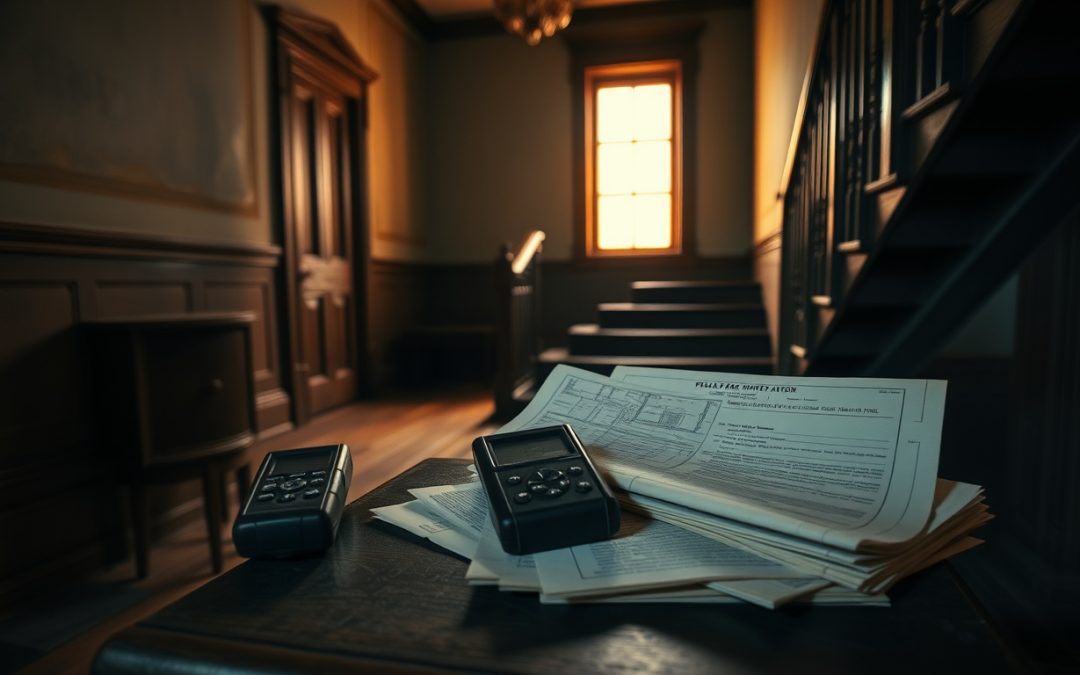
Before an investigator records a single frame of video or tags a possible EVP, there’s a quieter, less glamorous piece of work that decides how useful the whole case will be. It has nothing to do with instruments. It’s the location’s history — who built the place, what it was used for, what’s been renovated, what’s flooded or burned, and who has lived and died within its walls. In serious paranormal research, that background isn’t a footnote. It’s frequently the fastest path to an ordinary explanation, and when the ordinary explanations run out, it’s what gives the remaining questions any weight.
Consider a common scenario. A homeowner reports cold spots in a back bedroom, footsteps on the stairs at night, and a door that opens on its own. Alarming to live with. But before we reach for the extraordinary, the Lodestra Razor asks us to rule out the mundane first. And the mundane is often written into the building itself: a bedroom on the north wall with a failing window seal, a staircase built from old lumber that expands and contracts with temperature, a door hung slightly out of plumb in a house that has settled for ninety years. You cannot evaluate any of that without knowing the structure’s story.
What Location History Actually Tells You
Location history is the documented record of a place over time. For a house, that might include the year of construction, major renovations, additions, changes in heating and plumbing, past owners, and any significant events tied to the address. For a public building — a theater, hotel, hospital, or cemetery — the paper trail is often richer and more accessible, sometimes stretching back a century or more.
This matters for two reasons. First, history generates explanations. A “phantom smell” of smoke may trace to a real fire decades earlier that left residue in the framing. Recurring cold drafts may follow the path of an old chimney flue that was sealed but never insulated. Second, history shapes expectation, and expectation shapes perception. When a witness knows a building is “supposed” to be haunted — because a previous owner said so, or because the local reputation precedes it — that knowledge primes them to interpret ordinary noises as significant. That’s not a character flaw. It’s how human attention works. Knowing the source of a story is as important as knowing the source of a sound.
The Difference Between Folklore and Record
Not all history carries the same weight, and a good case file keeps the categories separate. There’s documented record: deeds, census data, newspaper archives, building permits, obituaries, fire and police reports. Then there’s oral history and folklore: the stories neighbors tell, the legend attached to a room, the name everyone uses for “the haunted stairs.” Both belong in a file, but they are not equal evidence. Folklore tells you what people believe about a place. Record tells you what actually happened there. Confusing the two is one of the most common failures in amateur paranormal investigation, and it’s easy to avoid simply by labeling your sources honestly.
How Location History Prevents False Positives
Most reported activity has an ordinary cause hiding in the building’s physical past. A methodical historical review catches a surprising share of them before you ever set up equipment.
- Structural settling. Older buildings shift. Wood frames creak on temperature cycles, especially at dusk and dawn when temperatures swing. Construction dates and materials tell you what to expect.
- Renovation seams. Where new construction meets old, you get uneven insulation, hidden voids, and airflow paths that produce drafts and temperature gradients. Permit records reveal where those seams are.
- Plumbing and HVAC. Knocking pipes, expanding ductwork, and old radiators produce raps and groans on a schedule. Knowing the age and layout of these systems lets you correlate “activity” with a furnace cycle.
- Electrical history. Old or overloaded wiring can produce elevated electromagnetic fields. High EMF exposure is associated in some laboratory research with feelings of unease and a sense of presence. Knowing the wiring’s age and routing helps you interpret meter readings honestly — a spike near old knob-and-tube wiring is an electrical finding, not a spirit.
- Prior claims. If a location’s reputation predates your witness, their expectations may be inherited rather than independent. That doesn’t dismiss their experience, but it changes how you weigh it.
None of this proves nothing happened. It means you’ve done the work required to say, honestly, that a given report does or does not have an obvious cause. That honesty is the entire value of evidence-based investigation.
Infrasound, EMF, and the Physical Fingerprint of a Building
Some of the most interesting mundane explanations in paranormal research are also the least intuitive, and they’re tied directly to a building’s construction. Infrasound — sound below roughly 20 Hz, too low to hear consciously — has been studied as a possible cause of unease, chills, and the sensation of a presence. Certain research has explored how low-frequency vibration from fans, traffic, wind across a structure, or resonant spaces might produce these effects. A building’s shape, its mechanical systems, and its surroundings all influence whether infrasound is present. You won’t know to look for it unless you understand the site.
The same logic applies to electromagnetic fields. An EMF meter measures electromagnetic fields — nothing more. It does not detect spirits, and no honest investigator should imply otherwise. What it can do is help you map the electrical environment of a location so you can correlate a witness’s “creepy feeling” in one corner with, say, an old fuse panel behind that wall. When you pair meter readings with an accurate picture of the building’s electrical history, the readings start to mean something. Without that context, a number on a screen is just a number.
Building the Location History Section of a Case File
Here’s a practical framework for documenting a site’s past thoroughly enough to stand up later.
1. Start With the Public Record
Pull what’s available: property records and deeds from the county, building permits, historical maps, census records, and archived newspapers. Libraries and local historical societies are often more useful than anything online. Record dates, sources, and the specific document you drew each fact from. If you can’t verify something, mark it unverified rather than dropping it silently.
2. Interview With Care
Talk to current occupants and, where possible, previous ones and neighbors. Ask open questions and avoid leading them toward paranormal framing. “Tell me about this room” yields cleaner information than “Where do you feel the presence?” Note who told you what, and keep their beliefs labeled as beliefs.
3. Walk the Structure Physically
Match the paperwork to the building. Where are the additions? Which walls are exterior? Where does the HVAC run? Which windows are original? A floor plan annotated with these features turns abstract history into something you can test against reported activity. Mapping tools like SpecterGrid Location Mapper let you build a scaled layout, mark rooms and equipment placement, and drop pins where activity was reported, so the spatial relationship between a claim and its possible physical cause is visible at a glance.
4. Keep It All in One Structured File
Scattered notes are how good context gets lost. History, witness statements, room readings, and later evidence all need to live together so you can cross-reference them. A dedicated Paranormal Case File Manager is built for exactly this — logging the location history alongside witness accounts and room-by-room readings, then exporting a conclusion that shows your reasoning rather than just your findings. When your final report can point to the deed, the permit, the interview, and the meter reading that led to each conclusion, it holds up to scrutiny.
When the History Runs Out
Here’s the part that keeps careful investigators curious. Sometimes you do all of this — you pull the records, walk the structure, rule out the plumbing and the wiring and the drafts and the settling — and a small residue of experience remains that you genuinely can’t explain. That’s the honest edge of paranormal investigation. It’s a much smaller territory than television suggests, but it’s real, and it’s only interesting because of the rigor that got you there.
Location history is what makes that residue meaningful. Without it, an unexplained cold spot is just a cold spot you didn’t bother to investigate. With it, you can say: I know when this building was built, how it’s been changed, what its systems do, and what its neighbors claim — and this particular observation still doesn’t fit. That statement carries weight precisely because you earned the right to make it. The mystery you find at the end of a thorough historical review is worth far more than the one you assume at the beginning.
The Habit That Separates Serious Work From Guesswork
Every strong case file in paranormal research shares a quiet feature: it treats the building as a witness with a long memory. The walls record renovations, the wiring records its age, the floor plan records where cold air travels. Read that testimony first, and half your “anomalies” resolve into ordinary physics. Read it carefully, and the handful that remain become genuinely worth your attention.
If you’re building an evidence-based practice, start treating location history as a required section rather than an optional one. Document it with the same care you’d give an EVP or a piece of video. You can explore the field methods and research tools at Lodestra to see how structured documentation, honest instrumentation, and the Lodestra Razor fit together into an investigation that respects both the witness and the evidence.