
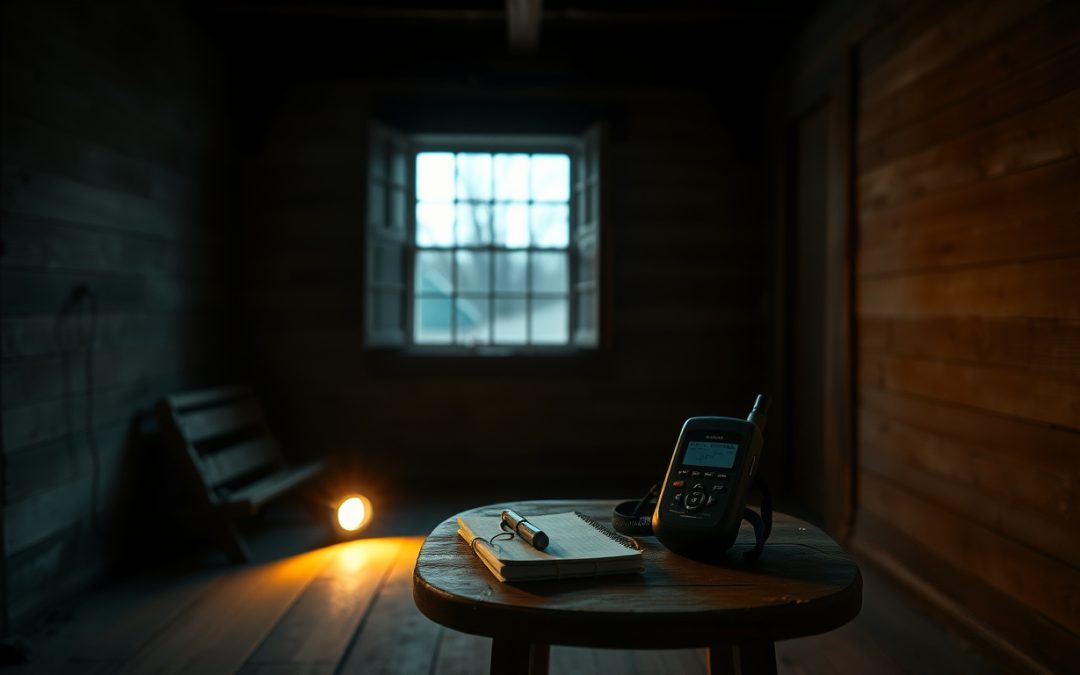
There’s a common misunderstanding about serious paranormal research: that skeptics and investigators sit on opposite sides of a line. In practice, the best investigators are the most demanding skeptics in the room. They arrive at a reportedly haunted house wanting to find the loose ductwork, the failing wiring, the low-frequency hum from a nearby compressor — because every ordinary cause they rule out is a cause they no longer have to argue about later. Skepticism isn’t a rejection of the unexplained. It’s the discipline that makes an unexplained result worth taking seriously at all.
This is the heart of what we call the Lodestra Razor: rule out the ordinary before you reach for the extraordinary. It sounds simple. Applied honestly, in the dark, at two in the morning, when a witness is frightened and your own senses are primed to find meaning, it is one of the hardest things a paranormal investigation can ask of you.
What Skepticism Actually Means in Paranormal Research
Skepticism gets a bad reputation because people confuse it with denial. A denier decides the answer before looking. A skeptic withholds judgment until the evidence earns it. Those are opposite habits of mind. Real paranormal research depends on the second one.
The scientific attitude here is straightforward. A claim is only as strong as the effort made to disprove it. If you record an anomalous sound and stop investigating the moment it excites you, you haven’t found evidence — you’ve found a stopping point that felt good. The value of any finding lives entirely in how hard you tried to explain it away first.
This is why parapsychology, the formal academic study of these phenomena, has always lived or died by methodology. The field’s more credible chapters — controlled card-guessing trials, sensory-deprivation experiments, statistical analysis of large data sets — earned attention precisely because they built in controls against fraud, coincidence, and self-deception. Its weakest moments came when enthusiasm outran rigor. The lesson holds for anyone doing field investigation today: your conclusions are only as trustworthy as your controls.
The Mundane Explanations That Fool Everyone
Before we talk about instruments or evidence, it helps to know what usually causes a “haunting.” These explanations are not exotic. They’re common enough that experienced investigators check for them reflexively.
Infrasound and Low-Frequency Vibration
Sound below roughly 20 hertz sits under the threshold of conscious hearing, yet the body can still respond to it. Researchers have documented that infrasound around 18–19 Hz can produce feelings of unease, pressure, or the sense of a presence in a room. Fans, ventilation systems, traffic, and even wind moving across a structure can generate it. A room that feels “wrong” may simply be a room with a resonant frequency you can’t hear.
Electromagnetic Fields
Old or faulty wiring, unshielded appliances, and high field strengths near electrical panels can create conditions that some studies associate with feelings of dizziness or the sensation of being watched. This is why an EMF meter belongs in every kit — not because it detects spirits, but because it detects the fields that can explain a witness’s experience. Read that sentence twice. An EMF meter measures electromagnetic fields. That is all it does. Any device that spikes near a wall may be reacting to a live cable behind the plaster, not to anything paranormal.
Drafts, Settling, and Structure
Buildings move. Wood expands and contracts with temperature, foundations settle, pipes knock, and pressure differences pull doors shut. A cold spot is very often a draft path you haven’t traced yet. Before a temperature drop becomes evidence, you owe it to the case to find the window frame, chimney, or gap under the floor that explains it.
Perception, Suggestion, and Pareidolia
The human brain is a pattern-finding machine. Pareidolia is the tendency to see faces in wallpaper and hear words in noise. Suggestion is even more powerful — tell a group that a room is active, and people will begin to notice their own heartbeat, the creak of the house, the shape in the shadow. None of this makes witnesses liars. It makes them human. A responsible paranormal investigation accounts for the observer as carefully as the environment.
What Instruments Can and Cannot Tell You
Ghost hunting technology has grown enormously, and with it a great deal of confusion about what these tools actually measure. Here is the honest version.
An EMF meter reads electromagnetic fields. A thermometer reads temperature. A digital recorder captures air-pressure changes as audio. A camera records light. Not one of these instruments has a “paranormal” setting, because none of them can detect something that has never been physically defined. What they can do — and this is genuinely useful — is document the environment precisely enough that you can separate the explainable from the unexplained.
That distinction is the entire game. Good paranormal technology doesn’t prove anything supernatural. It builds a rigorous record of conditions, so that when something truly doesn’t fit the ordinary explanations, you can show your work. The instrument is a witness with no imagination and no fear. That’s exactly why it’s valuable.
The Problem With Chasing the Reading
A meter spikes. The room goes quiet. Everyone leans in. This is the moment skepticism matters most, because a single reading in isolation means very little. Was there a phone nearby? A motor cycling on? A fluctuation in the building’s power draw? The reading is a question, not an answer. Treat it as the start of an investigation, not the end of one.
Building Evidence That Survives Scrutiny
The strongest defense against self-deception is documentation. If your process is loose, your conclusions can’t be trusted — not by a client, not by a peer, and not by your own memory a month later. This is where careful paranormal research separates itself from a night of atmospheric guessing.
Audio Evidence and EVP Review
Electronic voice phenomena — apparent voices captured on recordings that weren’t heard at the time — are among the most cited and most misunderstood categories of evidence. Most alleged EVPs turn out to be radio bleed, stray voices, equipment noise, or the mind imposing words onto random sound. Serious EVP review means working non-destructively, keeping the original file untouched, isolating and labeling anything of interest, and being brutally honest about how much interpretation you’re adding.
A dedicated tool helps enforce that discipline. Something like the DeadAir Audio Analyzer Pro lets you import, slow, mark, and classify possible EVP events while preserving the source audio, which matters because the first rule of audio evidence is that you never alter the original. The software doesn’t decide whether a sound is paranormal. You do — and you should do it skeptically.
Video and Photo Analysis
The same principle applies to footage and stills. A “shadow figure” is often a compression artifact, a moth near the lens, a reflection, or motion blur. Working frame by frame, comparing enhanced views against an untouched original, and inspecting metadata are how you tell a real anomaly from an ordinary one. Tools such as the PhantomFrame Pro Video Analyzer and the PhantomCapture Photo Analyzer are built around that A/B honesty — enhancement that never overwrites the source, so you can always show what you started with. That transparency is what makes an image worth presenting at all.
Documenting the Whole Case
A single piece of evidence rarely means anything on its own. What matters is the full picture: the witness accounts, the location’s history, the environmental readings, the timeline, and — crucially — the debunks. The things you ruled out are part of the record, not footnotes. A structured Paranormal Case File Manager keeps all of it in one place, from the first client call to the final conclusion, so the reasoning behind your findings stays visible and defensible. When you can show what you eliminated, whatever remains carries real weight.
A Practical Framework for Skeptical Investigation
If you want to bring this discipline into your own field investigation, a simple sequence keeps you honest:
- Interview before you investigate. Gather witness accounts separately when possible, so no one’s story shapes another’s. Note emotional state and expectations.
- Baseline the environment. Before you look for anomalies, record normal readings — EMF, temperature, ambient sound. You can’t recognize the unusual without knowing the usual.
- Hunt for the ordinary cause first. Trace drafts. Check wiring. Identify sources of infrasound and vibration. Map where activity is reported against where mundane explanations exist.
- Capture cleanly and preserve originals. Never edit source files. Every enhancement should be reversible and shown alongside the untouched original.
- Document your debunks. Write down what you explained and how. This is the most valuable part of any report.
- Report only what the evidence supports. “Unexplained” is an honest conclusion. “Proof of a ghost” almost never is.
Notice that most of this work is unglamorous. That’s the point. The dramatic footage and the eerie voices are the small end of the effort. The real labor is the patient, skeptical grind of elimination — and it’s what makes the rare, genuinely puzzling result mean something.
Skepticism as Respect
There’s an ethical dimension here that’s easy to miss. When someone invites you into their home because they’re frightened, the least respectful thing you can do is confirm a haunting you haven’t earned the right to claim. Sometimes the kindest and most honest outcome of a paranormal investigation is a mundane explanation — a fix for the wiring, a source for the draft, a name for the sound in the walls. Taking a witness seriously means testing their experience rigorously, not flattering it.
Skepticism, done right, is not coldness. It’s care. It says: your experience mattered enough that I refused to hand you a cheap answer.
Where Serious Paranormal Research Goes From Here
The future of credible paranormal research belongs to investigators who treat rigor as the whole point rather than an obstacle to the good part. Better instruments, cleaner documentation, and honest analysis won’t produce more ghosts. They’ll produce fewer false positives — and that’s genuine progress, because it means the cases that survive scrutiny are the ones actually worth studying.
If that’s the kind of investigator you want to be, keep sharpening the skeptical habit until it’s second nature. You can explore the research and field methods at Lodestra to see how a disciplined, evidence-first approach translates into tools built for careful work. The mystery survives careful investigation just fine. Everything else is what we’re supposed to clear away.