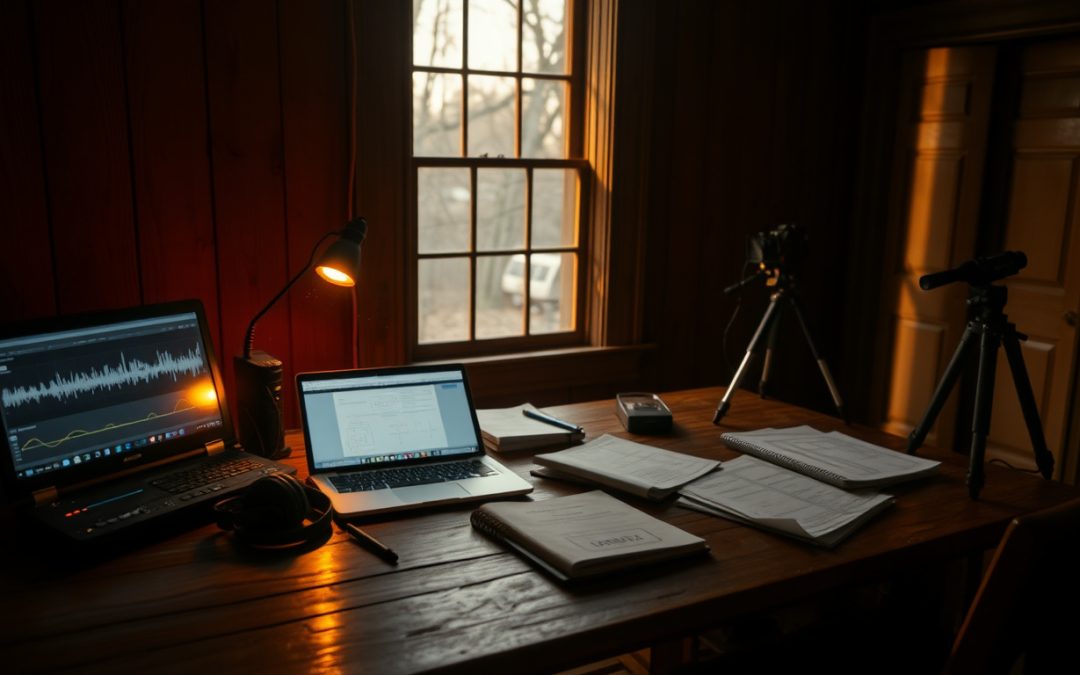
The most important part of paranormal research doesn’t happen in a dark hallway at two in the morning. It happens days later, at a desk, with a good pair of headphones and a strong cup of coffee, when you sit down to review what your instruments actually recorded. This is where careful work separates a credible case from a collection of jump scares. Evidence review is slow, unglamorous, and frequently disappointing — and that is exactly why it matters.
Most of what feels compelling in the field falls apart under review. The whisper you were sure you heard turns out to be a colleague shifting their weight. The shadow in the doorway becomes a passing car’s headlights sweeping through a gap in the curtains. A rigorous investigator treats that outcome as a success, not a letdown. Every mundane explanation you confirm makes the genuinely unexplained residue — the small percentage of events you truly cannot account for — far more interesting and far more honest.
This guide covers how to review the three most common forms of evidence: audio, video, and photographs. Throughout, we apply the Lodestra Razor: rule out the ordinary before you reach for the extraordinary.
Why Evidence Review Is the Heart of Paranormal Investigation
Field work generates data. Review turns data into evidence. Those are not the same thing. A recorder running for six hours captures thousands of sounds, the overwhelming majority of which have plain causes: HVAC cycles, plumbing, insects, distant traffic, the building settling as it cools. Your job during review is to account for as many of those as you can and to flag only what survives honest scrutiny.
This is also where the discipline of parapsychology has always struggled. The history of the field is full of sincere people who mistook expectation for observation. The famous cases that held up did so because someone documented conditions carefully, kept original recordings intact, and invited criticism rather than avoiding it. The ones that collapsed usually did so because enthusiasm outran method. A serious paranormal investigation lives or dies on the quality of its review process.
The Mindset That Protects You
Before touching a single file, adopt two habits. First, never alter your originals. Work on copies, and keep the raw capture untouched so you can always return to the source. Second, assume every anomaly has a normal cause until you have made a genuine effort to find it. If you go looking for a mundane explanation and come up empty after real work, that failure is worth something. If you never look, your “evidence” proves only that you didn’t try.
Reviewing Audio: EVP and the Trap of Pareidolia
Electronic voice phenomena — sounds resembling speech that appear on recordings when no obvious source was present — are the backbone of a great deal of paranormal research. They are also the category most vulnerable to error, because the human brain is relentlessly good at hearing voices in noise.
This tendency is called auditory pareidolia. Your perceptual system is built to detect speech, and it will manufacture words out of ambiguous sound, especially when someone tells you what to listen for. That last part is the killer. The moment you say “listen, doesn’t that sound like it says get out?” you have contaminated everyone in the room. From then on, they will hear it too, whether it’s there or not.
How to Review Audio Responsibly
Good EVP review follows a few firm rules:
- Listen blind first. Before anyone suggests what a clip might say, let each reviewer note independently what they hear. Compare afterward. Agreement across people who weren’t prompted means far more than a room nodding along to a suggestion.
- Log your environment. If you tagged sounds in the field — a car passing, someone’s stomach growling, a chair creak — those notes are gold during review. Most “voices” are accounted for this way.
- Classify honestly. Investigators often sort possible EVPs into rough tiers: clear and unambiguous, moderately clear but debatable, and faint enough that you’re probably projecting. Be ruthless. Almost everything belongs in the bottom tier.
- Watch what enhancement does. Slowing, amplifying, or applying noise reduction can reveal a genuinely masked sound — or it can carve artifacts out of random noise that your brain then reads as words. Always compare against the untouched original.
A dedicated audio tool makes this discipline easier to maintain. Software like the DeadAir Audio Analyzer Pro is built around a non-destructive workflow, so you can isolate, slow, reverse, mark, and classify possible EVP events while the original file stays untouched. That last feature matters more than any filter. If you can’t return to the raw capture, you can’t defend your conclusion — and you can’t check whether an “enhancement” created the very thing you’re excited about. An EVP tool doesn’t detect spirits. It helps you examine audio carefully and document what you found and how you found it.
Reviewing Video: Motion, Artifacts, and the Frame-by-Frame Method
Video feels like strong evidence because we trust our eyes. That trust is exactly the problem. Cameras introduce a long list of artifacts that look uncanny until you understand them: dust particles drifting close to the lens and catching the infrared illuminator (the classic “orb”), lens flares, compression glitches, autofocus hunting in low light, insects, and moisture on the glass. Night-vision footage is especially deceptive because the flat, grainy image strips away the depth cues your brain normally uses to judge distance and scale.
Stepping Through the Footage
Real video review is done frame by frame, not at full speed. A shape that flashes past in real time might be a moth six inches from the lens, obvious the moment you step through it one frame at a time and watch it track across the field in a straight, physical path. Movement that seems to appear from nowhere often has a mundane entry point you missed at speed.
Tools built for this — such as the PhantomFrame Pro Video Analyzer — let you step frame by frame, enhance dark footage without altering the original, run movement detection, and build motion heatmaps to see exactly what changed and where. Its RAW A/B comparison keeps enhancements honest by letting you flip between the processed and untouched versions. That honesty is the whole point. Enhancement should reveal what was already in the footage, never invent something that wasn’t.
Questions to Ask of Any Clip
- Where did the object enter the frame, and does its path obey physics?
- How close is it to the lens? Small, near objects mimic large, distant ones.
- Was the illuminator on? Reflective particles love infrared light.
- Does the artifact appear on a second camera covering the same space? If only one camera “saw” it, suspect the camera.
Reviewing Photographs: Metadata, Zoom, and Honest Comparison
Still photos carry many of the same traps as video, plus a few of their own. Long exposures blur moving light into ribbons. Camera straps and hair drift into frame as pale streaks. Reflections off windows and glossy surfaces produce faces and figures that vanish once you find the real source. And digital compression can smear detail into shapes that pareidolia happily interprets.
The first thing to examine is the metadata. Every digital photo carries EXIF data — shutter speed, aperture, ISO, timestamp, whether the flash fired. That information often resolves an anomaly outright. A long shutter speed explains a blur. A fired flash explains a bright reflective spot. A timestamp can confirm or contradict a witness’s account. Reading the metadata before you interpret the image keeps you grounded in what the camera was actually doing.
A Structured Photo Workflow
Work methodically. Inspect the metadata, zoom into the questionable region at high magnification, and compare the original against any enhanced version side by side so you can see what your adjustments added or removed. A dedicated tool like the PhantomCapture Photo Analyzer is built for exactly this: inspecting metadata, zooming into questionable areas, comparing original and enhanced versions, tagging possible anomalies, and exporting a grounded report. As always, the software analyzes an image. It does not certify anything as paranormal, and no honest tool claims to.
Documenting the Case So It Holds Up
Evidence review is only as good as the record you keep of it. If your conclusion can’t be traced back through your reasoning to the original files, it isn’t a conclusion — it’s an opinion. Strong documentation ties everything together: witness statements, the location’s history, environmental readings, the raw evidence, your enhancements, and every mundane cause you ruled out along the way.
Keeping all of that in one structured place is where a Paranormal Case File Manager earns its keep. Logging witnesses, room-by-room readings, evidence, and debunks as the case unfolds lets you export a conclusion that actually holds up to scrutiny. Mapping where activity occurred adds another layer of clarity; a tool like the SpecterGrid Location Mapper lets you build a scene layout and drop evidence pins so anyone reviewing the case can see exactly where each event happened relative to windows, vents, and equipment. Often that spatial context is what reveals the ordinary cause — the “cold spot” sitting directly under an air return, the “voice” caught nearest an exterior wall facing a road.
The Debunk Log Is Your Credibility
Keep an explicit record of everything you explained away. This “debunk log” is not an admission of failure — it is the strongest part of your case. It shows anyone reading your report that you did the work, that you tried to break your own evidence before presenting it. In serious paranormal investigation, the debunks you document are what give weight to the handful of events you couldn’t explain.
Conclusion: The Discipline Is the Point
Good paranormal research is not about proving the extraordinary. It’s about respecting the evidence enough to test it honestly, over and over, until only the genuinely unexplained remains. The whisper that survives blind review. The movement that no artifact accounts for. The photo whose metadata and geometry offer no ordinary answer. Those rare survivors are worth taking seriously precisely because you tried so hard to explain them away and couldn’t.
That patience — the willingness to sit with disappointing footage and dull audio until the truth surfaces — is what separates a hobbyist from an investigator. The instruments and software only matter insofar as they help you stay honest with yourself.
If you want to sharpen your own review process and see how rigorous, evidence-based methods come together, explore the field methods and tools at Lodestra. Bring your curiosity, and bring your skepticism. You’ll need both.