
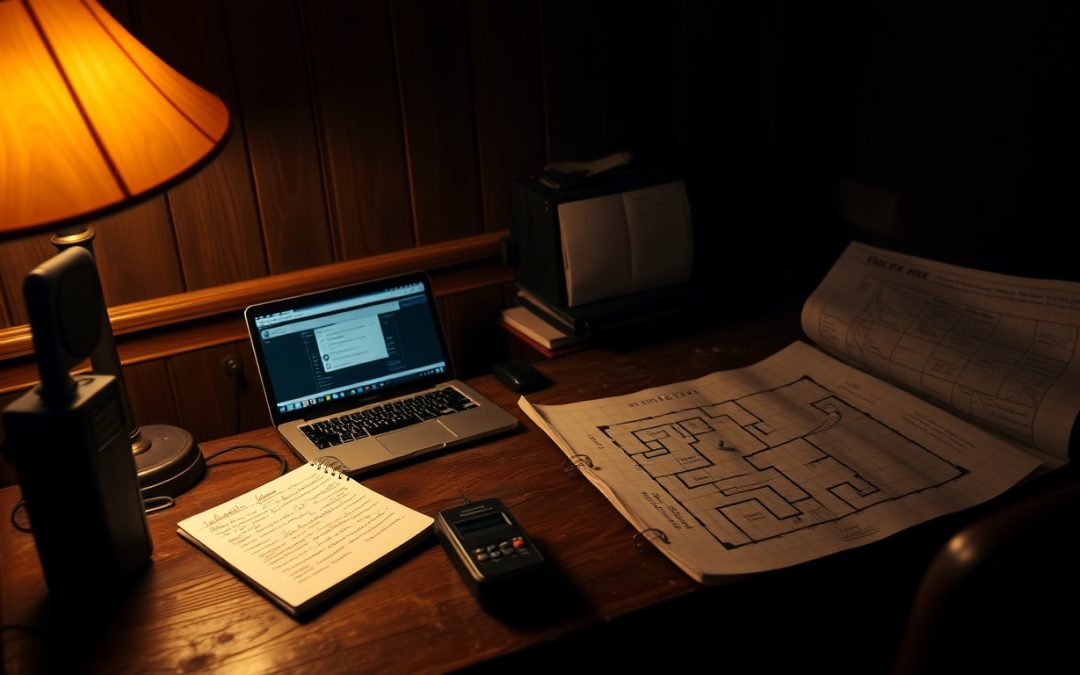
Picture the end of a long investigation. You’ve got audio files scattered across two recorders, a phone full of photos, a notebook with times that don’t quite match the timestamps on your camera, and a witness who told you three slightly different versions of the same story over the course of the night. Somewhere in that pile might be something interesting. But without a system, you’ll never be able to say so with any confidence. This is the exact problem a paranormal case manager exists to solve, and it’s one of the least glamorous, most important tools in serious paranormal research.
A case manager isn’t a gadget that blinks or beeps. It won’t detect anything. It’s the organizing spine of an investigation — the place where every observation, reading, and file lives in a structured, time-stamped, searchable form. And in a field where sloppy record-keeping has buried more genuine curiosities than any hoax ever could, that spine matters more than most people expect.
What a Paranormal Case Manager Actually Is
At its simplest, a paranormal case manager is software — or, historically, a very disciplined paper system — that holds an entire investigation in one organized file. It tracks the case from the first phone call with a worried homeowner all the way to the final report you hand back to them. Instead of evidence and notes living in a dozen apps and folders, everything connects to a single case record.
Think of it the way a detective thinks about a case file, or the way a scientist thinks about a lab notebook. The value isn’t in any single entry. It’s in the completeness and the chain — being able to trace exactly what happened, when, who observed it, what instrument recorded it, and what you eventually concluded. Good paranormal investigation depends on that traceability, because the moment your records get fuzzy, so do your conclusions.
The core things it keeps track of
A well-built paranormal case file manager generally organizes several distinct layers of information:
- The client and witnesses. Who reported the activity, what they experienced, and — crucially — their own words before anyone suggested an interpretation to them.
- Location history. The age of the building, known renovations, prior owners, plumbing and electrical quirks, and anything documented about the site’s past.
- Readings. Room-by-room measurements: temperature, electromagnetic fields, humidity, baseline noise, and the time each was taken.
- Evidence. Audio, video, and photo files, each tied to a timestamp and a location within the site.
- Debunks. The ordinary explanations you tested and either confirmed or ruled out.
That last category is the one amateurs skip and professionals obsess over. A case file that logs your debunks as carefully as your anomalies is far more valuable than one that only records the spooky bits.
Why Documentation Is the Real Foundation of Paranormal Research
The history of parapsychology is, in large part, a history of arguments over records. When researchers in the late nineteenth and early twentieth centuries began studying reported apparitions and mediums, the disputes almost never turned on whether something strange had happened. They turned on the quality of the documentation. Who witnessed it? Was the account written down that night or years later? Were the conditions controlled, or could someone have tampered with the setup? Cases collapsed not because they lacked drama but because they lacked rigor.
That lesson holds today. Human memory is reconstructive, not photographic. A witness who is certain they heard footsteps at midnight may, when pressed gently, realize it was closer to eleven — or that the sound came before, not after, the temperature drop they described. None of this means people are lying. It means memory drifts, and it drifts fast. A case manager that captures statements early, with timestamps, preserves the account before suggestion and hindsight reshape it.
There’s also the matter of the Lodestra Razor: rule out the ordinary before reaching for the extraordinary. You can’t apply that principle well from memory. You apply it by comparing records. When you can lay a witness’s reported “cold spot at 12:15” next to a logged reading showing an exterior door was opened at 12:14, the mystery often resolves itself. The case manager is what makes that comparison possible.
The problem with scattered evidence
Consider a common failure. A team captures what sounds like a whispered word on a recorder. Months later, they want to revisit it. But nobody noted which room the recorder was in, who else was present, or whether a car passed outside at that moment. The clip might be genuinely puzzling. It’s also useless as evidence, because every ordinary explanation remains open and untested. Scattered evidence isn’t just disorganized — it actively prevents honest analysis.
How a Case Manager Fits Into a Real Investigation Workflow
A paranormal investigation moves through phases, and a good case manager mirrors each one. Understanding that flow shows why the tool belongs at the center rather than tacked on at the end.
Before the investigation: intake
It starts with the initial contact. You record what the client claims, when it began, how often it happens, and what they’ve already tried to explain it. This is also where you gather practical facts that often crack a case wide open — the home’s age, recent electrical work, nearby traffic or industry, medications or stress that might affect perception. Logging this early keeps you honest later, when it’s tempting to remember only the details that support a dramatic conclusion.
During the investigation: field logging
On site, the case manager becomes a running record. You note baseline readings before anything else, because you can’t identify an anomaly without knowing what “normal” looks like at that location. Then you log events as they happen, with times that line up across your team and your instruments. A paranormal case manager works best alongside mapping — knowing an event occurred is one thing, but knowing precisely where it happened is another. Tools like the SpecterGrid Location Mapper let you build a layout of the site, mark where equipment sat, and drop pins on exactly where activity was reported, so your case file shows the scene instead of merely describing it.
After the investigation: analysis and reporting
This is where the pile of raw material becomes something defensible. You review your audio, video, and photos, comparing each flagged moment against your logs and debunk notes. Specialized analysis tools feed into this stage. Suspected voice phenomena can be examined in dedicated EVP software like the DeadAir Audio Analyzer Pro, which lets you isolate, slow, and mark possible events while keeping the original recording untouched. Video gets the same scrutiny — stepping frame by frame and running movement detection in a tool such as the PhantomFrame Pro Video Analyzer to separate a genuine anomaly from a bug drifting past the lens.
The point of tying these together in one case file is simple. Analysis results shouldn’t float free. A flagged audio event means far more when it’s connected to the exact time, room, and conditions in which it was captured — and to the notes explaining what ordinary sources you already checked.
Digital Case Managers Versus the Old Shoebox Method
For decades, dedicated investigators kept everything in binders, envelopes, and labeled cassette tapes. That method can work, and the discipline behind it is admirable. But it has real weaknesses. Paper doesn’t cross-reference itself. A binder can’t instantly show you every event logged between midnight and one in the morning across three rooms. And physical media degrades, gets misfiled, or vanishes entirely.
Digital paranormal case management software solves the cross-referencing problem. A structured case file lets you search, sort by time, link a photo to a witness statement, and pull it all into a coherent timeline. When it’s time to hand something back to a client — or to explain your reasoning to a skeptical colleague — you can export a clean, organized report instead of a shoebox. A dedicated Paranormal Case File Manager is built around exactly this workflow: witnesses, location history, room-by-room readings, evidence, and debunks all live in one structured file, with a conclusion at the end that holds up because every step behind it is documented.
What a case manager cannot do
Let’s be clear about the limits, because honesty about tools is part of the Lodestra approach. A case manager does not detect anything paranormal. It doesn’t analyze audio or enhance video by itself — those are separate tasks. It won’t tell you whether an event was genuinely anomalous. What it does is organize, preserve, and connect your data so that you can reason well. It’s an instrument for thinking clearly, not a substitute for it. Good software makes rigorous investigation easier; it can’t make a careless investigation rigorous.
Building Better Habits in Your Own Paranormal Research
You don’t need any particular software to start investigating more responsibly. The habits matter more than the tools, and they’re worth practicing regardless of what you use.
- Timestamp everything. Sync your recorders, cameras, and notes to the same clock before you begin. Mismatched times destroy your ability to correlate events.
- Record baselines first. Know what the environment reads normally before you go looking for the unusual.
- Capture witness accounts early and verbatim. Write down their exact words before you offer any interpretation. Don’t lead them.
- Log your debunks with the same care as your anomalies. “Checked the furnace at 12:30, cycled on, explains the knocking” is genuinely valuable data.
- Keep originals untouched. Work from copies. Preserve every raw file so you can always return to the source.
Adopt those five habits and your work immediately becomes more credible, whether you’re a curious hobbyist or running a structured team. A case manager simply makes them easier to sustain across a long, messy night when it’s late and you’re tired and the temptation to cut corners is strongest.
The Bottom Line on Case Managers and Paranormal Research
A paranormal case manager is not the flashiest part of an investigation, and that’s precisely why it matters. The genuine mysteries in this field — the handful of reports that resist easy explanation — only stay interesting when they’re documented well enough to survive scrutiny. Everything else dissolves under the Lodestra Razor, and a good case manager is how you apply that razor systematically instead of relying on memory and hope.
The best paranormal research looks a lot like careful, patient bookkeeping punctuated by moments of real curiosity. Organize your data, respect your witnesses, test the ordinary explanations first, and let your conclusions rest on evidence you can actually point to. If you want to see how these methods and tools fit together in practice, explore the field methods and software at Lodestra and build an investigation workflow that holds up when someone asks the hard questions.