
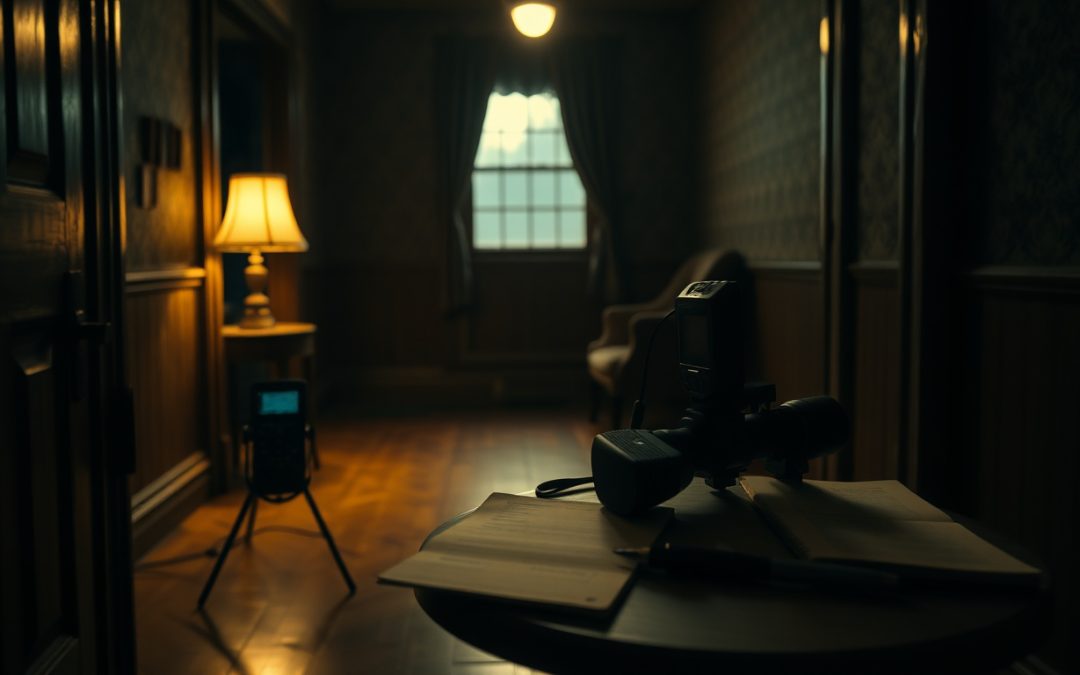
Most people picture a haunted location as a single unforgettable moment: a door that slams, a shape at the end of a hallway, a voice caught on a recorder. But serious paranormal research almost never turns on one dramatic event. It turns on sequence — what happened, in what order, under what conditions, and whether the same thing keeps recurring at the same time or place. A timeline is the tool that turns a pile of scattered impressions into something you can actually reason about.
An evidence timeline is a chronological record of everything relevant during an investigation: environmental readings, audio and video captures, witness statements, and the mundane events that so often explain the “activity.” Built well, it does something a single clip never can. It shows you patterns, and it shows you coincidences that only looked meaningful because you weren’t tracking the ordinary world alongside the strange one.
This is where the Lodestra Razor earns its keep. Before a timeline can suggest anything unexplained, it has to rule out the explainable. A good timeline is, first and foremost, a debunking machine.
Why a Timeline Matters in Paranormal Investigation
Human memory is a poor recorder. Witnesses reorder events, compress hours into minutes, and unconsciously link things that happened far apart. Ask someone about a frightening night weeks later and they’ll often describe a tidy narrative that never actually occurred in that order. This isn’t dishonesty — it’s how memory works. A written, timestamped record is your defense against it.
A timeline also protects you from your own bias. When you’re on site at 2 a.m. and tired, a creak overhead feels connected to the cold spot you felt ten minutes earlier. On paper, with real timestamps, you might see that the creak came right after a temperature drop outside, or right as the building’s heating cycled off. The connection you “felt” dissolves. That’s not a disappointment. That’s the method doing its job.
What a Good Timeline Captures
The entries that matter most fall into a few categories:
- Environmental readings — temperature, humidity, electromagnetic fields, and any measurable change over time.
- Sensory events — sounds, apparent movement, smells, and physical sensations reported by anyone present.
- Captured media — audio, video, and photos, each with an exact time and location.
- Mundane context — HVAC cycles, passing traffic, planes overhead, plumbing, appliances, and who moved where in the building.
- Investigator actions — when you entered a room, ran a session, or changed equipment.
That last two categories are the ones amateurs skip, and they’re often the most important. If you don’t log the ordinary, you can’t rule it out.
Building the Timeline Step by Step
Good paranormal investigation starts before you ever arrive. The timeline begins with the client’s account and the history of the site, then extends through the setup, the active investigation, and the review that follows.
1. Start With the Baseline
Before you record a single “event,” document the normal state of the location. Walk every room and note baseline temperature, ambient sound, and electromagnetic readings near wiring, breaker panels, and appliances. An EMF meter measures electromagnetic fields — nothing more. It does not detect spirits. What it can do is tell you that the “hotspot” where a witness feels watched sits eighteen inches from an unshielded junction box. High EMF exposure has itself been linked to feelings of unease and even visual distortions in some people, which makes those baseline readings doubly valuable.
Log the time of every baseline reading. These become your reference points. An anomaly only means something if you know what “normal” looked like an hour earlier.
2. Synchronize Your Clocks
This step sounds trivial and is constantly ignored. If your audio recorder, your camera, your phone, and your notebook all disagree on the time by a few minutes, your timeline is useless for cross-referencing. Set every device to the same clock before you start. When a recorder captures a possible voice at 1:14 a.m. and a camera shows a curtain moving, you need to know whether those happened together or twenty minutes apart. Without synchronized time, you can’t tell — and coincidence starts masquerading as correlation.
3. Log Events as They Happen
Note everything in real time, with a timestamp and a location. Be specific and neutral in your language. “Cold spot” is an interpretation; “temperature dropped from 68°F to 61°F over roughly 90 seconds near the north window” is data. Record who was present and what equipment was running. If someone reports a sensation, write down exactly what they said, not your paraphrase.
Crucially, log the boring stuff too. Furnace kicked on. Car passed outside. Someone opened the back door. Investigator walked upstairs. These entries are the ones that later explain half your “activity.”
4. Time-Stamp Every Piece of Media
Every recording, clip, and photo needs to land on the timeline at the moment it was captured. Photo metadata — the EXIF data embedded in the file — often carries an exact timestamp, along with camera settings that help you judge whether an “orb” is a dust particle near the lens or something else. Audio and video files carry their own timing. Pull that information and place each item where it belongs.
Reviewing Evidence Against the Timeline
The investigation doesn’t end when you pack up. Most of the real work happens during review, when you sit with the recordings and test each apparent anomaly against everything else that was happening at that moment.
Cross-Referencing Is the Whole Point
Say you flag a knock on your audio at 2:47 a.m. Before you call it unexplained, check the timeline. Was anyone moving? Did the video show a shift in the room? Was there a temperature change? Did a truck pass? Nine times out of ten, the timeline supplies an ordinary answer. The tenth time — the event with no mundane match, corroborated across multiple independent instruments — is the one worth taking seriously. And even then, “unexplained” means exactly that. It does not mean “paranormal.”
Handling Audio Carefully
Electronic voice phenomena are among the most misread evidence in the field, because the human brain is relentless about finding speech in noise. This is pareidolia — the same mechanism that makes us see faces in wood grain. A whisper of static, played on a loop while someone tells you what to listen for, will “become” a word almost every time. That’s suggestion, not evidence.
Rigorous EVP review means working non-destructively — keeping the original file untouched — and documenting exactly where each possible event sits on your timeline. A tool like DeadAir Audio Analyzer Pro is built for that kind of careful work: import, isolate, slow, and mark possible events while the source audio stays intact. But no software turns noise into proof. The discipline is yours; the software just keeps you honest and organized.
Handling Video and Photos
Video review benefits enormously from a timeline, because movement is easy to imagine and hard to verify. Stepping through footage frame by frame, comparing an enhanced version against the untouched original, and running motion detection can separate a genuine change from a trick of low light or compression artifacts. Purpose-built review software such as PhantomFrame Pro Video Analyzer supports that A/B comparison so your enhancements never quietly become your evidence. For stills, a photo analyzer that inspects metadata and lets you compare original and adjusted versions helps you catch the dust, insects, lens flare, and long-exposure smear that account for the overwhelming majority of “ghost photos.”
Keeping the Timeline in a Case File
A timeline scattered across notebooks, phone photos, and three different apps isn’t a timeline — it’s a mess waiting to be misremembered. The value of chronological evidence comes from keeping it together, cross-referenced, and reviewable long after the night is over.
This is where structured case management matters. A dedicated Paranormal Case File Manager keeps the whole investigation in one place — the first client call, the location history, room-by-room readings, media, and the debunks — so the timeline reads as a single coherent record from setup to conclusion. When you can lay the readings, the audio marks, and the mundane events side by side against the clock, the story either holds up or falls apart. Both outcomes are useful.
Write for a Skeptical Reader
Assume the person reading your final report doesn’t believe you and shouldn’t have to. Every claim on the timeline should be traceable to a source: a reading, a file, a named witness. Note what you ruled out and how. A report that says “we couldn’t explain this, and here is everything we tried” is far stronger than one that leaps to a conclusion. Honesty about uncertainty is not weakness. In this field, it’s the only thing that gives your work credibility.
The Payoff of Rigorous Paranormal Research
A well-built evidence timeline rarely delivers the dramatic confirmation people hope for. What it delivers is better: clarity. It shows you which events had ordinary causes, which witness impressions don’t survive contact with the clock, and — occasionally — which handful of moments genuinely resist explanation after you’ve done the work to rule the ordinary out. That residue, small and carefully documented, is where honest paranormal research actually lives.
Build the timeline for every investigation, even the quiet ones. Especially the quiet ones. The habit of logging the mundane alongside the strange is what separates a hobby from a method, and a story from a case.
If you want to see how these methods come together in practice — the tools, the field techniques, and the reasoning behind them — explore the research and field methods at Lodestra. Bring your curiosity, and bring your skepticism. You’ll need both.