
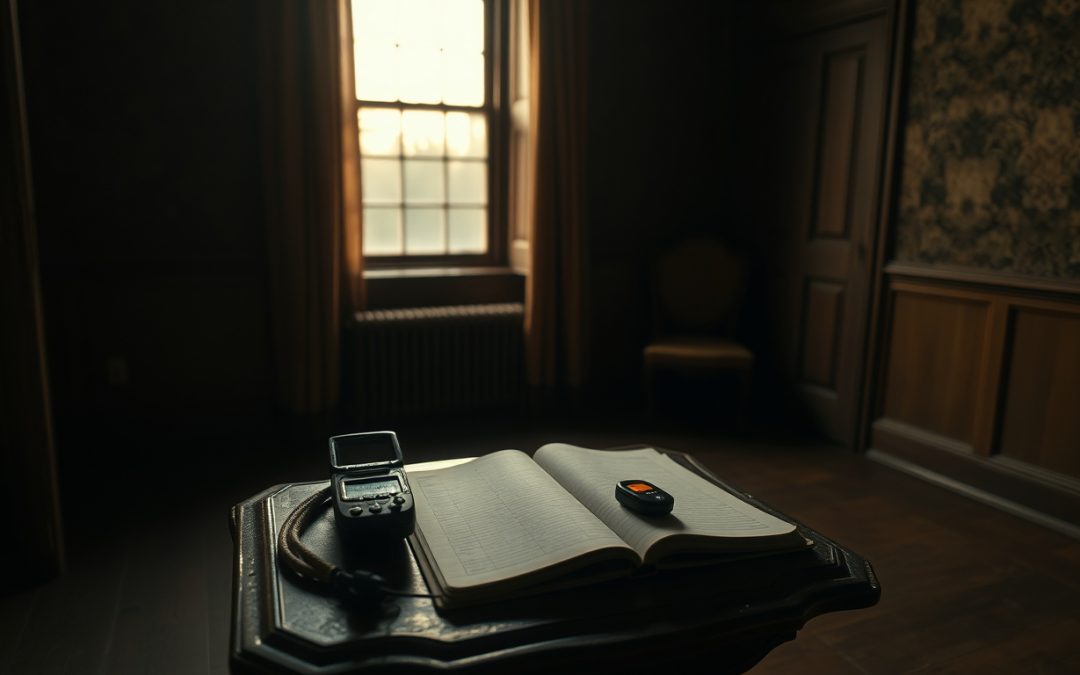
Picture this: an investigator’s meter spikes at 2 a.m. in a quiet bedroom, and the room goes tense. Everyone assumes something has arrived. But nobody checked that same reading at 2 p.m., when the house was empty and calm. Without that comparison, the spike means almost nothing. It could be the refrigerator compressor two rooms away, a heating unit cycling on, or wiring buried in the wall. This is the quiet failure at the heart of a lot of sloppy work, and it is exactly why baseline conditions matter so much in serious paranormal research.
A baseline is a simple idea with big consequences. Before you go looking for the unusual, you document the usual. You measure the ordinary state of a location — its temperature, its electromagnetic fields, its ambient sound, its drafts and creaks and light levels — while nothing unusual is reported to be happening. That record becomes your reference point. Every later reading gets compared against it. Without a baseline, you have no way to tell the difference between a genuine anomaly and the building simply being a building.
The Lodestra Razor says to rule out the ordinary before reaching for the extraordinary. Baselines are how you actually do that in practice. They turn a vague feeling that “something changed” into a measurable claim you can test.
What a Baseline Actually Measures in Paranormal Investigation
A good baseline in paranormal investigation is not one number. It is a profile of a place across several dimensions, taken while conditions are calm and well understood. The goal is to capture the natural range of each variable, because almost nothing in a real building holds perfectly steady.
Electromagnetic fields
An EMF meter measures electromagnetic fields, and that is all it measures. It does not detect spirits, presences, or intentions. What it picks up is the invisible activity of electricity and magnetism: house wiring, appliances, chargers, fuse boxes, power lines outside, and the fields that fluctuate as devices switch on and off. When you walk a location before an investigation and log the readings room by room, you learn where the fields are naturally high. The corner by the breaker panel might read elevated all night, every night. If you did not know that in advance, you might mistake it for something meaningful later.
There is a further reason baselines matter with EMF. Strong, fluctuating fields have been linked in some studies to feelings of unease, dizziness, or the sense of being watched — the body responding to a physical stimulus. If you find a high-field zone during baseline mapping, you may have found the cause of the “creepy corner” before anyone even reports it.
Temperature and air movement
“Cold spots” are a staple of ghost lore, but old buildings are riddled with mundane temperature swings. Single-pane windows, uninsulated exterior walls, chimney flues, gaps under doors, and forced-air vents all create pockets of cool air and moving drafts. A baseline temperature sweep — ideally with an ambient thermometer rather than only an infrared surface reader, which measures surface temperature and is easily misread — tells you where the cold naturally lives. When a genuinely unexplained drop happens later, you will know it stands apart from the building’s normal thermal map.
Sound and infrasound
Ambient sound is one of the most underrated baseline measurements. Plumbing, HVAC systems, settling timber, wind against the structure, traffic, and distant machinery all contribute to a location’s acoustic signature. Recording several minutes of “quiet” during baseline gives you a reference for what the room sounds like when nothing is happening. That reference is invaluable during audio review, when you are trying to decide whether a faint sound is anomalous or just the water heater doing its job.
Infrasound deserves special mention. These are sound waves below the range of human hearing, and research has connected them to feelings of dread, pressure, and even visual disturbances. Fans, engines, wind, and certain building resonances can all produce it. You may not hear it, but your body can respond to it. A location with a strong infrasonic source can generate exactly the sensations people report as paranormal.
Why Skipping the Baseline Undermines Paranormal Research
The most common mistake in amateur paranormal research is treating the investigation as the whole job. Investigators arrive, wait for something to happen, and react to whatever their instruments do. But a reading only carries meaning in context. A number without a reference point is just a number.
Consider the classic sequence. A device chirps. The room reacts. Someone asks a question. The device chirps again. It feels like communication. But if the device was chirping intermittently all evening because of a nearby power source, the “responses” are coincidence dressed up as contact. A baseline breaks this illusion. If you already know the device tends to fluctuate in that spot, you interpret the later chirps with appropriate caution.
Baselines also protect witnesses. People who report experiences in their homes deserve to be taken seriously, and the best way to honor that is to investigate rigorously rather than confirm their fears reflexively. Sometimes a baseline reveals a genuine safety issue — faulty wiring producing high fields, or a carbon monoxide risk from a malfunctioning appliance, which can itself cause hallucinations and dread. Ruling out the ordinary is not just good method. Occasionally it is a service that matters.
How to Record a Baseline Properly
Good baseline work is methodical, not glamorous. Here is a practical approach any investigator can follow.
- Do it before anything else. Take your baseline readings when you first arrive, before the location gets “charged” by expectation and before your team starts moving around and introducing new variables.
- Go room by room. Sweep each space systematically. Log EMF at consistent points, note ambient and surface temperatures, record a few minutes of audio, and observe light levels and airflow.
- Map the sources. Note every appliance, outlet, panel, vent, and window. Identify what is running and what could switch on later, like a refrigerator cycle or a thermostat-triggered furnace.
- Record the same conditions you will test later. If you plan to investigate at night with the power off, take a baseline in that exact state too, not only with the lights on.
- Document, don’t just observe. Write it down, timestamp it, and keep it. A baseline you remember vaguely is not a baseline. A baseline in your case file is.
That last point is where documentation tools earn their place. When you are trying to keep room-by-room readings, source maps, timestamps, and later comparisons all straight, structure matters. A tool like the Paranormal Case File Manager is built to hold this kind of record — location history, room-by-room readings, evidence, and debunks — in one place so your baseline and your active readings live side by side and can actually be compared. Mapping the physical layout helps too. Something like the SpecterGrid Location Mapper lets you mark where equipment sat and where readings were taken, so your baseline is tied to real locations rather than fuzzy memory.
Baselines and Evidence Review
The value of a baseline does not end when the investigation does. It comes back into play during review, when you sit down with your recordings and try to separate signal from noise.
In audio review, your baseline “quiet” recording is the control. If you flag a faint sound as a possible EVP, the honest first question is whether that same sound appears in the baseline. A tool built for careful review — one that lets you isolate, slow, and compare audio without altering the original, like the DeadAir Audio Analyzer Pro — makes that comparison far easier than raw playback. Non-destructive workflow matters here because you want the original file preserved exactly as recorded, always.
The same logic applies to video and photos. A baseline shot of an empty room, taken in the same lighting and from the same angle, gives you something to compare against later frames. Dust, insects, lens flare, and reflections are among the most common explanations for “anomalies” in visual media, and a baseline reference helps you recognize them. Frame-by-frame video review and honest before-and-after image comparison — the kind of work supported by analyzers like the PhantomFrame Pro Video Analyzer and the PhantomCapture Photo Analyzer — let you check whether that “figure” was present all along or is simply a trick of compression and shadow.
The Mindset Behind Good Baselines
Recording baselines is really about a way of thinking. It reflects the assumption that a location is full of ordinary explanations until proven otherwise, and that the burden of proof sits with the extraordinary claim, not the mundane one. That mindset is what separates careful paranormal investigation from wishful thinking.
It also builds credibility. When you present findings that include a documented baseline, you are showing the work. You are saying: here is what normal looked like, here is what changed, and here is why the change is hard to explain by ordinary means. Even skeptics respect that structure, because it is the same structure any honest inquiry uses. The genuine mysteries — the readings that stand apart from a well-documented baseline and resist every mundane explanation — become far more interesting precisely because you have earned the right to call them mysterious.
Most anomalies dissolve under a good baseline. That is not a disappointment. It is the process working. And the rare few that survive careful comparison are worth far more than a hundred unexamined spikes.
Start With the Ordinary
If you take one habit from this into your next case, make it this: measure the normal before you go hunting the strange. Good paranormal research is built on that discipline. The baseline is unglamorous, it takes time, and it rarely makes for dramatic footage — but it is the difference between an investigation that convinces and one that merely excites.
If you want to sharpen your methods and see how careful documentation changes the quality of your findings, explore the research and field tools at Lodestra. The best investigators are not the ones who find the most activity. They are the ones who can tell you, with evidence, exactly what was ordinary and what was not.