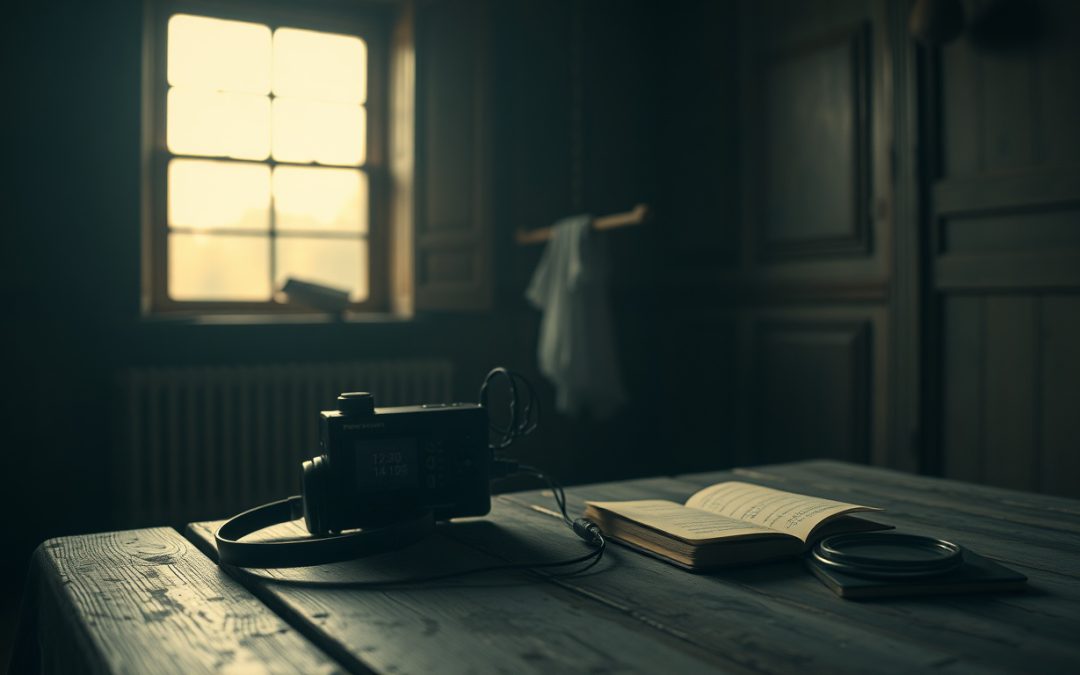
Somewhere on nearly every investigator’s hard drive is a clip they can’t quite let go of. A faint syllable in the hiss. A word that seems to answer a question no one heard at the time. Electronic voice phenomena — EVP — are among the most cited and least understood forms of evidence in paranormal research, precisely because sound is so easy to misread. The human brain is built to find voices. That talent is exactly what makes honest EVP review so hard.
Reviewing an EVP session like a researcher means slowing down and treating your own ears as unreliable witnesses. It means logging what you actually recorded, not what you hoped to catch. Most of what gets flagged as an EVP has a plain explanation waiting to be found, and the discipline of finding it is what separates careful paranormal investigation from wishful listening.
This is a method piece. By the end you should be able to sit down with a night’s worth of audio and work through it the way a field researcher does: patiently, skeptically, and with a written trail you’d be comfortable showing to a critic.
What an EVP Actually Is — and Isn’t
The term “electronic voice phenomena” describes voice-like sounds captured on recording equipment that weren’t consciously heard at the time of recording. That definition is deliberately narrow. It says nothing about ghosts, spirits, or any source at all. It describes a recording artifact and a listener’s interpretation of it. Everything beyond that is inference.
The idea gained popular attention in the mid-twentieth century, and investigators have been chasing it ever since with steadily better gear. What hasn’t changed is the core problem: a voice-like sound is not the same as a voice, and a voice is not the same as a message. Each of those leaps deserves scrutiny.
Researchers often sort candidate recordings by clarity, using informal classes ranging from clear and unambiguous speech down to sounds that require heavy prompting to hear as words at all. The rougher the audio, the more your expectations fill the gaps. That’s not a character flaw. It’s how perception works.
The Pareidolia Problem
Auditory pareidolia is the tendency to hear structure — words, names, phrases — in random or ambiguous sound. It’s the audio cousin of seeing faces in wood grain. Play a garbled clip for ten people with no context and you’ll often get ten different transcriptions. Tell them what to listen for first, and suddenly most of them “hear” it. That priming effect is one of the biggest threats to credible EVP work, and it’s why blind review matters so much.
Rule Out the Ordinary First
The Lodestra Razor is simple: exhaust the mundane explanations before entertaining the extraordinary. With audio, the mundane explanations are numerous, and most flagged EVPs never survive them. Before a clip earns a second look, walk it through the usual suspects.
- Stray speech. Investigators whispering, a teammate in the next room, a comment someone forgot they made. Timestamped logs of who was where solve most of these instantly.
- Radio frequency bleed. Cheap recorders and unshielded cables can pick up radio, baby monitors, or two-way transmissions. A “voice” that sounds like a broadcast fragment usually is one.
- Structural and environmental noise. Pipes, HVAC cycling, settling wood, wind through a gap, insects, distant traffic. Old buildings are noisy in ways that mimic speech rhythms.
- Handling and equipment artifacts. Fabric brushing the mic, a finger on the case, compression noise, digital glitches from a failing file. These produce sharp, voice-adjacent sounds constantly.
- Contamination during recording. Phones, smartwatches, and other electronics that ping, buzz, or transmit near the recorder.
The habit worth building: for every candidate, write down the most boring explanation that could account for it. If you can’t rule that explanation out, the clip isn’t evidence yet. It’s an open question.
Set Up the Session So Review Is Even Possible
Good EVP review starts before you press record. Sessions that weren’t controlled at capture can’t be salvaged in analysis, no matter how good your software is.
Control the Environment
Silence phones or remove them from the room. Note every person present and their position. Announce and log intentional sounds — a chair scraping, a door, a cough — out loud as they happen, so your recording narrates its own contamination. Investigators call this “tagging,” and it turns a mystery noise into a labeled non-event during review.
Record Clean
Use the highest-quality settings your device allows and record uncompressed where you can. Keep the recorder still on a stable surface rather than in a hand. If you’re running more than one recorder, note their positions; a real acoustic event should register on multiple devices, while an internal artifact usually won’t.
Reviewing the Audio Like a Researcher
Now the actual work. This is where discipline pays off, and where good paranormal research separates itself from a spooky highlight reel.
Listen Blind First
Do a full pass without expectations. Don’t hunt for the moment you “felt something.” Listen straight through and mark timestamps where something genuinely stands out, before you’ve decided what it is. If you can, have a second reviewer listen independently without knowing what you flagged. Agreement between blind listeners is far more meaningful than one excited person replaying a clip fifty times.
Never Suggest the Answer
When you bring in a second set of ears, don’t tell them what you think it says. Ask “do you hear anything here, and if so, what?” The moment you say “doesn’t that sound like get out?” you’ve contaminated the response. Written, independent transcriptions carry weight. Group agreement after prompting carries almost none.
Work Non-Destructively
Always preserve the original file untouched. Any slowing, isolating, or amplifying happens on copies, and every step gets noted. This matters because aggressive processing can manufacture “words” out of noise — boost the gain enough and hiss starts to sound intentional. A researcher keeps a clear before-and-after trail so a skeptic can retrace every move. Purpose-built tools like the DeadAir Audio Analyzer Pro are designed around this idea: import, isolate, slow, reverse, mark, and classify candidate events while leaving the source audio intact and documented. The point isn’t to make a clip sound more convincing. It’s to examine it without deceiving yourself.
Beware the Enhancement Trap
There’s a strong temptation to keep processing a clip until it “resolves” into words. Resist it. Each round of filtering and amplification adds interpretation and removes information. If a sound only becomes a phrase after heavy manipulation, the phrase is very likely something you built, not something you found. Note how much processing was required to hear anything at all — that number is itself data, and usually it argues against the clip.
Documenting What You Find
An EVP that lives only in your memory or a shared folder is not evidence. It’s an anecdote. Rigorous documentation is what lets a finding survive contact with a critical reader months later, or lets you compare sessions across a long investigation.
For each candidate clip, record the same core facts:
- Exact timestamp and which recorder captured it.
- Who was present and where, from your session log.
- What was happening in the room at that moment.
- The independent transcriptions, and whether reviewers were blind.
- Every processing step applied, in order.
- The mundane explanations considered and why each was kept or ruled out.
- Your honest classification: clear, ambiguous, or discarded.
Most clips should end up discarded, and that’s the sign of a healthy process, not a failed night. When the paperwork lives inside your case record rather than in scattered notes, patterns become visible and mistakes become correctable. A structured Paranormal Case File Manager keeps witness statements, room readings, evidence, and debunks in one file, so an EVP is never floating free of its context. Context is often what decides whether a sound is interesting or just the furnace.
What Honest EVP Research Can and Can’t Claim
Even a clean, well-documented, blind-verified voice-like recording does not prove a paranormal source. It proves you captured a sound you can’t yet explain. That is a genuinely interesting result, and it’s also the honest ceiling of what the method supports. No recorder detects spirits. It records air pressure changes and electrical signals, and everything past that is interpretation.
This is the mindset worth carrying into every session: an unexplained recording is an invitation to keep investigating, not a conclusion. The researchers who earn trust are the ones who discard most of their own findings and can explain exactly why. Mystery that survives that kind of scrutiny is worth far more than a dozen clips that never faced it.
If you want to sharpen your own method — the tools, the field techniques, and the experiments behind them — you can explore the research and field methods at Lodestra and see how a disciplined workflow changes what your evidence is actually worth.