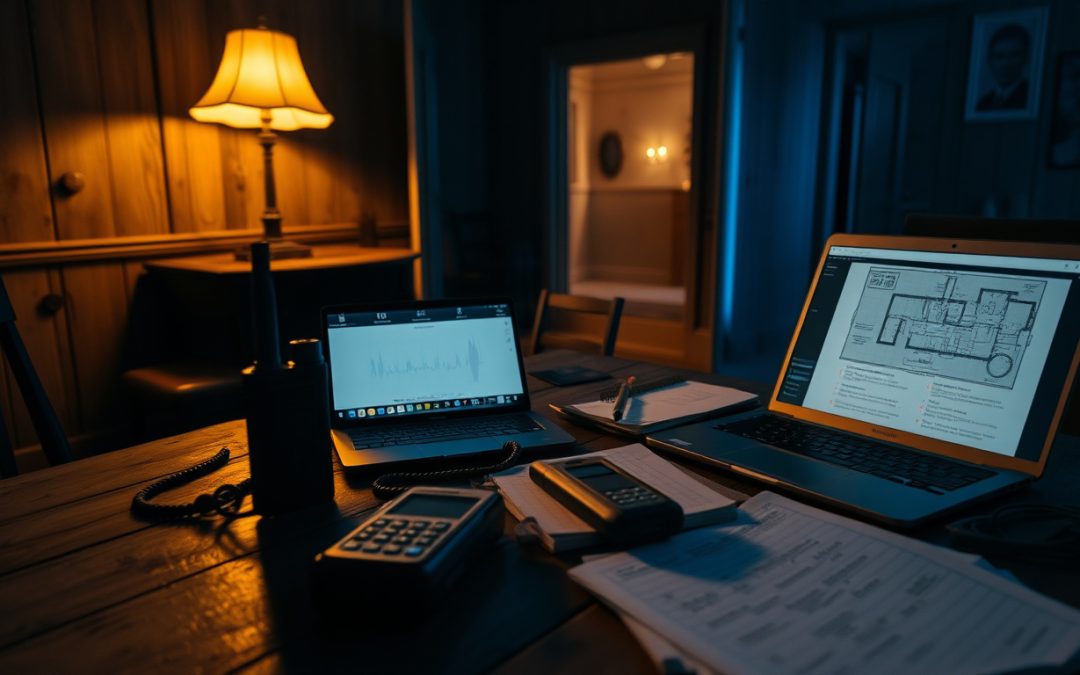
Picture a team of five walking out of an old farmhouse at two in the morning. Everyone is tired, a little cold, and running on adrenaline. One person swears they heard a voice near the staircase. Another remembers a temperature drop in the back bedroom, but can’t say exactly when. The audio recorder captured something — maybe. Nobody wrote down the time. Two weeks later, when it’s time to write the report, the memories have drifted and the timeline is a fog. This is where a lot of promising paranormal research quietly falls apart, not because the evidence was weak, but because the process was.
A shared investigation workflow is the fix. It’s the agreed-upon set of steps every member of a team follows, from the first client phone call to the final conclusion. It sounds unglamorous next to the idea of chasing the unexplained, but the truth is that discipline is what separates serious paranormal investigation from a night of jumpy storytelling. The mystery is more interesting, not less, when you can trust your own records.
Why Consistency Matters More Than Gear
It’s tempting to think the quality of an investigation comes down to equipment. Better recorders, better cameras, more sensors. Gear helps, but it doesn’t save you from the real weakness in most teams: human memory and inconsistent habits. Memory is reconstructive. We fill gaps without noticing, and expectation shapes what we recall. If three people describe the same event three different ways, you don’t have three data points — you have a mess.
The Lodestra Razor asks us to rule out ordinary causes before extraordinary ones. That principle only works if your documentation is good enough to test against. Was that cold spot near a window with an old, leaky frame? Was the “voice” recorded at the same moment a car passed outside, or a pipe knocked in the wall? You can only answer those questions if everyone logged the time, the location, and the conditions the same way. A shared workflow turns scattered impressions into something you can actually cross-check.
The Cost of Doing It Loosely
When each investigator keeps their own notes in their own style — or worse, in their heads — you lose the ability to reconstruct the night. You can’t line up the audio timestamp with the moment someone felt watched. You can’t tell whether the photo anomaly appeared before or after someone walked through with a flashlight. And when a skeptic asks a fair question, you have no clean answer. Loose process doesn’t just weaken your evidence. It makes honest debunking impossible, which means you’ll never know what actually happened.
The Backbone of Good Paranormal Research: A Repeatable Process
A workflow doesn’t need to be complicated. It needs to be shared, written down, and followed by everyone the same way every time. Here’s a framework that reflects how careful field investigation actually runs.
1. Intake and Client History
Long before anyone sets foot on site, the case begins with a conversation. What is the client actually experiencing? When did it start? Are there patterns tied to time of day, weather, or specific rooms? A good intake also gathers the boring but crucial context: the age of the building, recent renovations, known plumbing or electrical issues, medications, stress levels, and whether anyone in the household has a strong prior belief in the supernatural. None of this is about doubting the witness. It’s about giving their experience a fair, thorough hearing — and it often surfaces mundane explanations before you ever arrive.
2. Site Assessment and Baseline Readings
When you arrive, document the environment before you start investigating. Take baseline readings of temperature, humidity, and electromagnetic fields throughout the location. This matters more than people realize. An EMF meter detects electromagnetic fields — nothing more. It does not detect spirits. But if you know that a particular corner of the basement already reads high because of old wiring or a breaker panel, you won’t mistake that field for an anomaly later. High electromagnetic fields have also been linked in research to feelings of unease and the sense of a presence, so mapping them is part of ruling out the ordinary.
Mapping the physical space helps here too. Knowing exactly where each room, window, vent, and piece of equipment sits lets you tie every reading and report to a location. Tools like the SpecterGrid Location Mapper let a team build a shared layout, mark rooms, place equipment, and drop evidence pins so everyone is working from the same picture of the scene rather than a vague memory of “the back room.”
3. The Investigation Itself
This is where a shared workflow earns its keep. Everyone should log events the same way: time, location, who witnessed it, what instruments were running, and what the conditions were. A dropped temperature at 1:14 a.m. in the north bedroom means something only if the log tells you the window was closed, the heating had cycled off, and two people were present. Consistent, timestamped notes let you build a timeline you can trust when the adrenaline fades.
4. Evidence Review
The morning after is where most of the real work happens. Audio, video, and photos need careful, methodical review — and this is where honest tools matter. Any analysis software should keep the original file untouched so you can always return to source. For audio, a review tool that lets you isolate, slow, and mark a possible event without altering the master recording keeps your findings defensible; the DeadAir Audio Analyzer Pro is built around exactly that kind of non-destructive workflow. For footage, stepping frame by frame and running movement detection helps you separate a genuine anomaly from a bug on the lens or a shift in light, which is the sort of thing the PhantomFrame Pro Video Analyzer is designed to support with its RAW A/B comparison.
None of these tools prove anything paranormal. They help you look closely and honestly, and they make it easy to show your work. That distinction is the whole game.
Where Teams Break Down
Even good teams stumble in predictable ways. Naming the failure points is the first step to designing a workflow that resists them.
- Everyone documents differently. One person uses a notebook, another a phone, another just remembers. The records never line up.
- Timestamps don’t match. If the audio recorder, the camera, and the investigator’s watch all read different times, you can’t correlate events. Sync every device before you begin.
- Debunks go unrecorded. Someone figures out the “footstep” was the furnace, mentions it out loud, and it never makes the file. Later, the footstep resurfaces as evidence.
- The report is built from memory. Weeks pass, details blur, and the final write-up quietly drifts toward the most dramatic version of the night.
Almost every one of these problems traces back to the same root: no shared, structured place to put the information as it happens. When documentation lives in five heads and three formats, the case can’t hold together.
Building a Workflow Your Whole Team Can Follow
A workflow is only real if everyone uses it. That means it has to be simple enough to follow at two in the morning and structured enough to survive scrutiny later. A few principles help.
Standardize How You Log Events
Agree in advance on what every logged event must include: time, location, witness, instruments active, environmental conditions, and a short factual description. No interpretation in the moment — just what happened and when. Interpretation comes later, during review, when you’re calm and looking at everything together.
Keep Debunks in the Same File as the Evidence
A ruled-out explanation is not a failure. It’s one of the most valuable things you can produce. Record it with the same care you’d give a genuine anomaly, right alongside the original observation. A case file that shows what you eliminated — and why — is far more credible than one that only lists the spooky stuff.
Centralize the Case File
The single biggest upgrade most teams can make is putting the whole investigation in one structured place instead of scattering it across notebooks, phones, and memory. A dedicated case manager keeps intake, witness accounts, location history, room-by-room readings, evidence, and debunks together as the case unfolds, then lets you export a conclusion that actually holds up. The Lodestra Case File Manager is built for exactly this — one file that carries the investigation from the first client call to the final report, so nothing gets lost between the field and the write-up.
The Payoff: Paranormal Research You Can Defend
A shared workflow won’t make your investigations more exciting in the moment. It will make them honest, and over time that’s far more valuable. When you can lay out a clean timeline, show your baseline readings, point to the mundane causes you ruled out, and present your evidence exactly as it was recorded, two things happen. Skeptics take you seriously. And you take yourself seriously, because you’re no longer relying on the shakiest instrument in the room — human memory.
The genuine mystery in paranormal research doesn’t live in blurry photos or half-remembered voices. It lives in the small number of observations that survive careful, disciplined scrutiny — the ones you couldn’t explain away no matter how hard you tried. A shared workflow is how you find those. It’s the difference between collecting stories and doing paranormal investigation that means something.
If you want to build a process your whole team can rely on, it’s worth looking at how the tools fit together. You can explore the research and field methods at Lodestra and see how a structured workflow — from mapping a scene to reviewing evidence to closing the case file — turns a long, uncertain night into something you can actually stand behind.