
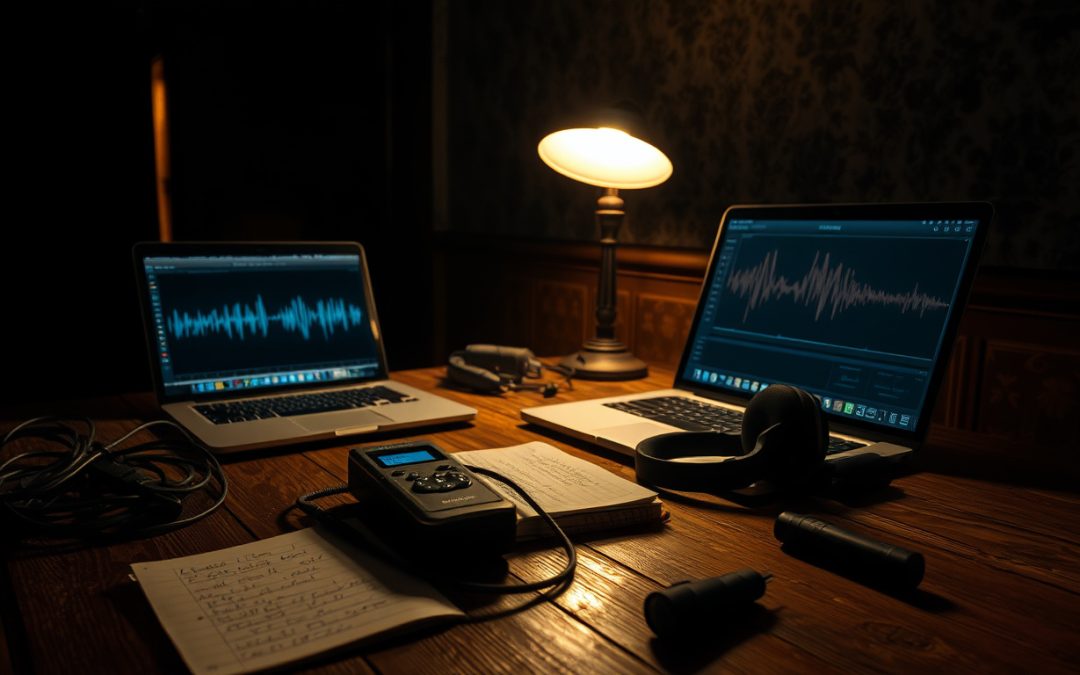
Play almost any recording claimed to hold an electronic voice phenomenon, and the first thing you actually hear is not a voice. It’s the room. A refrigerator compressor two floors down. Wind pressing against old window frames. The faint hiss of the recorder’s own circuitry. Serious paranormal research begins with an unglamorous truth: before you can argue that something on your recording doesn’t belong, you have to know exactly what does. Background noise isn’t the obstacle standing between you and the evidence. Background noise is most of the evidence, and learning to read it is the difference between a careful investigator and a hopeful one.
EVP — electronic voice phenomena — describes voices or voice-like sounds that appear on a recording but weren’t consciously heard at the time. The term has been around since the mid-twentieth century, and the recordings themselves have been debated ever since. The honest position isn’t that EVP is proven or debunked. It’s that the vast majority of samples people call EVP have ordinary explanations sitting right there in the audio, waiting to be found by anyone willing to listen critically instead of listening for what they hope to hear.
What Background Noise Actually Is
Noise, in audio terms, is any sound in your recording that isn’t the signal you meant to capture. In a quiet house at 2 a.m., that “quiet” is layered and busy once you amplify it. Understanding those layers is the foundation of responsible EVP review.
Environmental noise
This is everything the building and its surroundings produce. HVAC systems cycling on and off. Water moving through pipes. Refrigerators, dehumidifiers, and fluorescent ballasts humming. Traffic, wind, rain, settling timber, and expanding or contracting materials as temperature shifts overnight. Old structures are especially talkative. A house that has stood for a century has joints, gaps, and cavities that whistle, tick, and groan in ways that can sound startlingly deliberate.
Human noise
Investigators contaminate their own recordings constantly. Breathing, swallowing, stomachs, joints cracking, clothing rubbing against a strap, a shoe shifting on grit. Whispered comments from a teammate in the next room bleed through walls and register as a disembodied murmur on playback. This is why disciplined teams call out (“that was me,” “car passing,” “my chair”) in real time — those tags become priceless during review.
Equipment and electrical noise
Every recorder introduces its own self-noise: the electronic floor of the microphone and preamp, heard as a steady hiss. Cheap or highly compressed recorders add artifacts. Automatic gain control, a feature that boosts quiet passages, can pump the noise floor up and down and manufacture rhythmic swells that sound almost like speech. Then there’s radio frequency interference. Poorly shielded cables and certain microphones can pick up stray broadcast signals, cellular data bursts, and baby-monitor chatter — a genuinely well-documented source of “voices” that are simply someone else’s transmission leaking into your gear.
Why Noise Fools Us: The Human Side of Paranormal Research
The equipment is only half the story. The other half is the brain doing the listening. Our auditory system evolved to find meaningful patterns — especially voices — in messy input. That skill kept our ancestors alive. It also makes us spectacularly good at hearing words that aren’t there.
This is auditory pareidolia: the mind imposing structure on ambiguous sound. Random noise, filtered through expectation, resolves into speech. The effect gets dramatically stronger when someone tells you what to listen for. Play a muddy clip cold and a listener hears nothing. Say “it sounds like it’s saying get out,” play it again, and suddenly everyone hears get out. The suggestion, not the audio, created the message. Any honest paranormal investigation has to treat this as a live threat in every review session, because it contaminates results silently and feels exactly like discovery.
The Lodestra Razor applies with full force here. Before a clip earns the label “possible EVP,” you should be able to say you’ve ruled out breathing, cross-talk, structural noise, radio bleed, gain artifacts, and pareidolia reinforced by suggestion. What survives that gauntlet is rare — and far more interesting for having survived it.
Building a Noise Baseline Before You Record
You cannot subtract what you never measured. The single most useful habit in EVP work is capturing a baseline: a stretch of the location’s ordinary sound before any session activity begins.
- Record the empty room. Five to ten minutes of the space with no one speaking and no movement. This documents the HVAC cycle, the fridge, the pipes, the ambient hum — the sonic fingerprint of the location.
- Walk and narrate the sources. Speak aloud as you point the recorder at each appliance, vent, window, and pipe run. Later, when a strange tick appears, you’ll have a reference for what that tick sounds like.
- Note the time of everything. A furnace kicking on at a predictable interval explains a lot of “activity” that clusters around it.
- Log the equipment. Which recorder, which mic, any gain settings. Different gear produces different noise floors, and you’ll want that on record.
A baseline turns review from guesswork into comparison. When you hear something odd during the session, the first question is simple: does this match a sound already on the baseline? Most of the time, it does.
How to Review EVP Evidence Responsibly
Good review is slow, repetitive, and skeptical by design. The goal is not to find a voice. The goal is to correctly classify every candidate sound, most of which will turn out to be mundane.
Listen blind first
Before anyone offers an interpretation, listen to a flagged clip without being told what to expect. If reviewers independently converge on the same words, that’s mildly interesting. If they hear wildly different things, you’re almost certainly looking at pareidolia. Never announce the “message” before others have listened.
Work non-destructively
Always keep the untouched original. Every enhancement — amplification, noise reduction, slowing, filtering — changes the file and can introduce artifacts that sound like new information. Aggressive noise reduction is notorious for creating watery, warbling tones that the ear happily interprets as speech. Compare any processed version directly against the raw source so you can see what the processing added.
Match sounds to sources
For each candidate, ask concrete questions. Was anyone breathing near the mic? Does the timing line up with the furnace, a passing car, a teammate’s movement? Could it be radio interference? Does an identical sound appear elsewhere in the session at a moment you can explain? A tool built for this kind of methodical work helps. Software like the DeadAir Audio Analyzer Pro lets investigators import, isolate, slow, reverse, mark, and classify possible EVP events while keeping the original audio untouched — which is exactly the discipline this work demands. A recorder captures; software helps you scrutinize. Neither one detects a spirit, and it’s worth saying so plainly.
Classify honestly
A widely used informal scale sorts candidates into three rough tiers: clear and easily understood, needing enhancement or headphones, and requiring so much interpretation or suggestion that it barely qualifies. Be ruthless. Most of what excites a room at 3 a.m. lands in the bottom tier, which is another way of saying it doesn’t survive scrutiny.
Documentation Is the Point
Evidence that isn’t documented isn’t evidence — it’s a memory. The strength of any paranormal research claim rests on whether an outsider can trace your reasoning. That means logging the baseline, the equipment, the timestamps, the real-time callouts, the review notes, and every ordinary explanation you tested and ruled out.
This is where a structured workflow earns its keep. Keeping audio findings inside a broader case record — witness accounts, room-by-room readings, environmental notes, and the debunks you performed — lets you see whether an odd clip lines up with anything else or stands alone. A Paranormal Case File Manager is built for exactly that: holding the whole investigation in one file, from the first client call to a conclusion that an outside reader can actually follow. The habit matters more than any single tool, but the right tool makes the habit easier to keep.
What’s Left When the Noise Is Gone
Here’s the part that keeps careful investigators coming back. When you take background noise seriously — baseline it, tag it, filter it, and rule it out with genuine rigor — the pile of “evidence” shrinks dramatically. Ninety-something percent of exciting clips dissolve into pipes, breath, radio, or the mind’s hunger for a voice. That’s not a failure. That’s the method working.
And every so often, something doesn’t dissolve. A clip with no matching source on the baseline, no plausible cross-talk, no radio signature, heard consistently by listeners who weren’t primed. Cases like that are uncommon, and honest researchers don’t overstate them. But they’re the reason the work is worth doing. You’ve earned the right to call something genuinely unexplained only after you’ve exhausted the explanations.
Background noise, in the end, is not the enemy of good paranormal investigation. It’s the standard everything else has to beat. Treat it with respect and your conclusions will hold up — to skeptics, to peers, and to your own second look a year later.
If you want to see how this evidence-first approach plays out in real equipment and real methods, you can explore the research and field tools at Lodestra and put the Lodestra Razor to work on your own recordings.