
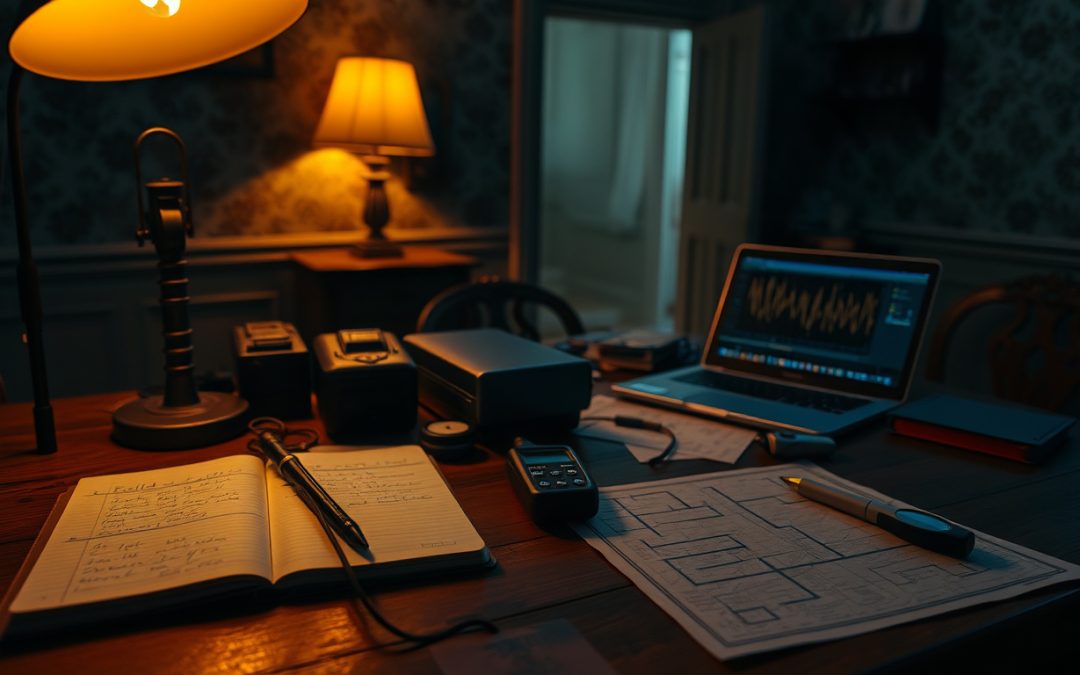
The difference between a compelling ghost story and credible paranormal research usually comes down to one unglamorous document: the report. A story asks you to feel something. A report asks you to check the work. When an investigation ends and the equipment is packed away, the report is the only thing that survives — and it’s the only thing anyone else can actually evaluate. If it’s vague, emotional, or missing its timeline, even a genuinely interesting case becomes impossible to defend.
Most people never see a real paranormal investigation report. What they picture is the edited version — the dramatic highlights, the isolated audio clip, the single blurry frame. The real document is quieter and far more useful. It records what happened, when, under what conditions, and what the investigator ruled out before landing on any conclusion. That last part is where most reports fail, and it’s exactly where a good one proves its worth.
This is a practical guide to writing a report that respects both the witness and the evidence. It leans on the Lodestra Razor: rule out the ordinary before reaching for the extraordinary. Done right, that discipline doesn’t kill the mystery. It protects the parts that survive honest scrutiny.
Why the Report Is the Real Work of Paranormal Research
An investigation feels like the main event. You’re on-site, instruments are running, something unexpected happens, and the adrenaline is real. But the fieldwork is only data collection. The analysis — sorting, comparing, testing, and writing it down — is where paranormal research actually happens.
Consider a simple test. Hand your raw notes to another investigator who wasn’t there. Can they follow what you did, reconstruct the environment, and reach their own conclusion? If yes, you have a report. If they’re forced to trust your memory and your mood, you have an anecdote. Anecdotes have value, but they aren’t evidence, and confusing the two is the fastest way to lose credibility.
A strong report also protects you from yourself. Memory is reconstructive and suggestible. Weeks after a long night in a cold, dark building, your recollection of a sound or a shadow will drift toward the more dramatic version. Contemporaneous documentation — written in the moment, timestamped, tied to instrument readings — anchors you to what actually occurred.
The Anatomy of a Credible Report
Formats vary, but the strongest paranormal investigation reports share a common skeleton. Each section exists to answer a specific question a skeptical reader will ask.
1. The Intake and Witness Account
Start before you ever arrive. Record how the case came to you, what the client or witness reported, and — critically — how they described it in their own words. Don’t clean it up. Note whether they used loaded language (“demonic,” “attached”) or neutral description (“cold spots in the hallway”). Capture relevant context: recent stress, sleep disruption, medications that might affect perception, prior interest in the paranormal. None of this is meant to dismiss the witness. It’s context that any honest analysis requires.
2. The Location Profile
Describe the building and environment with the detachment of a home inspector. Age and construction. Known plumbing and HVAC quirks. Electrical wiring, especially old or ungrounded systems that produce strong electromagnetic fields. Nearby roads, rail lines, or industrial equipment that generate vibration and low-frequency sound. Weather during the visit. A settling nineteenth-century house makes noises a new build never will, and that fact belongs in the record before a single “unexplained” knock is logged.
3. The Environmental Baseline
Before you investigate, you measure the normal. Temperature, humidity, EMF readings room by room, background sound levels, and any obvious drafts. This baseline is the single most valuable thing most amateur reports lack. Without it, a temperature drop or an EMF spike means nothing — you have no idea what “normal” looked like an hour earlier. With it, you can point to a genuine deviation and, just as often, explain one away.
4. The Timeline
Every notable event gets a timestamp, a location, and a description. Who was present, what instruments were running, and what natural events coincided — a passing truck, the furnace kicking on, a phone buzzing. A clean timeline is what lets you later match a recorded sound to the moment the heating system cycled. That single correlation has quietly resolved countless “voices” and “footsteps.”
5. The Evidence Log
Each piece of captured evidence — audio, video, photo — needs a unique identifier, the exact capture time, the device used, and the raw file preserved untouched. Enhancements and analysis happen on copies. The original is sacred. If you can’t produce the unaltered source file, your evidence is worth very little to anyone reviewing it later.
6. The Analysis and Ruled-Out Explanations
This is the heart of it. For each anomaly, you list the mundane explanations you tested and what you found. Not “we couldn’t explain it,” but “we checked for drafts with a smoke pen, confirmed the window was sealed, and the cold spot persisted.” The strength of a paranormal research report is measured by how many ordinary causes it eliminates, not by how many spooky moments it collects.
7. The Conclusion
A good conclusion is proportional to the evidence. Most honest investigations end with “explained” or “insufficient evidence,” and that’s a healthy outcome, not a failure. Reserve “unexplained” for the residue that survives genuine testing — and even then, “unexplained” means exactly that. It does not mean “ghost.” The moment you translate an anomaly into a specific supernatural claim, you’ve outrun your data.
Giving Mundane Causes a Fair Hearing
A report earns trust by showing its skepticism on the page. The usual suspects deserve explicit attention in nearly every case.
- Drafts and thermal layering. Cold spots are often just air behaving the way air does in old buildings. Document airflow before you document a presence.
- Electromagnetic fields. Faulty wiring, unshielded appliances, and fuse boxes generate fields strong enough to cause real physiological effects in sensitive people — including unease and the sense of being watched. An EMF meter measures those fields. It does not detect spirits, and no meter ever has.
- Infrasound. Low-frequency sound below roughly 20 Hz, produced by fans, traffic, or wind across an opening, has been associated in research with feelings of dread and even visual disturbances. It’s inaudible but physically real, and it’s a leading mundane explanation for “haunted” sensations.
- Pareidolia. The brain is relentless about finding faces and voices in noise. This is why an ambiguous audio clip “becomes” clearer the moment someone tells you what it says. Note whether an interpretation was suggested before it was heard.
- Structural settling and pests. Knocks, creaks, and scratching in walls have ordinary sources. Rule them in or out before elevating them.
Writing these down isn’t padding. It’s the argument. A conclusion that says “unexplained” is only credible in proportion to the ordinary causes visibly eliminated above it.
Handling Evidence So It Survives Review
Evidence integrity is where good intentions often collapse. The core principle is simple: never alter the original. Work on duplicates, keep a clear record of every enhancement, and be able to show the before-and-after side by side. If you brighten dark footage or slow down an audio file, the report should say so and preserve the untouched source.
This is where purpose-built tools help, not because they prove anything, but because they enforce honest habits. A dedicated EVP tool like the DeadAir Audio Analyzer Pro lets you isolate, slow, and mark possible audio events while keeping the original recording intact — a non-destructive workflow that means your analysis can always be checked against the raw file. For footage, the PhantomFrame Pro Video Analyzer steps through video frame by frame and keeps a RAW A/B comparison, so an enhancement never quietly becomes the evidence. For stills, the PhantomCapture Photo Analyzer lets you inspect metadata and compare original and enhanced versions before you ever call something an anomaly.
None of these tools decides what a sound or shape is. They make it possible to show your work — which is the only thing a reviewer can actually trust.
Structure, Consistency, and the Case File
A single well-written report is good. A consistent system across every case is better. When your intake forms, baselines, timelines, and evidence logs follow the same structure every time, patterns become visible — a location that always spikes near the same faulty circuit, a witness effect that repeats under specific conditions.
Keeping all of that in one structured place matters more than any single instrument. A Paranormal Case File Manager can hold the whole investigation in one file, from the first client call through room-by-room readings, evidence, debunks, and a final exportable conclusion. Pairing that with a scene map from something like the SpecterGrid Location Mapper — showing exactly where each reading and event occurred — turns a wall of notes into something a reader can follow at a glance. The tools serve the discipline. The discipline is what makes the paranormal research credible.
The Test of a Good Report
Come back to the simple standard. A good paranormal investigation report can be handed to a stranger who was never on-site, and that stranger can retrace your reasoning, weigh your ruled-out explanations, examine your unaltered evidence, and arrive at their own honest conclusion. If they end up agreeing that something remains genuinely unexplained, you’ve found the rare and valuable thing worth chasing. If they find the ordinary cause you missed, the report did its job too.
That’s the quiet ambition behind serious paranormal research: not to be believed, but to be checkable. The mystery that survives that process is the only kind worth reporting.
If you want to see how rigorous documentation and honest evidence handling come together in practice, explore the field methods and tools at Lodestra and build your next case file to a standard that holds up long after the lights come back on.