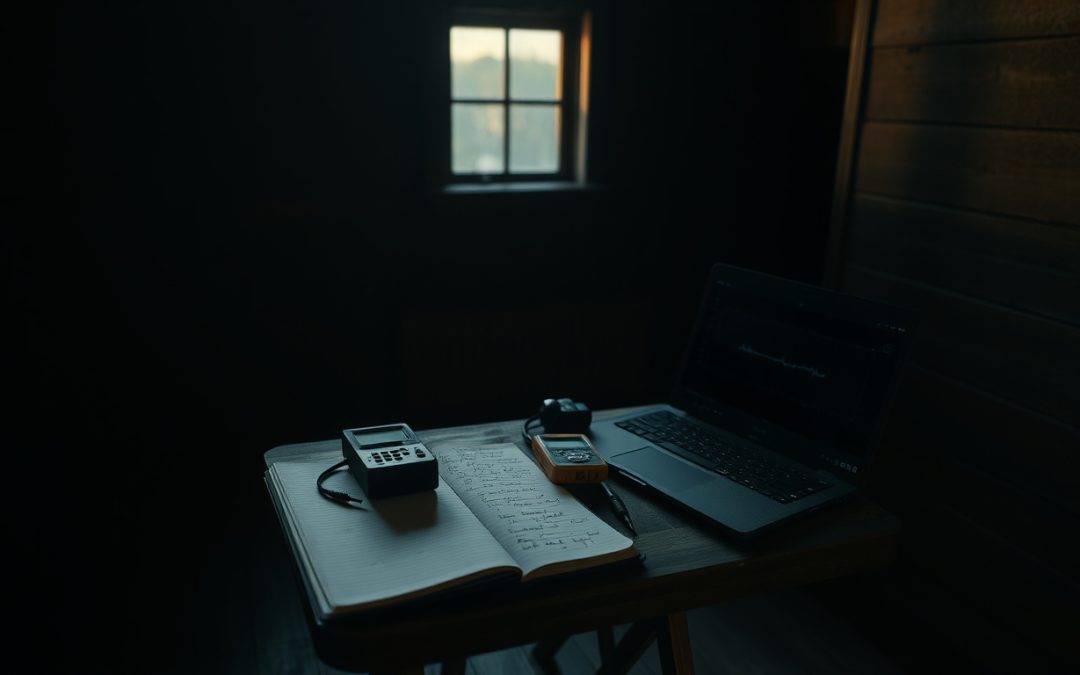
Picture a single audio clip: three seconds of hiss, then something that sounds like a whispered word. Played alone, on a loop, at midnight, it can feel like proof of something. But good paranormal research almost never turns on a clip played in isolation. The word only means something once you know what else was happening in that room — who was standing where, what the heating system was doing, whether a truck rolled past outside, and what the investigator said thirty seconds earlier. Strip away the context and you’re not analyzing evidence anymore. You’re interpreting a sound the way you want to hear it.
This is the quiet failure point in a lot of paranormal investigation. People collect enormous amounts of raw material — hours of audio, gigabytes of video, hundreds of photos — and then review each fragment as if it arrived from nowhere. The Lodestra Razor cuts the other way. Before a fragment can be called anomalous, you have to reconstruct the ordinary world around it and rule that world out. Context isn’t a nicety. It’s the difference between a debunk and a discovery.
What “Context” Actually Means in Paranormal Research
When investigators talk about context, they usually mean four overlapping layers of information that surround any single piece of evidence. Miss any one of them and your conclusion gets weaker.
Environmental context
Every location has a baseline. Old buildings settle and tick as temperatures drop. Pipes knock. HVAC systems cycle on and push air through vents, moving curtains and papers and creating that faint low rumble that recorders love to capture. Fluorescent lights and old wiring throw electromagnetic fields. Some spaces carry infrasound — sound below roughly 20 hertz that people can’t consciously hear but that has been associated in research with feelings of unease, pressure, and the sense of a presence. None of that is paranormal. All of it can masquerade as such if you don’t measure it first and note it alongside your evidence.
Temporal context
When did the event happen, and what else happened in the same minute? A knock at 2:14 a.m. is far less interesting once you learn the furnace kicked on at 2:13. This is why serious investigators keep a running timeline. The moment a recorder captures something odd, the log should be able to answer: who spoke, who moved, what equipment was running, and whether anything mundane coincided with it.
Human context
People make noise they forget making. Stomachs growl, joints pop, fabric rustles, and whispered side comments get picked up by sensitive microphones and later mistaken for disembodied voices. Suggestion matters too. If someone announces, “Did you hear that?” before a clip, everyone who reviews it afterward is primed to hear the same thing. That’s not dishonesty. It’s how human perception works, and honest paranormal research accounts for it rather than pretending it away.
Instrumental context
Every device has artifacts. Digital recorders compress audio and can generate their own faint tones. Camera sensors produce noise in low light that looks like drifting orbs. Compression algorithms smear moving objects into strange shapes. Knowing how your tools behave on an ordinary night is the only way to recognize when something genuinely departs from that behavior.
The Classic Example: EVP Without Its Surroundings
Electronic voice phenomena — faint voice-like sounds found in recordings that no one heard at the time — are probably the most context-dependent evidence in the entire field. The history here is instructive. Interest in EVP grew through the mid-twentieth century, and by the 1970s researchers were debating whether these captures represented anything beyond radio bleed, equipment noise, and the brain’s relentless drive to find speech in randomness. That last tendency has a name: auditory pareidolia. Feed a person ambiguous noise and tell them what to listen for, and they will hear it, clearly, every time.
This is why an EVP reviewed in isolation is nearly worthless. To evaluate one responsibly, you need the surrounding minutes of audio, a log of everyone present, and a note of nearby radio sources, phones, and structural sounds. You want to know whether the “voice” sits inside the frequency range of human speech or whether it’s a mechanical artifact. You want to compare it against the room’s baseline hiss. A tool like the DeadAir Audio Analyzer Pro is built around that discipline — it lets you isolate, slow, and mark a possible event while keeping the original file untouched, so your analysis never quietly rewrites the evidence it’s supposed to examine. The non-destructive workflow matters precisely because context includes the unaltered source. If you can’t return to the raw audio, you’ve lost your ability to check your own work.
Video and Photos Lie Most When Cropped
The same principle governs visual evidence, often more dramatically. A single frame pulled from a video and zoomed until it pixelates can show almost anything. A shape in the corner becomes a figure. A smudge becomes a face. But run the surrounding frames and the “figure” resolves into a moth crossing the lens, a reflection sweeping across a window as a car turns, or an investigator’s own shadow.
Motion only reads correctly in sequence. That’s the entire argument for stepping through footage frame by frame rather than trusting a screenshot someone circled in red. Reviewing video in its full temporal context — with the ability to enhance a dark clip without altering the master file, run movement detection, and hold the raw and processed versions side by side — is what keeps an investigator honest. That kind of A/B comparison is exactly what the PhantomFrame Pro Video Analyzer is designed for. Enhancement is fine, as long as everyone can see what you changed and compare it against the untouched original.
Photographs demand the same care. Most so-called anomalies in still images have ordinary origins: dust and moisture close to the lens producing orbs, long exposures smearing light, flash bouncing off airborne particles, or straps and hair drifting across the frame. Metadata is part of the context here. Shutter speed, ISO, flash status, and timestamp often explain an image before you ever debate what it “shows.” A dedicated PhantomCapture Photo Analyzer lets you inspect that metadata, compare original and enhanced versions, and tag questionable areas — so the conversation stays grounded in what the camera actually recorded rather than what a cropped thumbnail seems to suggest.
How to Build Context Into a Paranormal Investigation
Context isn’t something you reconstruct after the fact by memory. The best time to capture it is while it’s happening. Here’s a practical framework for an evidence-based paranormal investigation.
- Establish a baseline first. Before anything else, sweep the location. Record ambient temperature, note EMF sources, listen for HVAC cycles and infrasound, and log the ordinary sounds a building makes. You can’t identify a departure from normal until you’ve measured normal.
- Tag reality out loud. When someone coughs, moves, or steps on a creaking board, say so on the recording. “That was me on the stairs.” These verbal tags save hours of confusion during review and prevent your own footsteps from becoming tomorrow’s phantom.
- Keep a synchronized timeline. Note the time of every notable moment and every environmental change. A knock means nothing until you can line it up against what the furnace, the wind, and the people were doing at that exact minute.
- Map the space. A written description of “the back bedroom” is far weaker than a diagram showing where equipment sat, where witnesses stood, and where the activity was reported. Tools like the SpecterGrid Location Mapper let you build a layout, place your equipment, and drop evidence pins so the geometry of a claim is visible rather than remembered.
- Preserve originals. Never analyze your only copy. Keep raw files untouched and work on duplicates, so context can always be rechecked.
Why the Case File Is the Real Unit of Evidence
Here’s the shift that separates casual ghost hunting from serious work: the meaningful unit of analysis is not the clip. It’s the case. A single anomaly is a curiosity. A documented pattern — the same cold spot recorded three visits running, corroborated by two independent witnesses, with mundane causes checked and ruled out one by one — is something you can actually reason about.
That’s why documentation deserves as much attention as capture. When witness statements, location history, room-by-room readings, environmental baselines, evidence, and debunks all live in one structured place, patterns become visible and weak conclusions collapse under their own gaps. A dedicated Paranormal Case File Manager exists to hold that whole arc together, from the first client call to a final report that can stand up to scrutiny. The point isn’t to produce a tidy PDF. The point is that context, gathered honestly and stored where it can’t drift, is what lets you say “we ruled out the ordinary causes” and actually mean it.
The Discipline Is the Payoff
Reviewing evidence in context is slower. It kills a lot of exciting clips. It turns most “voices” back into pipes and most “figures” back into insects. But that’s exactly the value. Every mundane explanation you confirm makes the genuine unexplained residue — the small fraction of cases that survive honest scrutiny — far more meaningful. Serious paranormal research isn’t about collecting the most anomalies. It’s about being able to defend the few you can’t explain.
If you’d rather investigate that way — building context instead of chasing fragments — you can explore the tools and field methods at Lodestra and see how a grounded, evidence-first workflow comes together. The mystery worth pursuing is the one that’s still standing after you’ve done the ordinary work of ruling everything else out.