
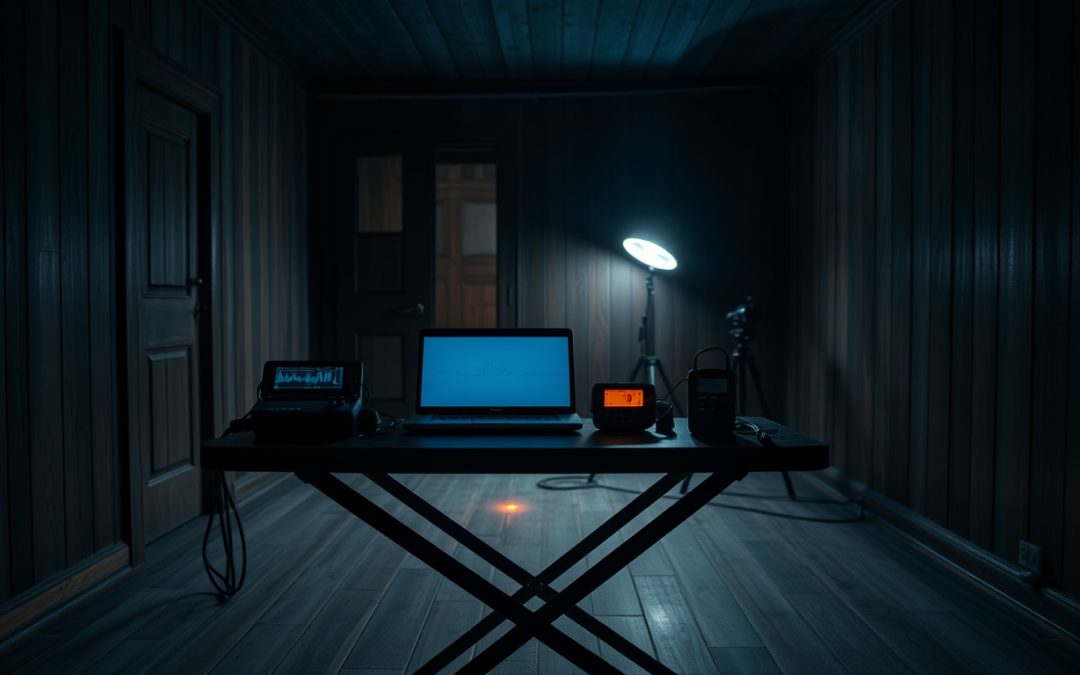
Somewhere in the middle of a long night investigation, a witness hears a knock. Twenty minutes later, a camera captures a shadow. An hour after that, someone’s EVP recorder picks up what might be a voice. On their own, these three events feel like a haunting building toward something. But line them up against the furnace cycle, a passing freight train, and the moment three investigators walked back inside from the cold, and the story changes. This is why timelines matter in serious paranormal research: they force scattered impressions into a sequence you can actually test.
Human memory is a terrible recorder. We compress time, reorder events, and unconsciously edit our notes to fit the story we already believe. A written, timestamped timeline is the antidote. It doesn’t tell you whether a location is haunted — nothing does that with certainty — but it tells you exactly what happened, in what order, and what else was happening at the same moment. For anyone practicing evidence-based paranormal investigation, that ordering is where the real work begins.
Why a Timeline Is Central to Paranormal Research
The value of a timeline comes down to one idea: correlation is easy to feel and hard to prove. Our brains are pattern-hunters. When two events happen close together, we instinctively link them. A cold spot followed by a door creak feels connected. But feelings aren’t evidence, and the Lodestra Razor asks us to rule out the ordinary before we entertain the extraordinary.
A timeline gives you the raw material to do that. When every event carries an accurate timestamp — sensor readings, personal experiences, audio markers, temperature dips, footsteps overhead — you can start asking better questions. Did the “unexplained” temperature drop line up with the HVAC kicking on? Did the strange knock happen every forty minutes, matching a mechanical cycle? Did the shadow appear right when a car turned into the driveway and swept headlights across the wall?
Without a timeline, these questions are unanswerable. With one, they become routine. This is the difference between collecting spooky moments and doing methodical field investigation.
The Difference Between a Log and a Timeline
A log is a list. A timeline is a list arranged against a clock and, ideally, against every other data stream you captured. Plenty of investigators keep logs. Fewer take the next step of synchronizing those logs with their audio files, video timestamps, environmental readings, and the ordinary events of the night — someone opening a window, a phone buzzing, a neighbor’s dog. The synchronization is where mundane explanations surface, and where the genuinely unexplained becomes easier to isolate.
What Goes on a Paranormal Investigation Timeline
A good timeline is boring in the best way. It records everything, not just the exciting parts. The dull entries are often the ones that later explain an anomaly. Here’s what belongs on it:
- Investigator movements. Who was where, and when. Most “phantom footsteps” turn out to be another team member two rooms away.
- Environmental readings. Temperature, humidity, and electromagnetic field measurements, logged with their exact times. An EMF meter measures electromagnetic fields — nothing more. It does not detect spirits. But a spike that lines up with a witness feeling “watched” near old wiring is a useful, mundane data point.
- Reported experiences. The moment a witness felt, saw, or heard something — noted immediately, before memory reshapes it.
- Equipment events. Recording start and stop times, battery changes, camera repositioning. A “sudden battery drain” often has a normal cause and a normal timestamp.
- External events. Traffic, trains, weather, aircraft, plumbing, HVAC cycles, other occupants. These are the usual suspects behind knocks, cold spots, and stray sounds.
- Captured evidence. The exact timestamp of any audio, photo, or video event you flag for review.
The goal is a single, honest record where an anomaly and its possible ordinary cause sit side by side on the same clock.
Getting Your Clocks to Agree
Here’s a problem that quietly ruins timelines: your devices disagree about what time it is. An audio recorder, a camera, three phones, and a laptop can all drift apart by minutes. When you try to line up an EVP with a video frame later, those minutes matter enormously.
Before an investigation begins, synchronize every device to a single reference clock, or at least record the offset of each one. A simple trick is to film a clap or a phone screen showing the reference time on every camera at the start of the night. That gives you a fixed anchor point to align everything against during review. It’s a small ritual that saves hours of confusion and prevents false correlations built on mismatched timestamps.
Reading the Timeline: Where Mundane Causes Hide
Once the night is over and the data is aligned, the timeline becomes an analysis tool. This is the phase where careful paranormal research earns its keep. You’re not looking for confirmation. You’re looking for coincidence — the ordinary event that explains the extraordinary one.
Some patterns worth hunting for:
- Periodic events. Anything that repeats at regular intervals almost always has a mechanical or electrical source. Furnaces, refrigerators, sump pumps, and automated systems all cycle on schedules.
- Human proximity. Cross-reference every “experience” against where investigators were standing. Suggestion is powerful; when one person reacts, others often follow within seconds.
- Environmental triggers. Low-frequency sound, or infrasound, below the range of human hearing has been associated in research with feelings of unease and the sense of a presence. A passing truck, wind across a chimney, or certain machinery can generate it. If a cluster of “dread” experiences shows up on your timeline, look for a vibration source at the same time.
- Draft and temperature paths. Cold spots often track with open doors, vents, and the movement of people. Plotted on a timeline, a “roaming cold spot” frequently reveals itself as ordinary airflow.
None of this is about dismissing witnesses. People experience real things. The timeline simply lets you separate the experience from the explanation, and to be honest about which anomalies survive scrutiny and which don’t.
A Short Note on History
The instinct to log carefully isn’t new. Early psychical researchers in the late nineteenth and early twentieth centuries built their credibility on meticulous documentation — recording sessions in detail, noting conditions, and cataloging the ordinary before entertaining the unusual. The organizations formed in that era treated careful record-keeping as the price of being taken seriously. That standard still holds. A timeline is the modern version of that same discipline, and parapsychology as a field has always risen or fallen on the quality of its documentation.
Building Timelines With Paranormal Software
You can build a timeline with a notebook and a wristwatch, and plenty of investigators do. But when a case involves hours of audio, dozens of photos, video from several cameras, and readings from multiple sensors, the manual approach breaks down fast. This is where purpose-built paranormal investigation tools save you from drowning in your own data.
The core idea is to keep every piece of evidence tied to its timestamp and to the rest of the case. When you review audio, the moment you flag a possible voice should carry a time you can drop straight onto the master timeline. A tool like the DeadAir Audio Analyzer Pro is built for that kind of non-destructive EVP review — you can isolate, slow, mark, and classify a possible event while leaving the original recording untouched, which matters when you need to defend a finding later.
Video works the same way. Stepping frame by frame and running movement detection with something like the PhantomFrame Pro Video Analyzer lets you pin the exact frame a shadow crossed a doorway, then check that timestamp against everything else that was happening. Its RAW A/B approach keeps any enhancement honest, so you’re never fooling yourself with an artifact you created in review.
All of it eventually needs a home. A Paranormal Case File Manager holds the whole investigation in one structured file — witnesses, location history, room-by-room readings, evidence, and debunks — so the timeline isn’t a loose document but the spine of the case. When you export a conclusion, it reflects the actual sequence of the night rather than a story assembled from memory.
What the Software Can and Cannot Do
Be clear-eyed about this. No case manager, audio analyzer, or video tool detects ghosts. They organize, measure, and document. They make your reasoning transparent and repeatable. Their entire value is that they help you rule things out and present what remains honestly. A timeline built in good software is a stronger argument precisely because it shows your work — including every ordinary cause you considered and eliminated.
A Practical Workflow You Can Use Tonight
Here’s a straightforward method for putting timelines to work in your next paranormal investigation:
- Before you arrive: Note the building’s mechanical systems, occupancy, nearby roads and rail lines, and expected weather. These become your baseline of ordinary causes.
- At setup: Synchronize all clocks and record a shared anchor point on every camera.
- During the investigation: Log everything with times — movements, readings, experiences, and any external event you notice. Keep it factual. “10:42 — knock, east wall, two raps” beats “something knocked at us.”
- After: Align your audio, video, photos, and sensor data against the master timeline. Look for coincidence first. Attach ordinary explanations wherever they fit.
- In the report: Present the sequence plainly. Show what you ruled out. Flag only what genuinely resisted a mundane explanation, and even then, describe it as unexplained — not as proof of anything.
Do this consistently and something quietly satisfying happens. Your cases get sharper. Your witnesses feel respected because their experiences were taken seriously and examined honestly. And on the rare occasion when something truly refuses to line up with any ordinary cause, that anomaly stands out clearly, because everything around it has been accounted for.
The Honest Payoff of Rigorous Paranormal Research
A timeline won’t manufacture a haunting, and it will dissolve a lot of them. That’s the point. The discipline of good paranormal research is not about proving the extraordinary — it’s about earning the right to be surprised. When you’ve placed every event on a shared clock, cross-checked it against the furnace and the freight train and the footsteps of your own team, and honestly labeled what you could explain, whatever is left is worth your attention.
That’s the mystery worth chasing: not the easy chill, but the residue that survives careful examination. If you want to see how structured tools support that kind of methodical work, explore the field methods and research at Lodestra and try building your next case file around a real timeline. Start with the ordinary. Let the evidence lead. The unexplained, if it’s there at all, will be waiting after the mundane has had its fair hearing.