
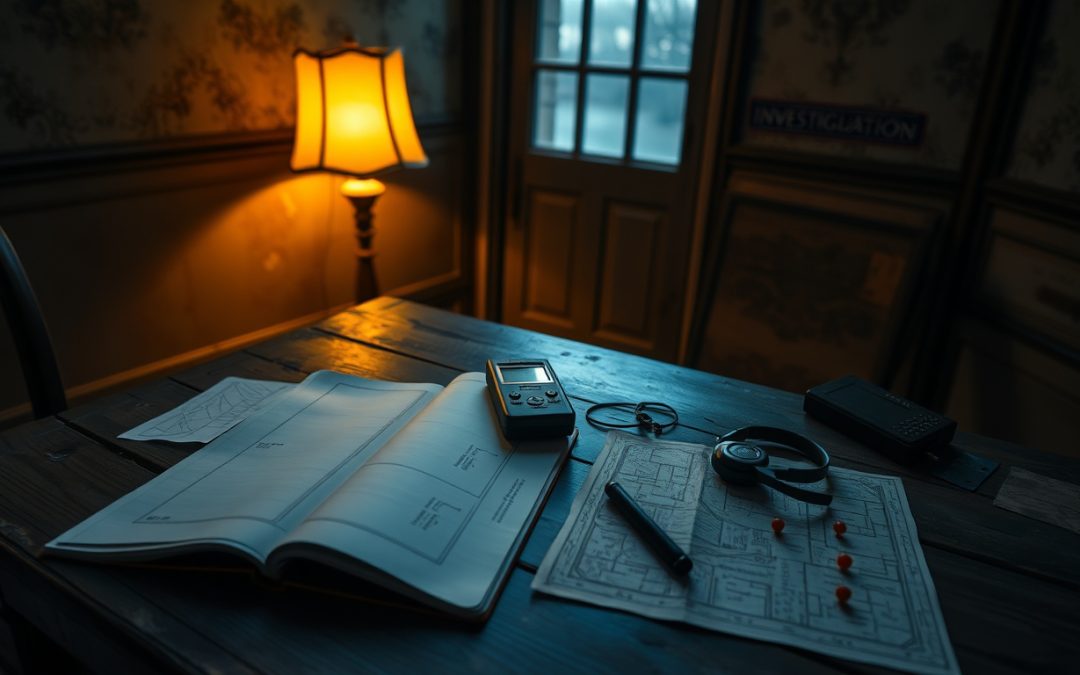
Ask any seasoned investigator what separates serious paranormal research from a night of wandering around with a flashlight, and the answer usually isn’t a piece of gear. It’s the paperwork. The unglamorous, methodical act of writing down what you saw, when you saw it, what the room was doing at the time, and what you ruled out. A case that isn’t documented isn’t a case. It’s a memory, and memory is the least reliable instrument any of us carry.
Case management is the backbone of credible paranormal investigation. It’s how a scattered pile of audio clips, temperature readings, witness statements, and half-remembered impressions becomes something a skeptical reader can follow and check. This guide walks through how to build a case file that earns trust — starting from the first phone call and ending with a conclusion you’d be comfortable defending to someone who doesn’t believe a word of it.
Why Case Management Is the Real Foundation of Paranormal Research
Here’s an uncomfortable truth about this field: most of the compelling stories fall apart the moment you ask for details. What time did the door slam? Was the heating on? Who else was in the house? Had the witness been told the location was “active” before they arrived? Without a structured record, those questions go unanswered, and an unanswered question is exactly where a mundane explanation usually hides.
The Lodestra Razor — rule out the ordinary before reaching for the extraordinary — only works if you’ve written enough down to test it. A draft, a settling floor joist, a passing truck, a phone charger throwing off an electromagnetic field, the power of suggestion after someone mentions a “cold spot.” Every one of those is easier to identify when your notes are timestamped and your readings are logged in context. Case management isn’t bureaucracy. It’s the machinery of honest investigation.
Parapsychology has struggled for over a century with exactly this problem. The early psychical researchers of the late 1800s understood that anecdote alone convinces no one, which is why they collected detailed witness testimony and tried, however imperfectly, to control for fraud and error. The lesson that survived is simple: your findings are only as strong as your records.
What a “Case” Actually Contains
A single investigation generates more material than people expect. A well-managed paranormal case file typically holds:
- The intake — who contacted you, what they reported, and their emotional state
- Location history and any relevant background on the building
- A witness log with individual statements kept separate from one another
- Baseline environmental readings taken before anything “happens”
- Room-by-room notes tied to specific times
- Audio, photo, and video evidence with capture data intact
- A running list of debunks and ruled-out causes
- A final conclusion that states what you found and what you couldn’t explain
Miss any one of these and the file develops a blind spot. The debunk log is the one people skip most often, and it’s arguably the most important. Recording what you disproved is what makes the small remainder — the genuinely unexplained — worth a second look.
Starting a Case: Intake and the First Contact
Case management begins before you ever set foot on site. The first conversation with a client or witness is evidence in itself, and it’s easy to contaminate. If you arrive already primed with a dramatic backstory, every creak becomes meaningful. So capture the initial report carefully, and capture it as they tell it, not as you’d like to remember it.
Write down the specifics. When did the experiences start? Is there a pattern to the time of day? Who has experienced what, and separately from whom? Has anyone in the household recently changed medication, started a new job with odd hours, or dealt with a major stressor? These aren’t intrusive questions for their own sake. Fatigue, stress, carbon monoxide exposure, and certain medications all produce experiences that feel deeply real and have nothing to do with the paranormal. A good intake surfaces those possibilities early.
Keeping Witness Accounts Independent
One detail that trips up even careful teams: witnesses talk to each other. Once two people compare notes, their memories begin to converge, and you lose the ability to see where their accounts genuinely agree versus where they’ve simply blended. Interview separately when you can. Record each account on its own, and note who had spoken to whom beforehand. In a paranormal investigation, the independence of testimony is data.
Baselines: The Readings You Take Before Anything Happens
Before an investigation can mean anything, you need to know what “normal” looks like in that space. That’s the baseline sweep — a walkthrough where you record temperature, electromagnetic fields, humidity, ambient sound, and airflow in each area while nothing unusual is occurring.
Baselines are what turn a reading into a finding. An electromagnetic field meter that spikes near a wall means little on its own — until you check the baseline and realize there’s old knob-and-tube wiring or a fuse box behind that plaster. High EMF fields, incidentally, are worth logging for another reason: some research suggests strong fields may affect the human brain in ways that produce feelings of being watched or unease. That’s a mundane explanation you can only reach if you measured the field and wrote it down.
Be honest about what these instruments do. An EMF meter measures electromagnetic fields. A thermometer measures temperature. Neither detects a spirit, and no reading proves one exists. What they give you is context — a way to correlate an experience with a measurable change in the environment, or to discover there was no change at all.
Managing Evidence Without Corrupting It
Every photo, audio file, and video clip you collect is potential evidence, which means it deserves the same care a lab technician gives a sample. The two rules that matter most: preserve the original, and preserve the context.
Audio and EVP
Electronic voice phenomena — sounds interpreted as voices on a recording that weren’t heard at the time — are among the most reported and most misunderstood pieces of evidence in the field. The trouble is that the human brain is relentlessly good at hearing patterns in noise. This is auditory pareidolia, and it’s why a snippet of radio bleed, a distant voice, or plain static can sound like a whispered word, especially once someone tells you what to listen for.
That’s exactly why an EVP review demands discipline. Keep the original recording untouched, work on copies, and note the exact timestamp of any event alongside anything happening in the room at that moment — a stomach growl, a passing car, a creaking chair. A tool like the DeadAir Audio Analyzer Pro is built for this kind of non-destructive review: import, isolate, slow, mark, and classify possible events while leaving the source audio intact. What it won’t do — what nothing can do — is tell you that a voice is paranormal. It helps you document and examine the sound honestly. The interpretation is still yours to defend.
Photos and Video
Photographic “anomalies” have some of the most well-understood mundane causes in all of paranormal research. Orbs are almost always dust, moisture, or insects catching the flash close to the lens. Streaks come from slow shutter speeds and camera straps. Faces in shadow are pareidolia again — the same wiring that finds a face in a cloud. Metadata matters here: shutter speed, ISO, timestamp, and flash settings buried in a photo’s EXIF data often explain the “anomaly” outright.
Reviewing footage frame by frame, comparing an enhanced version against the untouched original, and tagging exactly where something changed keeps your analysis grounded. Purpose-built tools such as the PhantomFrame Pro Video Analyzer and the PhantomCapture Photo Analyzer exist to make that process rigorous — stepping through frames, inspecting metadata, comparing original and enhanced side by side. The point isn’t to find ghosts. It’s to make sure that when you claim something changed, you can show precisely what and when, and that you didn’t create the effect yourself by over-processing an image.
Mapping the Scene
Words like “the far corner of the upstairs bedroom” mean different things to different readers. A scene map removes that ambiguity. Sketching the layout, marking where equipment sat, and dropping pins where activity was reported gives your case file a spatial backbone. It also exposes patterns you’d otherwise miss — three separate reports clustered along one wall might point to a shared vent, a traffic vibration, or a plumbing run rather than anything unexplained. Layout tools like SpecterGrid Location Mapper let you build that visual record and fold it into the case, so anyone reviewing later can see exactly where things happened rather than guessing.
Building the Timeline and the Debunk Log
A timeline is where a case file earns its credibility. When you can line up a witness’s reported cold spot against your temperature log, an exterior door opening, and a gust recorded by a nearby weather station — all on the same clock — you’re doing real paranormal investigation. Correlation across independent sources is far stronger than any single dramatic clip.
The debunk log runs alongside it. Every time you find an ordinary cause, write it down: the “footsteps” that turned out to be the water heater, the “shadow” that matched a passing headlight, the temperature drop that lined up with the HVAC cycle. A thorough debunk log doesn’t weaken your case. It strengthens whatever survives it, because it shows a reader that you tried hard to explain the event and couldn’t. That honest remainder is where the genuine mystery lives.
Writing a Conclusion That Holds Up
The final report is the whole point of case management. It should state what was reported, what you measured, what you ruled out, and — carefully — what you couldn’t explain. Resist the urge to overclaim. “Unexplained” is a legitimate and honest conclusion. “Proof of the paranormal” almost never is, and claiming it burns the credibility you spent the whole investigation building.
Keeping all of this in one structured place is what dedicated case management software is for. A system like the Paranormal Case File Manager is designed to hold the entire investigation — witness logs, location history, room-by-room readings, evidence, and debunks — and export a conclusion that reads clearly and stands up to questions. The tool doesn’t do the thinking. It keeps the thinking organized, which for most investigators is the difference between a file they trust and a shoebox of clips they’ll never make sense of.
The Discipline Behind Good Paranormal Research
None of this is as thrilling as the moment a device chirps in a dark room. But the chirp is meaningless without the record around it. Solid case management is what lets you go back a week later, a year later, or hand your file to a stranger, and still know exactly what happened, in what order, and what you’d already explained away. That’s the standard serious paranormal research should hold itself to.
If you want to see how this methodical, evidence-first approach comes together in practice, explore the tools and field methods at Lodestra. Start with the intake, respect the baseline, log the debunks, and let the conclusion follow the evidence rather than the other way around. The mystery that survives that process is the only kind worth writing home about.