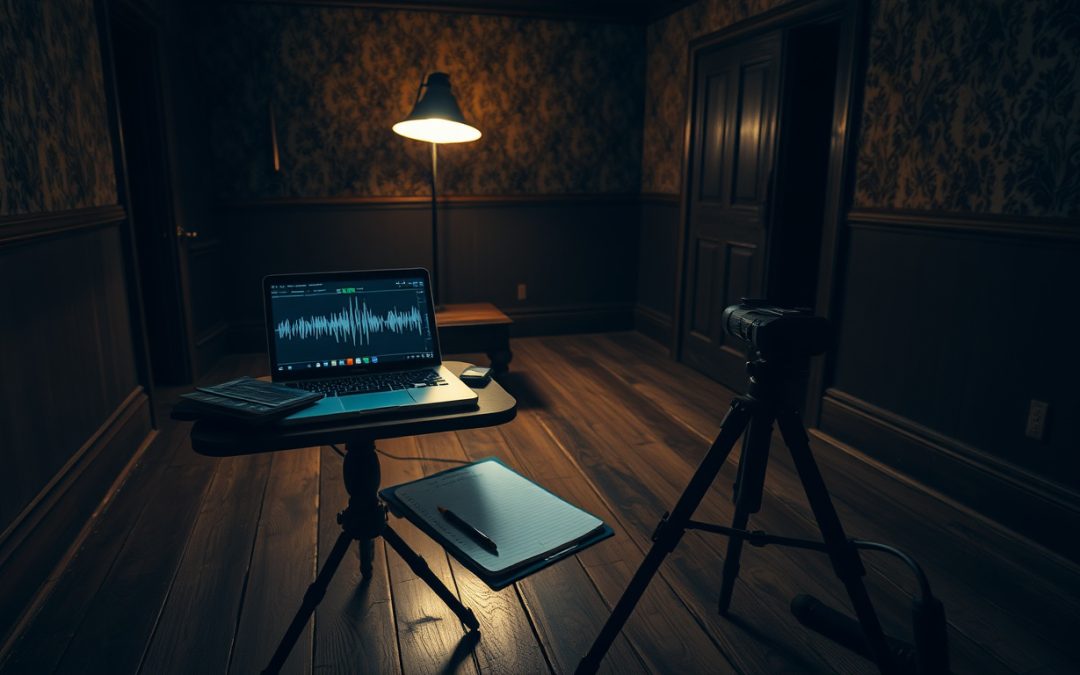
There’s a familiar moment on any long investigation. It’s two in the morning, someone’s cold and tired, and a recorder that’s been running for six hours needs reviewing. Somewhere in that audio might be a stray sound worth a second look. Most of it is a car passing, a stomach growling, a floorboard settling as the building cools. The hard part of paranormal research was never collecting data. It was making sense of it honestly, without fooling yourself.
That’s the real story behind the future of ghost hunting software. Not gadgets that promise to “detect spirits” — those promises have always been marketing, not measurement. The genuine shift is quieter and more useful: tools that help investigators document carefully, analyze without corrupting their evidence, and separate the ordinary from the genuinely unexplained. If you take the work seriously, that’s the direction worth watching.
Let’s be clear about what software can and can’t do, where the field has been, and what a thoughtful investigator should actually expect from the next generation of paranormal investigation tools.
What Software Actually Does in Paranormal Research
Start with an honest boundary. No app detects the dead. A microphone records air pressure changes. A camera records light. An EMF meter reads electromagnetic fields. Software processes the files those instruments produce. None of that chain touches anything supernatural, and any product claiming otherwise is selling you a story.
What software genuinely offers is leverage over information. A human being reviewing six hours of audio will drift, lose focus, and start hearing patterns that aren’t there — a well-documented quirk of perception called pareidolia, where the brain imposes meaning on noise. Good paranormal analysis software doesn’t remove that risk, but it structures the review so you’re less likely to be swept along by it. It lets you slow a clip, mark a timestamp, compare an original file against an enhanced version, and keep records that a skeptic could check later.
In other words, the value isn’t detection. It’s discipline. That distinction is the entire future of the field, and it’s why the Lodestra approach begins with the same rule every time: rule out the ordinary before reaching for the extraordinary.
A Short, Honest History of the Tools
Parapsychology has always leaned on whatever technology was available. In the late nineteenth and early twentieth centuries, researchers used cameras and mediumistic sittings, and much of what they produced later collapsed under scrutiny — double exposures, hidden accomplices, and outright fraud exposed by careful investigators. The lesson from that era wasn’t that people are gullible. It was that documentation and controls matter more than the sensational result.
By the mid-twentieth century, laboratory parapsychology tried to bring statistical rigor to questions of perception and chance. Whatever you make of those results, the ambition was sound: measure, record, and let others check your math. Field investigation of hauntings borrowed the same instincts more slowly, often relying on anecdote and atmosphere rather than method.
The modern era of consumer ghost hunting technology arrived when audio recorders, digital cameras, and sensors got cheap. That democratized the hobby, which was good, and flooded it with untested gadgets and wishful interpretation, which was not. The next phase — the one unfolding now — is about maturity: less magic-box thinking, more evidence management.
The Real Trend: From Gadgets to Documentation
Ask an experienced investigator what wins or loses a case, and it’s rarely a dramatic capture. It’s whether the evidence holds together. Where was the recorder placed? What else was in the room? Who spoke, and when? Was there a highway outside, a furnace cycling on, a phone in someone’s pocket? Cases fall apart on missing context, not missing spirits.
This is why the center of gravity in paranormal investigation software is moving toward the unglamorous work of tracking, logging, and reporting. The most important tool in a serious kit increasingly isn’t a sensor at all. It’s a system that keeps the whole investigation coherent.
The Case File as the Backbone
A good paranormal case file manager treats an investigation the way a detective treats one: as a structured record that grows from the first client phone call to the final written conclusion. Witness statements, the building’s history, room-by-room readings, timestamps, and — crucially — the debunks all live in one place. When you can show a client not only what you found but everything you ruled out, your credibility multiplies.
Lodestra’s Paranormal Case File Manager is built around exactly this idea: log witnesses, location history, readings, evidence, and debunks as the case unfolds, then export a conclusion that holds up to questioning. The future of the field belongs to investigators who can defend their reports, and organized documentation is how you do that.
Mapping the Scene, Not Just Describing It
Another quiet advance is spatial documentation. “We heard a knock in the back bedroom” means little without a layout showing where the bedroom sat relative to the plumbing, the exterior wall, and the road. Location mapping tools like SpecterGrid Location Mapper let you build an investigation layout, mark rooms, place equipment, and pin where activity occurred, then export a clean visual for the file. That turns a vague memory into a checkable claim.
Smarter Analysis Without Fooling Yourself
The most interesting frontier in paranormal research software is analysis — and it’s also the most dangerous, because enhancement is where honest investigators accidentally manufacture evidence.
Audio and EVP: The Non-Destructive Rule
Electronic voice phenomena are recorded sounds some interpret as voices that weren’t heard at the time. The mundane explanations are numerous and well established: radio interference bleeding into cheap electronics, stray speech, the recorder’s own processing artifacts, and above all pareidolia filling ambiguous noise with words. The more you process a clip — boosting, filtering, looping — the more your brain “hears” what you expect.
That’s why the direction of serious EVP analysis software is toward non-destructive workflows. You isolate, slow, or reverse a segment to examine it, but the original file stays untouched, and every step is documented so someone else can retrace it. A tool like the DeadAir Audio Analyzer Pro is built for this kind of review: import or record, mark and classify possible events, and keep the source audio intact. The point isn’t to make faint sounds sound like words. It’s to examine them without contaminating the record — and to be willing to conclude “inconclusive,” which is the most honest verdict in this work.
Video and Photos: A/B Honesty
Video and photo analysis face the same trap. Brighten a dark frame enough and dust, insects, lens flare, and compression noise all start to look meaningful. The responsible approach keeps the original and the enhanced version side by side so nothing gets misrepresented. Frame-by-frame review, movement detection, and region tracking in a tool like the PhantomFrame Pro Video Analyzer help you find and describe what actually changed — while a RAW A/B comparison keeps the enhancement honest.
Photos benefit most from metadata. EXIF data — the timestamp, camera settings, and exposure baked into an image file — often settles a case quickly. A “figure” in a long-exposure night shot is usually explained the moment you read the shutter speed. A PhantomCapture Photo Analyzer approach — inspect the metadata, zoom into questionable areas, compare original and enhanced, tag anomalies, export a grounded report — is exactly the kind of analysis that respects the evidence instead of inflating it.
What the Future Probably Looks Like
Predictions in this space should be cautious, because hype has a long track record here. But a few directions look reasonable.
- Better integration. Audio, video, photos, sensor logs, maps, and witness notes pulled into a single timeline, so an event at 2:14 a.m. can be checked against everything else happening in that moment.
- Automated first-pass screening. Software that flags candidate moments in long recordings for human review. This saves time, but it will never replace a careful investigator’s judgment — and it introduces its own bias if trusted blindly.
- Stronger metadata and chain-of-evidence tracking. The more a file can prove when and how it was created and altered, the harder it is to fake and the easier it is to trust.
- Reporting that shows the debunks. The reports that will matter are the ones that document what was ruled out, not just what was captured.
Notice what’s absent from that list: any promise that software will finally “prove ghosts.” It won’t, and a tool that claims to has told you something about its makers, not the afterlife.
How to Use These Tools Responsibly
If you want your paranormal investigation to hold up, let the software serve the method rather than replace it. A practical sequence:
- Document the baseline first. Before anything anomalous, record the ordinary conditions — temperature, drafts, ambient sound, EMF sources like wiring and appliances, and every person present.
- Keep originals sacred. Whatever you enhance, never alter the source file. Non-destructive tools exist precisely so your raw evidence stays defensible.
- Log as you go. Timestamp events in the moment. Memory reshapes itself; a contemporaneous record doesn’t.
- Chase the mundane hard. Apply the Lodestra Razor. A knock is a pipe until you’ve genuinely eliminated the pipe. Infrasound, settling structures, and suggestion explain far more than most people expect.
- Be willing to write “unexplained” — and mean it narrowly. Unexplained means you couldn’t find the cause, not that you found a ghost.
Do this consistently and your case files become genuinely valuable, whatever conclusion they reach. That’s the quiet revolution in paranormal research: not louder claims, but better records.
The Bottom Line
The future of ghost hunting software isn’t a smarter spirit detector. It’s a more disciplined investigator, supported by tools that make honesty easier than self-deception. The mystery worth chasing has always lived in careful observation — in the sound you slowed down and still couldn’t explain, in the reading you documented and the ten ordinary causes you eliminated first. Software that helps you do that work rigorously is the real advance, and it’s where serious paranormal research is heading.
If that’s the kind of investigating you care about, you can see Lodestra’s field methods and tools and decide what belongs in your own kit. Start with the method. Let the technology follow.