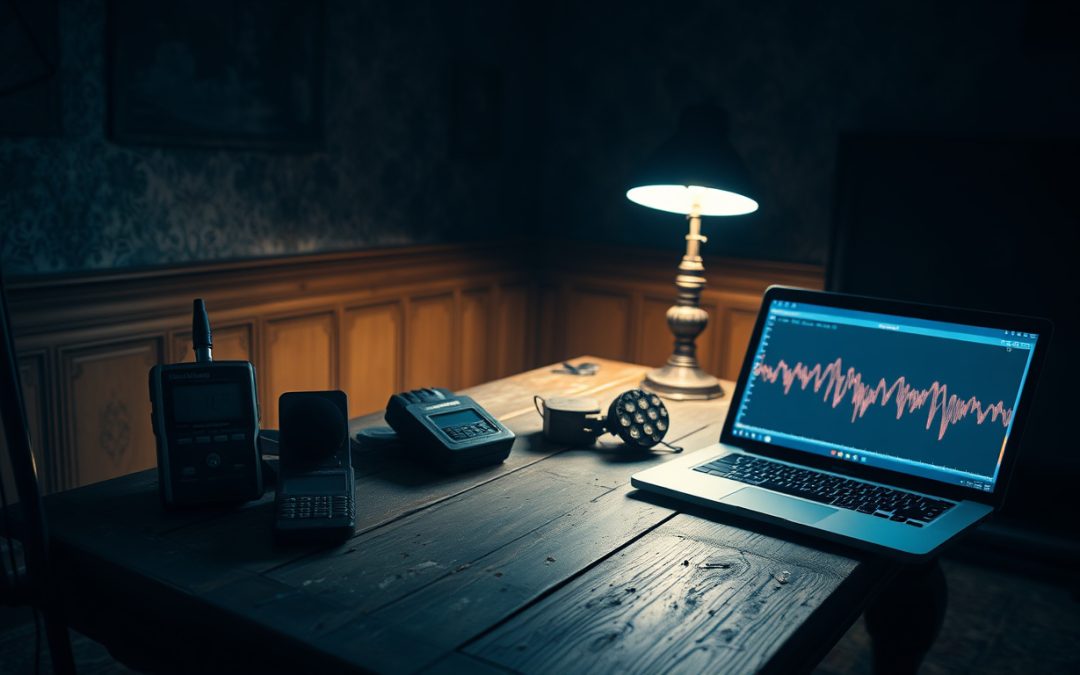
Walk into any modern investigation and you’ll see a table covered in gear: audio recorders, thermal cameras, EMF meters, laptops running analysis software. The equipment has never been better or cheaper. Yet more technology has not automatically produced better paranormal research. In many cases it has produced more confident mistakes — investigators pointing at a screen and calling a compression artifact a face, or a stray radio harmonic a voice. The tools are only as honest as the person reading them.
That’s the tension worth examining. Technology in paranormal investigation is genuinely useful, but not for the reason most people assume. It rarely reveals the extraordinary. What it does well is document conditions carefully, capture data you can review later, and help you rule out ordinary causes with far more rigor than memory and a flashlight ever could. Used that way — as instruments of elimination rather than proof — modern tools make investigation sharper. Used carelessly, they manufacture mysteries that were never there.
What the Instruments Actually Measure in Paranormal Research
The first rule of using any device is knowing what it detects. This sounds obvious, and it is routinely ignored.
An EMF meter measures electromagnetic fields. That’s the entire job. It responds to wiring, appliances, transformers, phone signals, and the meter’s own proximity to metal. It does not detect spirits, consciousness, or the presence of the dead. When a field spikes near an old fuse box, the meter is telling you there’s a field near an old fuse box. Nothing more. The same discipline applies to thermal cameras, which read surface temperature and are easily fooled by reflective surfaces, drafts, and the investigator’s own body heat lingering on a wall.
None of this makes the instruments useless. It makes them honest — as long as you interpret them honestly. A thermal camera is excellent for finding the actual draft behind a “cold spot.” An EMF meter is excellent for mapping the electrical environment of a room, which matters more than most people realize.
The Infrasound and EMF Connection
Here’s where technology earns its place. Research into environmental factors has suggested that strong electromagnetic fields and infrasound — sound below the range of human hearing, roughly under 20 Hz — may contribute to feelings of unease, the sense of a presence, and even visual disturbances in some people. Vibration engineer Vic Tandy’s well-known observations in the 1990s linked a low-frequency standing wave in a laboratory to reported apparitions and dread; when the vibrating source was identified, the effect faded.
This is exactly the kind of ordinary cause a serious investigator wants to find. If a location makes people feel watched, and your instruments reveal a strong intermittent field from faulty wiring or a low-frequency hum from an HVAC system, you may have explained the experience without invoking anything paranormal at all. The Lodestra Razor in action: rule out the mundane first, and be genuinely pleased when you find it.
Audio Evidence and the EVP Problem
Electronic voice phenomena — brief sounds captured on audio that some interpret as voices — are among the oldest claims in the field. They’re also among the easiest to get wrong, because human hearing is aggressively pattern-seeking. Our brains are built to pull speech out of noise, which is a survival trait and an investigator’s liability. Present someone with random static and the suggestion that a voice says a particular word, and many people will hear exactly that word. This is auditory pareidolia, and it’s reinforced by expectation.
Real audio capture is full of ordinary voice sources: distant conversation, radio bleed, an investigator’s own stomach or breath, the recorder’s internal electronics, and structural sounds a settling building makes all night long. Modern paranormal audio software doesn’t remove these problems, but it lets you examine a clip carefully instead of reacting to it in the moment.
How to Review EVP Evidence Responsibly
Good EVP analysis software supports a disciplined workflow rather than a dramatic one. The core practices matter more than any single tool:
- Work from the original file and never alter it. A non-destructive workflow keeps the source untouched so you can always return to the raw audio.
- Log the exact timestamp, who was present, and what everyone was doing. Most “voices” are explained the moment someone remembers they whispered.
- Avoid telling listeners what a clip “says” before they hear it. Suggestion contaminates the review.
- Isolate, slow, and mark sections, but treat any enhancement with suspicion — the more you process audio, the more artifacts you can introduce.
- Classify honestly. Most captures are best labeled “likely environmental” or “unexplained but weak,” not presented as speech.
A tool like the DeadAir Audio Analyzer Pro is built around this kind of review — import, isolate, slow, mark, and classify possible events while keeping the original recording intact. The value isn’t that it finds voices. It’s that it forces you to document your reasoning and preserves a clean copy so someone else can check your work. That’s what separates evidence-based paranormal investigation from wishful listening.
Video and Photo: Where Artifacts Masquerade as Anomalies
Cameras lie constantly, and they lie in predictable ways. Digital compression smears detail and can generate blocky patterns that resemble shapes. Long exposures blur moving light into streaks. Dust, moisture, and insects close to the lens catch the flash and appear as glowing “orbs” — one of the most thoroughly explained phenomena in the field, and one still routinely misread. Night-vision and infrared footage introduce their own noise, which the eye readily organizes into faces.
This is where analysis technology genuinely helps, provided it keeps you honest. Stepping through footage frame by frame often reveals that a “figure” was an investigator crossing the shot, or that a “moving object” is sensor noise that never actually traveled anywhere. Movement detection and motion heatmaps can show whether something in the frame really changed position or just flickered in the compression. The essential feature in any ghost hunting video analyzer is a way to compare the enhanced version against the untouched original, so an enhancement can never quietly become the “evidence.”
Photo work follows the same logic. Before anyone speculates about an image, the metadata deserves a look: shutter speed, ISO, flash state, and timestamp frequently explain a “ghost” outright. A long shutter and a bright light source account for a startling number of streaks. Tools such as the PhantomFrame Pro Video Analyzer and the PhantomCapture Photo Analyzer are useful precisely because they support that comparison and documentation — original versus enhanced, metadata in view, anomalies tagged with an explanation rather than a conclusion.
The Underrated Technology: Documentation and Case Management
Ask experienced investigators what actually improved their work, and many won’t name a gadget. They’ll name their record-keeping. A case falls apart not because the instruments failed but because nobody wrote down where they stood, what time the sound occurred, or that a truck passed outside at that moment.
This is the quiet revolution in paranormal technology. Mapping a scene, pinning where each reading was taken, logging witness accounts and the mundane explanations you ruled out, and assembling it into a report someone else can scrutinize — that’s what turns a collection of spooky moments into a defensible investigation. A location mapper like SpecterGrid lets you show exactly where activity was reported instead of describing it vaguely, and a structured Paranormal Case File Manager keeps witnesses, readings, evidence, and debunks in one place from the first client call to the final conclusion.
Good documentation is also an ethical practice. You’re often working with people who are frightened in their own homes. Taking their experience seriously means investigating it carefully, recording what you find honestly, and being willing to tell them the most likely answer is a plumbing knock or a drafty window — because usually, it is.
A Working Method for Technology-Assisted Paranormal Investigation
If you want technology to strengthen rather than distort your paranormal research, build a routine around elimination:
- Baseline first. Before anything else, measure the environment — EMF, temperature, ambient sound, airflow. You can’t spot an anomaly without knowing what normal looks like.
- Map the space. Note wiring, vents, windows, appliances, and known noise sources. Half your “activity” lives on this list.
- Capture continuously and honestly. Record with timestamps. Keep originals untouched.
- Review cold. Analyze audio, video, and photos later, without the atmosphere of the location pushing your interpretation.
- Explain before you elevate. For every possible anomaly, exhaust the ordinary causes — draft, settling, reflection, compression, suggestion, equipment noise — and document each one you considered.
- Report what survives. Whatever can’t be explained after honest scrutiny is your genuine “unexplained.” It’s usually small, and it’s far more interesting for being real.
The goal is never to prove a ghost. It’s to reach a conclusion that holds up when a skeptical stranger reads your file.
Where Technology Fits in Serious Paranormal Research
The honest answer to our title is that technology’s role in modern paranormal research is not to detect the supernatural. No device does that, and any product claiming it does is selling certainty it can’t deliver. What good tools offer is discipline: careful measurement, clean documentation, and the ability to review evidence slowly and comparatively instead of reacting to a fright in the dark. They make it far easier to find the ordinary cause — which is the outcome most investigations deserve — and far harder to fool yourself when you don’t.
That’s the standard worth holding. Curiosity paired with rigor. Instruments used for what they actually measure. A bias toward the mundane, and a genuine respect for the rare case that resists every explanation you throw at it. If that approach appeals to you, you can explore the research and field methods at Lodestra and see how careful documentation turns loose observations into evidence that stands on its own.