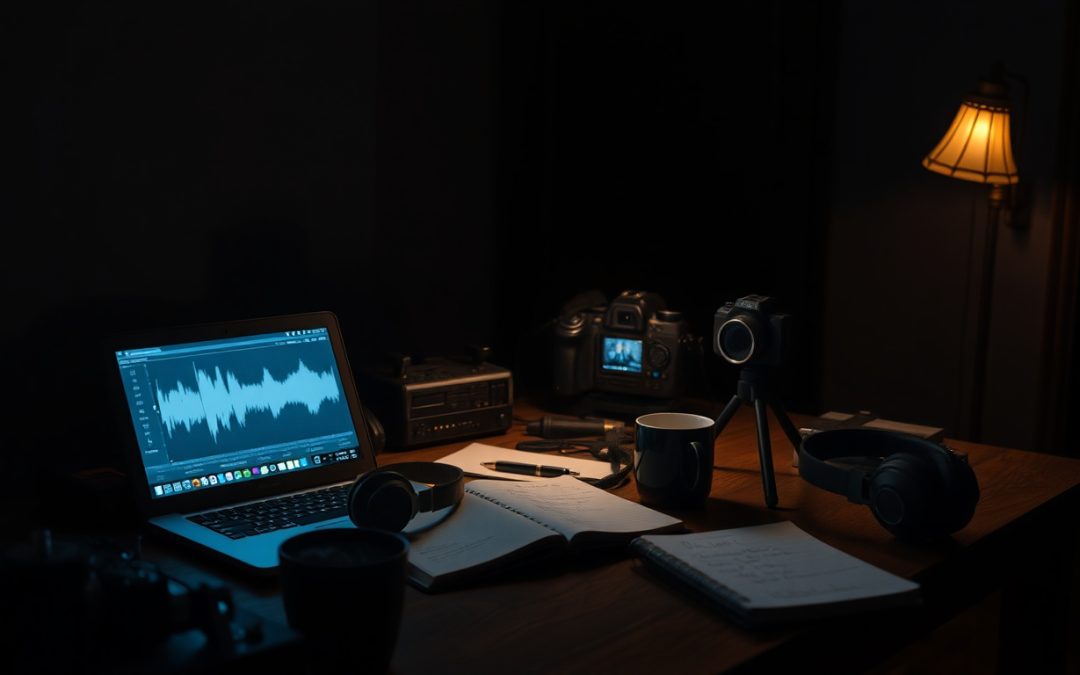
The most important part of any ghost hunt happens after everyone has gone home. The location is quiet, the flashlights are back in their cases, and you’re sitting in front of hours of recordings you barely paid attention to while you captured them. This is where serious paranormal research actually lives — not in the dramatic moment of a cold draft or a creaking floor, but in the patient, unglamorous review that follows. The night gives you raw data. The days after tell you whether any of it means anything.
Most people get this backwards. They treat the investigation as the main event and the review as a formality, skimming footage for the “good parts” and calling it a night. But careful review is where the Lodestra Razor does its best work: you rule out the ordinary before you even entertain the extraordinary. A knock might be a settling joist. A whisper might be your own breath on the mic. A pale shape might be a dust mote drifting past the lens. The only way to know is to slow down and look honestly.
This guide covers how to review evidence after a ghost hunt the way a methodical investigator would — audio, video, photos, and the case file that ties them together. The goal isn’t to find a ghost. The goal is to find the truth, whatever it turns out to be.
Why Evidence Review Is the Heart of Paranormal Research
Human perception is unreliable under exactly the conditions ghost hunts create. It’s dark. You’re tired, a little keyed up, and primed to notice anything unusual. Your brain fills gaps with patterns — faces in shadows, words in noise. This isn’t a flaw unique to believers; it’s how everyone’s nervous system works. Pareidolia, suggestion, and expectation shape what you think you saw and heard in the moment.
That’s why the recording matters more than the memory. A good paranormal investigation treats field notes as hypotheses and the recorded evidence as the test. When you review calmly, in daylight, with the ability to replay a clip fifty times, you strip away a lot of the emotional charge that distorts live experience. You also gain something you never have in the field: the ability to compare, measure, and cross-check.
Rigorous review is the difference between a hobby and real paranormal research. It’s slow, and it kills a lot of “evidence” that felt convincing at 2 a.m. That’s the point. Anything that survives honest scrutiny is worth taking seriously precisely because you tried so hard to explain it away.
Reviewing EVP and Field Audio
Electronic voice phenomena — EVP — are among the most cited and most misunderstood categories of paranormal evidence. The term refers to sounds resembling speech captured on recordings that weren’t obviously present during the session. The history here is long: researchers have been documenting alleged voices on recordings since the mid-twentieth century, and the field has always struggled with the same core problem. Human ears and brains are extraordinarily good at hearing words in noise, even when no words exist.
Rule Out the Ordinary First
Before you classify anything as anomalous, walk through the mundane sources:
- Contamination. Was anyone whispering, shifting, or breathing near the mic? Radios, phones, and stray transmissions bleed into recordings constantly.
- Environmental noise. Pipes, HVAC systems, wind, traffic, wildlife, and settling structures produce sounds that mimic speech or footsteps.
- Equipment artifacts. Compression, electrical interference, and cheap microphones generate their own noise and distortion.
- Suggestion. If someone tells you what a clip “says” before you hear it, you’ll hear it too. Always listen blind first.
Only after you’ve exhausted these should you flag a sound as unexplained — and “unexplained” still doesn’t mean “paranormal.” It means you don’t yet have an answer.
How to Review Audio Rigorously
Work with clean copies and never alter your originals. Listen through headphones in a quiet room. Note the exact timestamp of anything notable, log what you were doing at that moment, and resist the urge to loop a clip endlessly — repetition manufactures false clarity. If you slow or isolate a segment, keep the untouched version alongside it so you can always return to ground truth.
This is where dedicated EVP software earns its place. A tool like the DeadAir Audio Analyzer Pro is built for this kind of non-destructive review — you can import, record, isolate, slow, reverse, mark, and classify possible events while the original audio stays untouched. That last part matters more than any feature. If your workflow permanently changes the source file, you’ve lost the ability to verify your own conclusions. Honest EVP analysis software preserves the evidence exactly as captured.
Reviewing Video Evidence
Video feels more objective than audio, and in some ways it is. But it comes with its own catalog of ordinary explanations that produce genuinely eerie footage. Insects and dust close to the lens photograph as glowing “orbs” because they’re lit by the camera’s own infrared or flash. Lens flares, reflections, and compression artifacts create shapes that seem to move with intent. Low light introduces noise that the eye interprets as motion.
The Discipline of Frame-by-Frame
Most video “anomalies” fall apart the moment you step through them one frame at a time. A shape that looked like it darted across the room turns out to be a moth crossing the sensor over three frames. A “shadow figure” resolves into a change in exposure as headlights sweep past a window. The trick is to slow everything down and ask what physically could have produced the pattern on screen.
Enhancement is fine as long as it’s transparent. Brightening dark footage to see detail is reasonable; you just have to keep the untouched original beside it so no one — including you — mistakes an artifact of processing for something that was actually there. A dedicated tool such as the PhantomFrame Pro Video Analyzer is designed around this principle. It lets you step frame by frame, enhance dark footage without altering the source, run movement detection, and build motion heatmaps, with a RAW A/B comparison that keeps every enhancement honest. Movement detection is especially useful for scanning long, boring clips — it flags where something changed so you’re not staring at three hours of an empty hallway hoping to catch the two seconds that matter.
Reviewing Photo Evidence
Photographs are the easiest evidence to misread and, ironically, often the easiest to debunk. The classic culprits are well documented: orbs from airborne particles, motion blur from a slow shutter, reflections off glass and polished surfaces, and straps or hair drifting in front of the lens producing the infamous “vortex.” Pareidolia does the rest, turning random texture in wallpaper or wood grain into faces.
Start With the Metadata
Before you analyze the image itself, read the data attached to it. EXIF metadata records the camera settings, timestamp, exposure, and often more. This alone resolves a huge share of photo mysteries. A long exposure explains a smear of light. A timestamp confirms whether the photo was taken when the photographer claims. Missing or altered metadata is itself a red flag worth noting in your case file.
From there, zoom methodically into questionable areas, compare the original against any enhanced version, and tag what you find without overstating it. A grounded workflow — the kind supported by the PhantomCapture Photo Analyzer, which inspects metadata, compares original and enhanced versions, and exports a photo evidence report — keeps you honest about what an image can and cannot show. A photo can document that something appeared on a sensor. It can almost never tell you what that something was without corroborating information.
Bringing It Together: Documentation and the Case File
Individual clips and images don’t prove anything on their own. Their value comes from context — what was happening in the location, what other instruments recorded at the same moment, who was where, and whether ordinary explanations were tested and ruled out. This is why documentation is not paperwork; it’s the actual substance of paranormal investigation.
Build a Timeline
The single most useful thing you can do is line up your evidence chronologically. When you place an audio anomaly, a temperature reading, and a witness report on the same timeline, one of two things happens. Either they correlate in a way that’s genuinely interesting, or the “anomaly” lines up neatly with a passing truck, a furnace cycle, or an investigator walking through the room. Both outcomes are wins. A timeline turns scattered impressions into something you can reason about.
Map the Scene
Knowing where activity occurred is as important as when. Mapping the layout — rooms, equipment placement, and where each piece of evidence was captured — often reveals mundane sources you’d otherwise miss, like a draft path or a vibration source near a wall. Tools like the SpecterGrid Location Mapper let you build a layout, place equipment, and drop evidence pins so the spatial picture is part of the record, not just a memory.
Keep One Structured Case File
Scattered notes, phone recordings, and half-labeled video folders are how good evidence gets lost and bad evidence gets overstated. Keeping the whole investigation in one structured place — witnesses, location history, readings, evidence, and the debunks you performed — is the backbone of professional work. The Paranormal Case File Manager is built for exactly this: logging a case from the first client call to a final, exportable conclusion. The debunk log matters as much as the evidence log. Writing down what you ruled out, and how, is what separates a defensible conclusion from a hunch.
The Mindset That Makes Review Worth Doing
Here’s the uncomfortable truth about honest paranormal research: most of what you review will have an ordinary explanation. That’s not failure. That’s the process working. Every mundane cause you identify sharpens your judgment and strengthens the rare case that genuinely resists explanation. If you go into review hoping to confirm a ghost, you’ll find one in every shadow and hiss. If you go in trying to explain each anomaly away, the handful you can’t explain become far more meaningful.
Instruments help, but they don’t decide. An EMF meter measures electromagnetic fields, not spirits. Audio software reveals structure in sound, not intent. Video and photo tools show you what the sensor recorded, not what it means. The interpretation is always yours, and it should always be conservative. The best evidence is the evidence that survived your hardest effort to dismiss it.
If you want to sharpen your own review process and see how a disciplined, evidence-first workflow comes together, explore the field methods and research at Lodestra. Bring your recordings, bring your skepticism, and let the evidence say only what it can honestly support.