
Paranormal Research
The Haunted Mind
How darkness, suggestion, expectation, and sensory uncertainty shape what we experience in haunted places
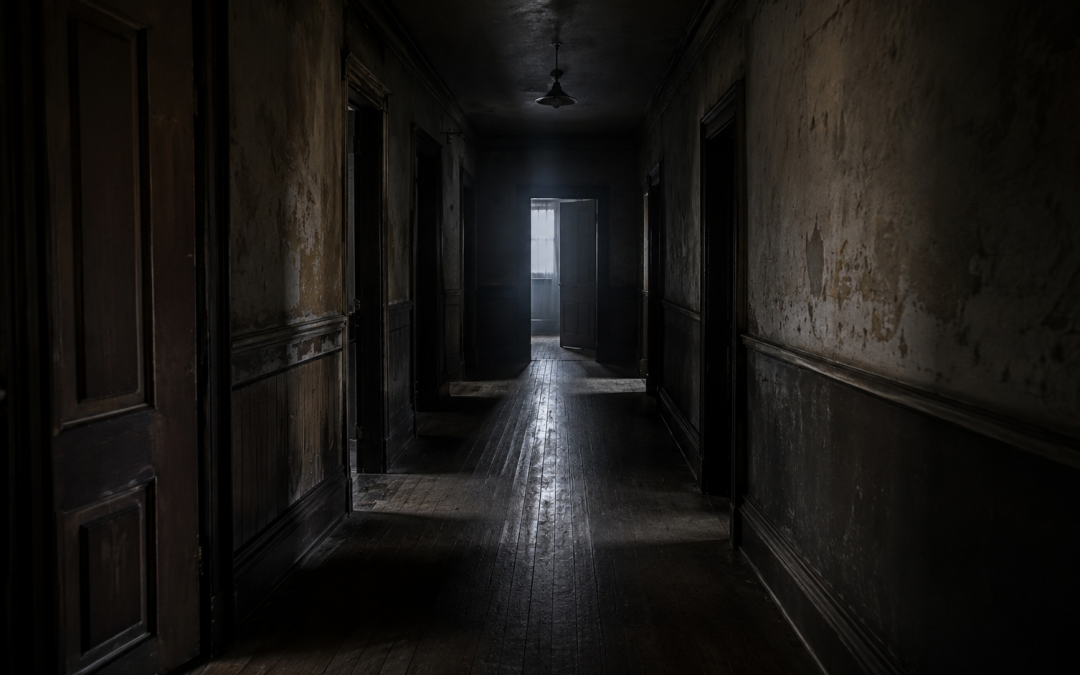
Haunted places have a strange power over the human mind. A dark hallway in an old house can feel heavier than an ordinary hallway. A cold room in a historic building can seem meaningful before anything unusual happens. A creak in the floorboards, a shape at the edge of vision, a whisper-like sound in an empty room — in the right setting, ordinary sensory information can feel charged with significance.
This does not mean people are foolish, dishonest, or imagining everything. It means the human brain is doing what it evolved to do: detect patterns, anticipate danger, and interpret incomplete information as quickly as possible.
Fear is not simply an emotion. It is a survival system. It changes attention, hearing, vision, memory, breathing, movement, and interpretation.
The science of fear does not disprove every paranormal experience. It does, however, help explain why haunted locations produce such vivid, sincere, and sometimes life-changing encounters. To understand haunted places intelligently, we have to understand the mind inside them.
Fear Is a Survival System, Not Just a Feeling
Fear prepares the body to respond to threat. When a person senses possible danger, the nervous system becomes alert. Heart rate increases. Muscles tense. Breathing changes. Attention narrows. The body becomes ready to fight, flee, freeze, or carefully scan the environment.
This reaction is useful when danger is real. The problem is that the system is not designed for perfect accuracy. It is designed for survival. A false alarm is usually safer than missing a threat.
That principle matters in haunted places. Old buildings, cemeteries, abandoned hospitals, battlefields, and historic homes often contain features that trigger alertness: low visibility, unfamiliar sounds, isolation, silence, age, decay, and stories of death or tragedy. Even before a person sees or hears anything unusual, the brain may already be primed to interpret the environment as threatening.
The Brain Is a Prediction Machine
The human brain does not passively receive the world. It constantly predicts what is likely to happen next. In a normal setting, this works smoothly. But if you hear the same thump at midnight inside an old building with a reputation for hauntings, the interpretation changes.
The sound itself may be identical. The context is not.
Expectation influences perception because the brain uses context to decide what sensory information means. If someone enters a location after hearing that people often see a shadow figure near the staircase, that person may become especially alert to movement and human-shaped forms near the stairs. This does not mean they are forcing the experience. It means attention has been directed.
Field Note
The haunting is not only in the building. It is also in the expectation carried into the building. A person may walk in already knowing where the ghost is "usually seen," what sounds have been reported, which room is considered active, and what emotions witnesses claim to feel. That information becomes part of the perceptual environment itself.
Darkness and the Fear Response
Darkness is one of the most important ingredients in haunted experiences. Human beings are visually dependent creatures. When visibility is reduced, uncertainty increases. In darkness, the brain has less information to work with, so it fills in gaps using memory, expectation, and imagination.
In low light, visual detail becomes less reliable. Edges blur. Depth perception weakens. Peripheral vision becomes more important but is less detailed than central vision. Shadows may appear to shift as the eyes adjust. Reflections can seem like movement. Objects that look ordinary in daylight may become ambiguous at night.
A coat hanging on a chair can become a crouched figure. A tree branch moving outside a window can become a hand. A dark opening at the end of a hallway can feel like a presence. The less information the brain receives, the more it must infer.
Darkness does not create fear by itself, but it removes certainty. Once certainty is removed, imagination and expectation have more room to operate.
Peripheral Vision and the Shadow Figure
Many ghost reports involve seeing something at the edge of vision: a shadow passing through a doorway, a figure standing in a corner, movement near the stairs, someone vanishing when looked at directly. These reports are often sincere and can be deeply unsettling.
Peripheral vision is good at detecting motion but poor at identifying detail. A slight movement, reflection, or contrast change may register as a person-like form. When the witness turns to look, the figure is gone. That disappearance may feel paranormal, but it can also happen because the original perception was never detailed enough to confirm.
The brain is especially sensitive to human shapes. Because of this, the mind may interpret vague forms as bodies, faces, or figures. This tendency is why people see faces in clouds, wood grain, old wallpaper, or reflections. In a haunted setting, that same tendency may turn a shadow into a watcher.
Suggestion: The Story Before the Sighting
Suggestion is one of the most powerful forces in haunted experiences. A suggestion does not need to be dramatic or manipulative. It can be as simple as someone saying, "People often feel watched in this room."
Once that idea is introduced, attention changes. A draft may feel like a cold spot. A settling noise may become a footstep. A normal emotional response may become evidence of an unseen presence. Suggestion works because people are social learners. We rely on others to tell us what matters.
Suggestion also spreads through groups. If one person says they heard a whisper, others may begin listening for whispers. If one person feels uneasy, others may become uneasy. Soon the group shares an emotional atmosphere. The location feels active because everyone is responding to one another's reactions.
Expectation and the Search for Meaning
Expectation shapes which details stand out. The human environment is full of information, most of which we ignore. Expectation helps decide which of these become important.
If someone expects a ghost to communicate through knocking, an unexplained knock becomes meaningful. If someone expects spirits to affect electronics, a battery failure becomes meaningful. If someone expects a particular room to produce sadness, a sudden mood shift becomes meaningful.
The Investigator's Distinction
"I heard three knocks" is an observation. "A spirit answered my question" is an interpretation. The first may be documented. The second requires much more evidence. A responsible investigation separates experience from interpretation at every step, even when the experience is powerful.
Sensory Uncertainty: When the Mind Fills the Gaps
Sensory uncertainty occurs when the brain receives incomplete, weak, conflicting, or ambiguous information. Haunted places are full of it. A sound may be faint. A shadow may be brief. A voice may be unclear. A photograph may contain a blur.
The mind prefers meaning over randomness. Randomness is uncomfortable, especially in a fearful environment. If something happens at the exact moment a person asks a question, the event may feel intentional. If a floorboard creaks after someone says a name, the timing may feel too precise to ignore.
Humans are excellent at detecting patterns. We are also capable of detecting patterns that are not actually there. In paranormal investigation, this can happen with audio recordings, photographs, knocks, and equipment fluctuations. Sensory uncertainty does not make paranormal research impossible. It makes careful methods necessary.
The Role of Sound in Haunted Places
Sound is especially important in haunted places because it travels in strange ways. Old buildings often contain hidden paths for sound: vents, pipes, hollow walls, stairwells, chimneys, wooden floors, and open cavities. A noise made in one area can seem to come from another. Footsteps upstairs may be plumbing. A voice-like sound may be people outside.
Fear also changes listening. A frightened person may listen for threat. This can cause ordinary sounds to seem louder, closer, or more intentional. Voice-like sounds are particularly powerful. Humans are tuned to language. We can detect speech patterns even in noise, which is why people sometimes hear words in static, running water, or wind.
Once someone says, "It sounds like it says 'get out,'" others may begin hearing the same phrase. This does not mean every strange recording is worthless. It means interpretation must be separated from wishful thinking.
The Body Can Feel Haunted Too
Not all haunted experiences are visual or auditory. Many people report physical sensations: chills, pressure, dizziness, nausea, hair standing up, heaviness, sudden sadness, or feeling touched. These sensations can be frightening because they feel internal and immediate. A sound can be questioned. A photograph can be examined. But a bodily feeling seems personal and undeniable.
Fear itself can create many physical sensations. Adrenaline and stress responses can cause trembling, chills, tightness in the chest, tingling, or heightened sensitivity to touch. Temperature perception can also shift under stress. A cold spot may be real as a physical condition without being paranormal.
The feeling of being watched is one of the most common experiences in haunted locations. In an uncertain environment, the mind may generate that feeling as part of threat detection. The experience can be powerful. But powerful does not automatically mean supernatural.
Memory, Groups, and What Happens After
A paranormal experience does not end when the person leaves the haunted place. Memory continues to shape it. Human memory is not a perfect recording. It is reconstructive. Each time a person remembers an event, the brain rebuilds it using the original experience, later thoughts, emotions, conversations, and new information.
After the event, people often discuss what happened. Group discussion can unintentionally reshape memory. If one person says the figure was tall, another may begin remembering it as tall. If a guide later explains that a ghost is known to appear in that spot, the witness may connect their experience to the legend. The best time to record an account is as soon as possible, before discussion and before outside information changes the memory.
An Investigator's Approach
- Record witness accounts early. Witnesses should describe what happened before hearing other interpretations. Avoid leading questions. "What did you notice?" is always better than "Did you feel the presence in that room?"
- Separate observation from interpretation. "I heard a knock" is different from "a spirit answered." Keeping these separate makes the case stronger and more honest.
- Document environmental conditions. Temperature, airflow, electrical sources, building materials, weather, plumbing, and nearby human activity all matter. Without environmental context, evidence is incomplete.
- Control suggestion when possible. Allow people to experience the space before hearing the stories. Compare results with and without prior information.
- Use independent review. Audio, video, and photographs should be reviewed by people who do not know what they are "supposed" to find.
- Value patterns over isolated events. Repeated reports from independent witnesses over time, with consistent details, deserve far more attention than a single anomaly.
- Accept uncertainty honestly. "Unexplained" is not a failure. It is an honest category when evidence is insufficient. The strongest investigators are those who can sit with that without forcing a conclusion.
The Haunted Mind Is Not a Weak Mind
One of the worst mistakes in discussing paranormal experiences is implying that people who report them are unintelligent, unstable, or easily fooled. That is not a scientific position. Intelligent, educated, skeptical, and emotionally grounded people report unusual experiences. Fear and perception affect everyone.
The brain mechanisms involved in haunted experiences are normal. Pattern recognition, threat detection, memory reconstruction, social influence, and expectation are not signs of weakness. They are part of being human.
A respectful investigation can say, "I believe you experienced something," while also saying, "We do not yet know what caused it."
The Mystery Is Not Only Out There
Understanding the science of fear does not make haunted places less interesting. It makes them more interesting. A haunted place is not only a possible site of paranormal activity. It is also a place where history, architecture, memory, emotion, folklore, and perception meet.
People go to haunted places because they want contact with mystery. They want to feel history as something alive. They want to test their courage. They want to confront death from a safe distance. They want to believe the past is not entirely gone.
The most intelligent approach to haunted places is neither blind belief nor automatic dismissal. It is disciplined curiosity. Fear is not the enemy of paranormal investigation. Unexamined fear is.
When we understand how fear works, we become better witnesses, better researchers, and better storytellers. We learn to respect both the mystery of haunted places and the complexity of the human mind that enters them.