
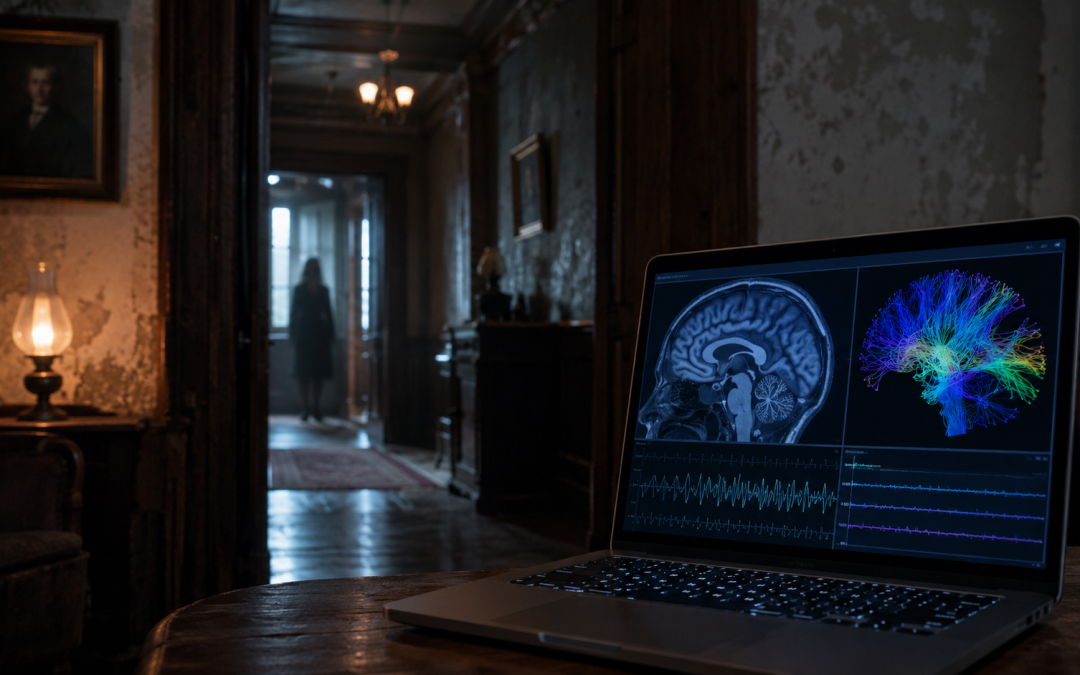
Paranormal Research
The Neuroscience of Apparitions
How the brain constructs presence, bodies, faces, and agents — and why apparition reports deserve more careful study than simple dismissal
Apparitions are among the most compelling and controversial experiences in paranormal history. People report seeing figures at the foot of the bed, shadowy forms in doorways, deceased loved ones standing nearby, strangers in old buildings, faces in windows, or human shapes that vanish when approached. Some accounts are brief and ambiguous. Others are detailed, emotionally powerful, and remembered for a lifetime.
The easy response is to dismiss all apparition reports as fantasy, superstition, or fraud. That response may feel efficient, but it is not intellectually satisfying. It fails to explain why apparitions are reported across cultures, why many witnesses are otherwise rational and healthy, why some reports occur during grief or crisis, and why the human brain is so strongly inclined to detect presence, faces, bodies, and intentional agents.
The real question is not whether the brain is involved in apparition experiences. It always is. Every human experience is mediated by the brain. The question is what caused the experience, how it was constructed, whether it involved external stimuli, and whether anything remains unexplained after careful analysis.
Apparition reports deserve study not because they automatically prove ghosts, but because they sit at the intersection of perception, consciousness, memory, emotion, culture, and possibly anomalous experience. They are not merely spooky stories. They are data about how human beings encounter the unknown.
The Constructed Nature of Perception
Most people assume seeing is simple: light enters the eyes, the brain receives an image, and we see what is there. In reality, vision is an active process. The brain takes incomplete signals from the eyes and builds a meaningful scene. It identifies edges, depth, motion, faces, bodies, objects, and likely causes. It fills gaps. It predicts what should be present. It compares current input with memory and expectation.
Apparition experiences often occur in conditions where sensory information is incomplete or ambiguous. A dim hallway, a bedroom at night, a reflective window, a half-open door, or a figure glimpsed in peripheral vision gives the brain less reliable data. When data is weak, prediction becomes more influential. If the setting is associated with death, fear, or grief, the brain may be more likely to interpret ambiguous shapes as meaningful presence.
The Core Principle
This is not a defect. It is how perception works. The same system that lets us recognize a friend from a partial silhouette can also make us see a figure in a shadowed corner. The brain is not inventing randomly. It is trying to make sense of uncertainty.
How the brain constructs a visual scene
Why the Brain Detects Agents Everywhere
Human beings are highly sensitive to agents: living beings that act with intention. Detecting agents quickly has survival value. If something moves in the dark, it is safer to assume it might be alive than to ignore it. This tendency is sometimes called hyperactive agency detection. The brain detects intentional beings even when evidence is incomplete. From a survival standpoint, false alarms are less costly than missed threats.
In haunted settings, this system becomes especially relevant. Apparition reports often involve the sense that "someone is there." Sometimes the witness sees a full figure. Sometimes they only feel watched. Sometimes they perceive a presence just outside the field of vision. The brain tracks where others are standing, infers gaze, intention, and movement, and can feel socially aware even when no one is speaking.
A sensed presence may arise when the brain's agent-detection systems become active without clear external confirmation. The person may genuinely feel that another being is nearby. The experience can be powerful, frightening, comforting, or sacred. The scientific point is not that the experience is meaningless — it is that the brain has systems capable of generating presence entirely from within.
The Sense of Presence
The sense of presence refers to the feeling that another person or entity is nearby, even when no one is visible. This sensation has been reported in many contexts: grief, sleep paralysis, extreme environments, neurological conditions, isolation, religious experience, mountaineering, polar exploration, bereavement, and haunted locations. It can be mild, like feeling watched in an empty room. It can also be intense, as if a specific person is standing just behind the witness.
Neuroscience suggests that the sense of presence may involve the brain's model of the self in relation to the environment. The brain constantly tracks where the body is, how it is positioned, and how it relates to surrounding space. If this system becomes disrupted, the brain may misattribute aspects of its own body representation to another presence nearby.
Key Research Context
Ordinary people can experience presence under stress, grief, fatigue, sensory deprivation, or fear without any severe pathology. In haunted places, the sense of presence may be intensified by darkness, silence, unpredictable sounds, and haunting stories. The body becomes alert. In that state, a vague feeling may become a perceived presence. These reports should be documented carefully — they are subjective, but not useless.
Faces: The Brain's Favorite Pattern
Faces are among the most important patterns the brain recognizes. The brain has specialized networks involved in face perception that are so sensitive they can detect faces where none exist. This is why people see faces in clouds, smoke, wallpaper, stone, tree bark, old windows, or blurred photographs. This tendency is called pareidolia. It is not stupidity or hallucination. It is normal pattern recognition operating under uncertainty.
Many apparition reports involve faces: a face at a window, a face in a mirror, a face in smoke, a face emerging from darkness, or a face glimpsed in a corner. Faces carry enormous emotional weight. A face implies identity, attention, and intention. A human-like face in a place where no person should be can trigger immediate fear. Once the brain interprets something as a face, the experience changes. A stain is ignored. A face is watched. A shadow is background. A face is presence.
Bodies, Motion, and Shadow Figures
The brain is also highly sensitive to body forms. We can recognize a human figure from posture, movement, outline, gait, and proportion. Even in low light, a few cues are enough. A vertical shape with a head-like top and shoulder-like width may register as a person. A moving dark patch may seem like a body in motion. A coat rack, curtain, lamp, or doorway shadow may briefly resemble a person.
Motion makes this more powerful. The brain is especially sensitive to biological motion: the patterns of movement associated with living bodies. Even minimal point-light displays can be perceived as human movement if the points move in the right relationships. In haunted environments, this sensitivity can produce shadow-person experiences. A dark shape in peripheral vision seems to move like a person. The witness turns, but the figure disappears.
Body perception also interacts with fear. If the brain suspects a person may be present, it prioritizes that interpretation. It does not wait for perfect evidence before reacting. It alerts the body first, then investigates. This is why apparition reports often feel sudden. The figure appears to be there instantly. The interpretation arrives with the perception.
Peripheral Vision and the Apparition at the Edge
Many apparitions are reported at the edge of vision: movement beside the witness, a figure near a doorway, a shadow crossing a hall, or someone standing just outside direct focus. When they look directly, the figure is gone. Peripheral vision is excellent for detecting motion and changes in light, but poor at resolving detail, color, and identity. This makes it both useful and prone to ambiguity.
In low light, peripheral uncertainty increases. The eye relies more heavily on light-sensitive cells that are good for detecting brightness and movement but poor for fine detail. The edges of vision become fertile ground for apparition-like experiences.
Questions That Matter
Was the figure seen directly or peripherally? How long did it last? Was there movement? What was the lighting? Was the witness tired or startled? Were there reflective surfaces nearby? Did the witness know the location's ghost story beforehand? A full-bodied figure seen clearly for several seconds under good lighting is evidentially different from a dark movement glimpsed at the edge of vision in a dim room. Both may be meaningful to the witness. They are not equal as evidence.
Sleep, Waking, and Bedroom Apparitions
Some of the most vivid apparition reports occur in bedrooms: a figure standing beside the bed, a shadow at the door, a deceased loved one nearby, or a threatening presence pressing on the body. Sleep-related states are critical to understanding these accounts.
During transitions into and out of sleep, people may experience vivid imagery, sounds, bodily sensations, or a strong sense of presence. Sleep paralysis is especially relevant. During REM sleep, the body normally inhibits voluntary muscle movement. Sometimes a person becomes aware before this paralysis has fully lifted. They may be awake enough to perceive the room but unable to move, accompanied by pressure on the chest, buzzing sounds, sensed presence, or shadowy figures.
Across cultures, sleep paralysis has been interpreted through local beliefs: demons, witches, spirits, old hag figures, night visitors, alien abductions, shadow people. The core physiology may be similar, but the interpretation changes with culture and expectation. This does not mean all bedroom apparitions are sleep paralysis. It means sleep-state explanations must be considered whenever an event occurs near sleep, in bed, or during partial waking.
Grief, Bereavement, and Seeing the Dead
Many apparition reports involve deceased loved ones. Bereavement experiences are common enough that they should not be treated as inherently pathological. Many healthy people report sensing, hearing, or seeing someone who has died. These experiences may occur days, months, or years after the death. They can be visual, auditory, tactile, olfactory, or simply a strong sense of presence.
From a neuroscience perspective, grief changes attention, memory, expectation, and emotional salience. The brain has spent years modeling the presence of the loved one: their voice, face, movement, smell, routines, and emotional significance. After death, the relationship does not vanish instantly from the brain's predictive systems. The mind may continue to anticipate the person's presence. A sound in the house may briefly be interpreted as them. A shape in the doorway may become them.
A Responsible Position
Bereavement apparitions should be treated with respect. They should not be mocked or used as instant proof of survival after death. A grieving person's experience may be psychologically understandable and still spiritually meaningful to them. Science can describe mechanisms without exhausting meaning. When evidential claims are involved — accurate information the witness says they did not know — a different and more careful investigation is warranted.
Memory and the Apparition After the Fact
Apparition reports are shaped not only by perception but also by memory. Memory is reconstructive. Each time a person recalls an event, the brain rebuilds it from sensory impressions, emotions, later interpretations, and conversations. A witness may initially see "something dark moving near the door." After discussing it and learning the location's history, the memory may become more structured: "I saw a tall man standing near the door."
This does not mean the witness is lying. It means memory seeks coherence. Fear and emotional intensity can make a memory feel more certain. People often assume that if they remember something vividly, the memory must be accurate. But confidence and accuracy are not the same.
For paranormal casework, the timing of witness statements is crucial. The best accounts are recorded as soon as possible, before group discussion, before the witness is told what others believe happened. If the witness says "dark shape," that should not be upgraded to "apparition." The first report is often the cleanest report.
Type
Peripheral figure
Dark movement at the edge of vision, gone when looked at directly. Very common. Driven by low-detail motion detection in poor light.
Type
Sensed presence
No visual component. Strong feeling of another being nearby. Associated with grief, fatigue, fear, isolation, and neurological disruption.
Type
Sleep apparition
Figure at the bedside, often with paralysis or pressure. Hypnagogic and hypnopompic states and sleep paralysis are significant factors.
Type
Bereavement vision
Deceased loved one seen, heard, or felt. Common in healthy grieving people. Brain's predictive models for the person remain active after death.
Type
Full-body apparition
Detailed figure seen clearly for multiple seconds. Rarer. More evidentially significant when conditions and witness history are documented.
Type
Crisis apparition
A person seen at a distance during or near the time of their death or a major event, without the witness having been informed.
Why Dismissal Is Not Enough
The neuroscience of apparitions can explain many features of ghostly experience: presence, faces, bodies, shadows, peripheral figures, sleep-state visions, grief encounters, and memory changes. Some may conclude that this is enough to dismiss apparitions entirely. That would be too simplistic.
A neurological explanation for how an experience can occur is not always a complete explanation of why a particular experience occurred. The brain is always involved in perception. If someone sees a living person in a room, their brain constructs that perception too. The fact that perception is constructed does not mean the object perceived is unreal.
The real question is evidential: Was there an external stimulus? Did multiple witnesses observe the same thing independently? Did the apparition correspond to a person unknown to the witness but later verified? Were alternative explanations ruled out? Most apparition reports do not meet strong evidential standards. But some cases are more complicated. These deserve careful study, even if no paranormal conclusion is reached.
Apparitions as Interdisciplinary Data
Apparition reports should not belong only to ghost hunters or skeptics. Neuroscience can study perception, body mapping, face detection, presence, and sleep states. Psychology can study grief, memory, fear, and expectation. Anthropology can study cultural patterns and how societies interpret the dead. History can study how accounts change across time. Parapsychology can investigate whether some reports contain information difficult to explain through ordinary means. Environmental science can examine lighting, sound, toxins, air quality, and electromagnetic sources.
This interdisciplinary approach is stronger than arguing over whether apparitions are "real" in a simplistic sense. Apparition reports are real as experiences. The cause of each experience is the question. Some may be perceptual errors. Some may be sleep phenomena. Some may remain unexplained. A scientific approach does not need one answer for all cases.
Toward better apparition research
- Record immediate accounts Witnesses should provide statements as soon as possible. Their first description should be preserved without interpretation. The first report is usually the cleanest.
- Avoid leading questions Do not ask "Did you see the woman in white?" Ask "What did you see?" The wording of a question can reshape memory.
- Document conditions Lighting, weather, time, room layout, reflective surfaces, sound sources, witness position, and emotional state all matter and must be recorded.
- Separate perception from interpretation "I saw a dark figure" is not the same as "I saw a ghost." Both should be recorded. Neither should be confused for the other.
- Seek independent corroboration If multiple witnesses report the same event, interview them separately before they compare stories. Differences and agreements are both informative.
- Consider sleep and health factors Sleep deprivation, medications, stress, grief, migraines, and sleep paralysis can all be relevant. These should be explored respectfully, not accusingly.
- Preserve uncertainty A case can be interesting without being solved. "Unexplained" should remain a valid category when evidence is genuinely insufficient.
Seeing Ghosts and Seeing the Mind at Work
Apparitions occupy a strange and important place in human experience. They appear in haunted houses, hospital rooms, battlefields, bedrooms, cemeteries, dreams, grief, folklore, and crisis moments. They are often dismissed too quickly, but they are also believed too easily. A serious approach must hold two truths at once.
First, the brain is capable of producing experiences that feel external, embodied, and real. It constructs perception from incomplete information. It searches for meaning in darkness and ambiguity. It can generate a sense of presence, see faces in noise, produce vivid experiences during sleep transitions, and preserve the dead through memory and expectation.
Second, the existence of neurological mechanisms does not justify careless dismissal of every report. Each case still deserves attention to evidence, context, witness reliability, environmental conditions, and possible corroboration.
Whether ghosts exist or not, the experience of seeing them is a serious subject. Apparition reports may tell us as much about the living as they do about the dead — about how the brain builds reality, how memory preserves presence, how fear sharpens perception, and how deeply human beings are wired to sense other minds in the dark.
The best question is not "Are apparitions real or imaginary?" That is too blunt. A better question is: what kind of experience occurred, how was it constructed, what conditions shaped it, and what evidence remains? That question allows science to do what it does best: clarify the unknown without pretending to have solved it prematurely.
Serious subjects deserve more than dismissal.