Paranormal Research
Paranormal Investigations as Field Anthropology
Why ghost research is also the study of living folklore — and what that demands from serious investigators
Paranormal investigators often describe their work as evidence collection. They enter a location, record audio, take photographs, monitor environmental conditions, interview witnesses, and try to determine whether something unusual has occurred. That evidence-centered approach has value, especially when investigators are careful, ethical, and skeptical of their own assumptions. But it is not the whole picture.
Every paranormal investigation is also a cultural encounter.
When someone says a house is haunted, they are not only making a claim about strange noises or apparitions. They are telling a story about place, memory, identity, fear, grief, history, and belief. They are often repeating what others have said before them. They may be preserving family lore, participating in a local legend, or interpreting a personal experience through religious language, ghost-tour storytelling, regional tradition, or inherited beliefs about the dead.
That means paranormal investigators are not simply looking for ghosts. Whether they realize it or not, they are documenting living folklore.
This does not mean the experiences are fake. In anthropology and folklore studies, stories are not treated as worthless because they cannot be placed in a laboratory jar. Stories are human data. They show how communities interpret uncertainty, death, suffering, injustice, trauma, and memory. A serious paranormal investigator should not only ask, "What happened here?" They should also ask how people talk about what happened, who tells the story, who benefits from it, and how it has changed over time.
What Field Anthropology Can Teach Paranormal Researchers
Anthropology is the study of human beings, human cultures, and human social life. Field anthropology involves spending time with people, listening to them, observing practices, recording context, and trying to understand beliefs and behaviors from inside their cultural world as much as possible. Folklore studies overlaps with this approach — folklore is not merely old material from the past, but part of living tradition that adapts and endures.
That definition matters for paranormal research because hauntings are rarely isolated claims. They usually exist inside a web of narratives and practices. A haunted hotel may have repeated room legends, guest rituals, staff warnings, anniversary stories, local rumors, ghost-tour versions, and private experiences that never enter public circulation. A family haunting may include generational stories, religious interpretations, inherited trauma, and household rules about what should or should not be spoken aloud.
The Core Reframe
A haunting is not only a claim about the dead. It is also an expression of human experience around the dead. A field-anthropology approach does not require the investigator to believe every claim. It requires something more difficult: disciplined listening.
The Haunting as a Social Event
A common mistake in paranormal investigation is treating a haunting as though it exists independently from the people who describe it. The investigator arrives and asks, "Where is the activity?" But hauntings are often social events before they are evidentiary events. A noise becomes meaningful because someone hears it and interprets it. A cold spot becomes frightening because it occurs in a room already associated with a death. A shadow becomes an apparition because a witness knows the story of a woman said to appear near the stairs.
This does not prove or disprove the paranormal claim. It recognizes that experience and interpretation are inseparable. Human beings do not encounter the world as raw data. That is why investigators should document not only the alleged phenomenon, but also the social life around it.
Questions that reveal more than a night of audio recording
- Who first called the place haunted?
- Who repeated the story, and who disagreed with it?
- Who refuses to talk about it?
- Who tells the story to visitors — and who tells a different version in private?
- Who has authority over the narrative, and who is left out?
Witness Statements as Oral History
Witness interviews are often treated as secondary evidence, something less important than video, audio, or instrument readings. But in a field-anthropology model, witness testimony becomes central. Not because every witness statement is automatically accurate, but because testimony preserves meaning.
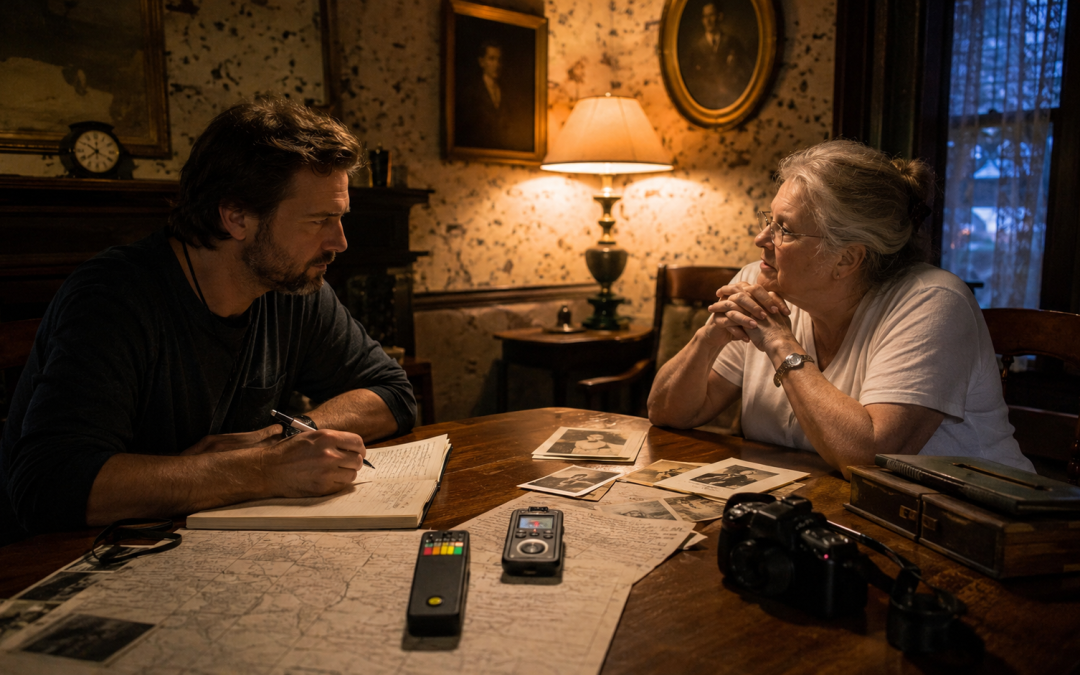
A witness statement should be collected with care. Investigators should avoid leading questions like "Did you feel the ghost touch you?" or "Was this the woman in white?" Better questions are open-ended. The goal is to preserve the witness's own language and sequence of interpretation — not to force the testimony into a preexisting paranormal category.
How Ghost Stories Change
A witness may first describe "a figure," but after hearing local lore, later call it "the old caretaker." A family may originally report "footsteps," but later connect them to a deceased relative. A hotel guest may initially say "I had a weird dream," but after reading online reviews, describe the experience as a visitation. Those changes are not necessarily dishonest. They are part of how human memory and folklore interact. A good investigator documents the evolution rather than flattening it.
Local Legends Are Not Background Noise
Many paranormal teams treat local legends as colorful background, something to mention before the "real" investigation begins. But from an anthropological perspective, the legend is part of the case. A haunting rarely appears in a vacuum. It often attaches itself to a death, injustice, crime, lost love, battlefield, hospital, or abandoned building. Sometimes the historical foundation is strong. Sometimes it is weak. Sometimes the legend survives because it satisfies a cultural need rather than because it is factually precise.
A legend may preserve distorted historical memory. It may attach a ghost to a person who never lived in the building. It may simplify a complex tragedy into a single dramatic figure. It may turn real suffering into entertainment. It may erase the people who actually lived, worked, died, or were harmed there. The investigator's job is not to destroy folklore, but to separate layers.
Haunted Tourism and the Performance of Place
Many haunted locations are also tourist spaces. Ghost tours, haunted hotels, paranormal events, books, podcasts, and social media all shape how people experience a place. Once a location becomes famous, witnesses may arrive already primed. They know what room is supposed to be active. They know which staircase is associated with footsteps. They may photograph the same window because others photographed it before them.
A field investigator should document this influence. Has the witness taken a tour? Read a book? Watched a video? Seen a sign in the lobby? The public story of a place can shape private perception. That does not make witnesses foolish. It makes them human.
The same alley can feel ordinary at noon, romantic at dusk, and terrifying at midnight because the social frame has changed. That frame is not irrelevant. It is part of the haunting's cultural life.
Rumor, Repetition, and the Growth of a Ghost Story
Rumor is one of the most powerful forces in paranormal culture. A small report can grow through repetition. A vague story can become specific. A single witness can become "many people." A family anecdote can become a town legend. A misremembered date can become "documented history." This is why investigators need to track provenance — the origin and chain of transmission of a claim.
Tracking a story's provenance
- Who said it first, and when was it first recorded?
- Was it written down at the time, or decades later?
- Did later authors copy earlier authors without verification?
- Did a tour guide invent or embellish a detail?
- Did the story appear only after the location became commercially haunted?
- Did a television episode popularize one version over others?
A strong paranormal case file should include a narrative history section — tracing not only what allegedly happened, but how the story developed over time and whose versions have been preserved.
Ritual Behavior in Paranormal Spaces
Paranormal investigations often include ritual behavior, even when investigators do not call it ritual. Teams may begin with a prayer. They may ask permission from spirits. They may use trigger objects, conduct EVP sessions in a repeated call-and-response format, turn lights off, form circles, use protective language, or close an investigation by telling spirits not to follow them home.
These practices are culturally meaningful. Some come from religion. Some from Spiritualism. Some from occult traditions. Some from television ghost-hunting formats. Some are invented by teams and repeated until they feel traditional. Rituals reveal what investigators believe they are doing. They create emotional structure. They turn an ordinary room into an investigative space.
Technology as Ritual
Placing a recorder in the center of a room, asking unseen entities to speak into it, waiting in silence, then reviewing the audio later is not only a technical procedure. It is also a ritualized exchange with the unknown. This does not mean the technology is useless. It means the human practice around the technology deserves study alongside the data it produces.
Memory, Place, and the Haunted Landscape
Hauntings often attach to places where memory is already dense: old houses, cemeteries, hospitals, hotels, prisons, theaters, battlefields, and historic districts. These places carry visible age, symbolic weight, and emotional expectation. Anthropologically, haunted places often function as memory sites. They allow communities to talk about death, injustice, violence, class, gender, illness, war, and unresolved history in symbolic form.
A ghost story may become the only way a community remembers a woman who was otherwise erased. It may preserve discomfort about a violent event. It may also distort history by turning real people into spooky entertainment. When a ghost is named, that name often belonged to a real person or is attached to a real tragedy. Researchers should avoid treating the dead as fictional characters.
A haunting narrative can preserve memory, but it can also exploit memory. The difference depends on accuracy, respect, context, and consideration for living communities connected to the story.
The Case File as Cultural Archive
Most paranormal case files focus on evidence logs: date, time, location, team members, equipment, weather, witness claims, audio clips, and conclusions. Those are useful, but incomplete. A stronger case file would also function as a cultural archive — making all layers of a haunting visible rather than collapsing everything into a single dramatic conclusion.
Layer 01
Historical
Documented property history, relevant deaths or events, ownership, changes in use, known myths, and verifiable inaccuracies in the popular legend.
Layer 02
Narrative
All known versions of the haunting story — who tells them, when they appear, and how they differ from one another over time.
Layer 03
Witness
Interviews recorded with consent, preserving the witness's exact language. The first report, before retelling, is usually the most valuable.
Layer 04
Social
How the location is discussed by locals, employees, family members, tourists, media, and online communities — including who is silent.
Layer 05
Ritual
Any practices used by witnesses or investigators — prayers, blessings, EVP sessions, trigger objects, protective customs, or repeated behaviors.
Layer 06
Environmental
Temperature, air quality, EMF sources, building structure, lighting, animals, plumbing, HVAC, traffic, vibration, and other ordinary variables.
Layer 07
Interpretation
Careful separation between what was observed, what was reported, what is historically documented, what is legend, and what remains genuinely unknown.
Why "Debunking" Is Not Enough
Skeptical analysis is essential. Investigators should look for ordinary explanations and understand audio contamination, pareidolia, building noise, sleep phenomena, memory distortion, and equipment limitations. But debunking alone can miss what is most important.
If a family believes a deceased grandmother is still present, and that belief comforts them, simply proving that footsteps were caused by old pipes may not fully explain the haunting's meaning. If a town tells a ghost story about a murdered woman, proving that one detail is historically wrong does not explain why the story persists for generations.
The question is not only "what caused the report?" — it is also "what does the report do?"
- Does it warn people, or preserve grief?
- Does it entertain tourists or create group identity?
- Does it mark a place as special or dangerous?
- Does it allow people to talk about death indirectly?
- Does it turn historical violence into legend?
- Does it comfort, frighten, or harm?
Ethics: The Witness Is Not Just a Data Source
In evidence-centered ghost hunting, witnesses are sometimes treated as information providers. But the witness is a person whose experience may be emotionally complicated. Some are excited. Some are grieving. Some are frightened. Some worry they will not be believed. Some may be dealing with stress, illness, trauma, family conflict, or sleep disruption.
Careless language can make things worse. Telling a family "you definitely have a demon" can increase fear. Telling a child "something is in your room" can cause distress. Telling a grieving person "your dead husband is trapped here" can deepen suffering. Even when investigators mean well, certainty can be dangerous. The first responsibility is not to the ghost story. It is to the living person.
Measured Language That Protects
"We documented these reports." "We observed these environmental conditions." "We cannot confirm a paranormal cause." "There may be ordinary explanations worth checking." "Here are steps for safety, documentation, and follow-up." That kind of language protects the witness while preserving the seriousness of the report.
The Investigator as Participant
One of the most uncomfortable lessons from anthropology is that the observer is never fully outside the field. Investigators influence the case simply by being there. Their questions shape answers. Their equipment changes expectations. Their fear or excitement spreads through the group. Their final report can alter the future legend.
Reflexivity is the practice of examining one's own role in the research process. It is rare in paranormal media. It is essential for serious work.
Toward a better paranormal field method
- Record context, not just events Do not only write "knock heard at 9:42 p.m." Write who was present, what had just been asked, what the room conditions were, whether people were already frightened, and whether the building had known sound sources.
- Separate report from interpretation "The witness saw a gray figure in the hallway" is different from "The witness saw the ghost of a Civil War soldier." The first is a report. The second is an interpretation unless additional evidence supports it.
- Preserve exact language If a witness says "it felt like my mother," do not rewrite that as "the spirit identified itself as her mother." Those are not the same claim.
- Track story versions If the legend has changed, document the changes. Do not hide contradictions — contradiction is useful data, not a problem to be smoothed over.
- Ask about prior knowledge Find out what witnesses knew before the experience. Prior knowledge can shape interpretation but does not automatically invalidate the experience.
- Include non-paranormal findings Environmental hazards, structural issues, animal activity, electrical problems, and sleep disruption should be in the report. They are not embarrassing. They are part of responsible investigation.
- Protect witness privacy Do not publish names, addresses, recordings, or sensitive details without informed permission. The first responsibility is to the living person, not the ghost story.
- Avoid final certainty when certainty is not possible A serious report can end with "unexplained" without claiming "proven paranormal." Unknown is a valid category.
Ghost Hunting Is Human Research
Paranormal investigators often stand in dark rooms asking whether the dead are present. But the living are always present. Their memories are present. Their fears are present. Their inherited stories are present. Their rituals, expectations, grief, skepticism, humor, and hope are present.
That is why paranormal investigation is never only about evidence. It is also about culture. A ghost story is not just a claim. It is a human act of meaning-making. It tells us how people live with uncertainty, how they remember the dead, how they mark places as sacred or dangerous, how they turn history into narrative, and how communities negotiate the boundary between the known and the unknown.
Not every haunting can be proven. Not every story is historically accurate. Not every witness interpretation will hold up under scrutiny. But every haunting exists inside human life. That alone makes it worthy of careful, ethical, intelligent study.
The best future for paranormal research may not be a choice between belief and skepticism. It may be a more mature field practice that includes both careful evidence review and serious cultural documentation. The question "Is this place haunted?" may always attract attention. But better questions take the field further — and they begin with taking the living as seriously as the dead.