
Paranormal Research
Can LiDAR Capture a Ghost?
Structured light, mapping errors, reflective surfaces, moving shadows, and why stick figures appear on ghost apps
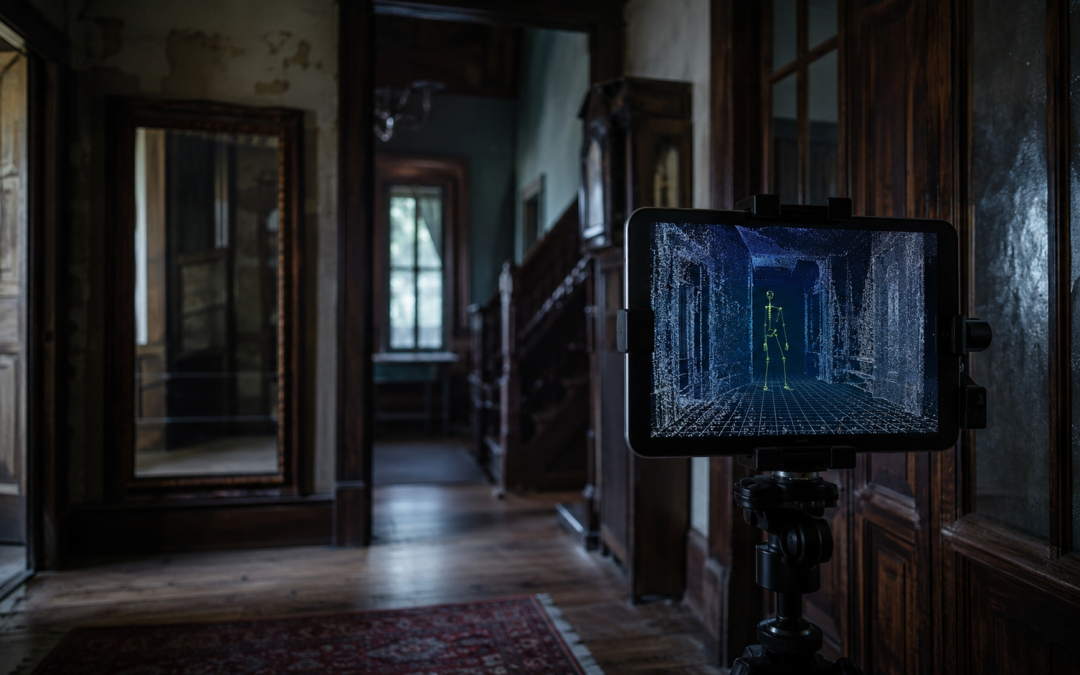
LiDAR has become one of the most misunderstood technologies in modern paranormal investigation. In ghost-hunting videos, it is often presented as if it can see invisible bodies, detect spirits moving through rooms, or map entities that cannot be seen by the human eye. A phone is pointed into a dark hallway, the room is scanned, and suddenly a stick figure appears on the screen. The figure may stand beside a chair, crouch near a wall, flicker in and out, or seem to respond when spoken to.
To many viewers, this looks like evidence. The screen appears to show technology identifying a human form where no living person is visible. That can be deeply unsettling.
The more accurate question is not simply, "Can LiDAR capture a ghost?" A better question is, "What does LiDAR actually measure, and why might it create human-like shapes in empty rooms?"
LiDAR can map surfaces, measure distance, and help devices understand three-dimensional space. It can also make mistakes. Reflective surfaces, shadows, furniture, low light, poor angles, moving people, camera motion, software assumptions, and object-recognition algorithms can all create strange results. Ghost apps that show stick figures are not necessarily showing what the sensor directly sees. They are often showing what software thinks it has identified. That distinction matters.
What LiDAR Actually Does
LiDAR stands for Light Detection and Ranging. In simple terms, it measures distance using light. A LiDAR system sends out pulses of light, often infrared, and measures how long it takes for that light to reflect back. By calculating the return time, the device estimates the distance between the sensor and nearby surfaces.
With many measurements taken rapidly, the device can build a depth map of the environment. This helps it understand where walls, floors, furniture, people, and objects are in three-dimensional space. LiDAR is used in many legitimate fields, including mapping, archaeology, robotics, autonomous vehicles, surveying, and augmented reality.
How LiDAR measures distance
But LiDAR does not identify ghosts. It does not detect consciousness, spirits, souls, energy bodies, apparitions, or the dead. It detects reflected light and estimates distance. That does not make it useless for paranormal investigation, but it does limit what it can honestly claim. If a LiDAR device shows something unusual, the first question should be technical: what surface, reflection, movement, angle, or software process caused that reading?
LiDAR Does Not See Like Human Eyes
One common misunderstanding is that LiDAR sees the world the same way a person does. It does not. Human vision uses visible light, color, contrast, motion, memory, expectation, and pattern recognition. LiDAR is measuring distance from reflected light.
A LiDAR sensor does not look at a dark chair and think "chair." It collects distance data. Software then interprets that data and may combine it with camera input, machine learning, motion tracking, or object recognition. This distinction is important because the strange figures seen in paranormal apps are often not raw LiDAR data. They are processed interpretations.
The Key Distinction
The device is not saying, "There is a ghost here." The software is saying, "This data resembles something I am programmed to represent as a person." That is a much weaker claim. And it is the claim being made every time a stick figure appears on a ghost app screen.
Why Reflective Surfaces Cause Problems
Reflective surfaces are one of the biggest sources of false readings. Mirrors, windows, polished floors, shiny furniture, metal objects, and glass picture frames can confuse depth sensors. LiDAR works by sending light outward and measuring its return. If the light reflects in an unexpected direction, bounces off multiple surfaces, or returns from a surface that is not where the software expects it, the depth map can become distorted.
A mirror is especially problematic because it appears to show space behind the surface. A sensor may misread reflected geometry or produce unstable spatial information. Windows create similar issues. At night, glass can reflect the room while also allowing some view into darkness beyond it. The sensor and camera may receive confusing information from both reflection and transparency.
This is one reason ghost app stick figures often appear near reflective objects, doorways, corners, windows, and antique mirrors. Those are not necessarily paranormal hotspots. They are technical trouble spots.
Mapping Errors and Phantom Shapes
Depth mapping is an estimate. It is not perfect. The device is constantly building and updating a model of the surrounding space. As the camera moves, the map changes. If the software loses track of surfaces, misjudges distance, or combines old and new information incorrectly, phantom shapes can appear.
A phantom shape is a data artifact: a shape that appears in the interpreted map even though no solid object exists in that form. Plain walls and dark corners provide fewer features for tracking. Clutter creates partial shapes that resemble body parts. If an object is partly hidden behind another, the software may fill in missing information incorrectly. Motion while scanning creates unstable or overlapping data.
Many apps are designed to simplify complex data into recognizable forms. If an app is built to identify people, it may force ambiguous data into a human-shaped model. A stick figure may therefore represent uncertainty, not discovery.
Why Stick Figures Appear on Ghost Apps
The stick figures seen in paranormal apps are usually produced by body-tracking or pose-estimation software. This kind of software is designed to identify human body positions. It looks for patterns that resemble a head, shoulders, arms, torso, hips, legs, or joints.
In normal use this is useful for games, fitness apps, and motion capture. But when the same software is used in an empty room, it can still try to find patterns. Software does not always know when to stop guessing.
How ordinary objects become stick figures
A chair back may become shoulders. A lamp may become a head. A coat rack may become a body. A curtain fold may become an arm. Once the app detects enough points that resemble a person, it may draw a stick figure. The figure may flicker, bend, or move strangely because the underlying data is unstable. To a viewer, that instability can look like a ghost appearing and disappearing. To a software engineer, it looks like a false positive.
Moving Shadows and Changing Light
LiDAR itself uses light, but ghost apps often combine depth data with camera input. That means changing light can influence what appears on screen. Moving shadows are especially important. A person walking behind the camera, a flashlight beam shifting, car headlights passing outside, tree branches moving near a window, or a television flickering in another room can all change the visual environment. If the shadow falls across furniture in a way that suggests a head, torso, or limbs, the app may display a stick figure.
Low light makes this worse. In darkness, camera noise increases. Edges become less clear. Shadows deepen. Reflections become harder to identify. The software has less reliable information, so its guesses can become more dramatic.
Ironically, the conditions that make a place feel haunted are often the same conditions that make sensor interpretation weakest.
The Difference Between Detection and Identification
A sensor can detect a signal without identifying its cause. This is one of the most important principles in paranormal investigation. A LiDAR device may detect a surface, detect movement, detect a change in distance, or map an object incorrectly. But none of these automatically identify a ghost.
Detection answers the question, "Did the device register something?" Identification answers the question, "What caused it?" Those are not the same. Many paranormal claims jump from detection to identification too quickly. A device shows a stick figure, so the investigator says, "It detected a spirit." But the device has not established that. It has displayed an interpreted result.
To claim a ghost, one would need far more than a single odd sensor display: controlled conditions, repeated results, independent verification, elimination of ordinary causes, and a clear explanation of why the data cannot be accounted for by the technology itself. Most viral LiDAR ghost videos do not meet that standard.
Could LiDAR Be Useful in Paranormal Investigation?
LiDAR can still be useful, but not in the way many ghost videos suggest. A depth sensor can help document a space, create a map of a room, show where investigators were standing, and help preserve spatial context. It can record whether an object moved, whether a door opened, or whether a person entered the frame. It can be useful when paired with ordinary video, environmental notes, and careful controls.
But using LiDAR responsibly means treating it as a measuring tool, not a ghost detector. The strongest use of LiDAR in paranormal research is not to prove spirits. It is to reduce confusion. It can help investigators understand the environment more accurately. The problem begins when the tool's output is treated as direct evidence of an entity.
How to test LiDAR claims more carefully
- Scan in normal light first Before investigating in darkness, scan the room with lights on. Note where the app produces false figures. Many "active" areas may correspond to furniture, corners, reflective surfaces, or clutter.
- Remove or document reflective objects Mirrors, windows, glass frames, shiny floors, and metal objects should be noted. If figures appear near them, that matters for interpretation.
- Use a second camera A normal video camera should record the same area simultaneously. If the app shows a figure, the ordinary camera can help determine whether a person, shadow, pet, reflection, or object was present.
- Keep the device still Moving the phone or tablet creates tracking errors. A stable mount reduces false readings significantly.
- Test with known objects Place chairs, coats, lamps, or mannequins in the room and observe how the app responds. This reveals how easily it creates stick figures from ordinary shapes.
- Watch without the paranormal framing Review the footage as if it were a technical error first. Ask what the sensor and software are likely doing before asking what the image emotionally suggests.
The Ghost May Be in the Algorithm
LiDAR and structured-light technologies are impressive tools, but they are often misunderstood in paranormal culture. They do not see spirits. They do not detect the dead. They measure distance, map space, and rely on software to interpret complex information.
In haunted environments, those interpretations can become strange. Reflective surfaces confuse sensors. Moving shadows create false impressions. Low light reduces reliability. Cluttered rooms resemble partial bodies. Body-tracking software may turn uncertain data into stick figures. That does not mean every LiDAR ghost video is intentionally fake. Many people may be sincerely startled by what their devices show. But sincerity does not settle the question.
A ghost app may show a figure in an empty room. The screen may look convincing. The moment may feel chilling. But before calling it paranormal, we have to ask a more grounded question: what is the sensor actually measuring, and what is the software assuming?
Based on what LiDAR is known to do, there is no established scientific basis for saying it can capture or identify ghosts. A strange stick figure should not be ignored — but it should not be accepted too quickly either. It should be treated as a question.
In many cases, the answer may not be a ghost in the room. It may be a ghost in the algorithm.